Lockheed Vega
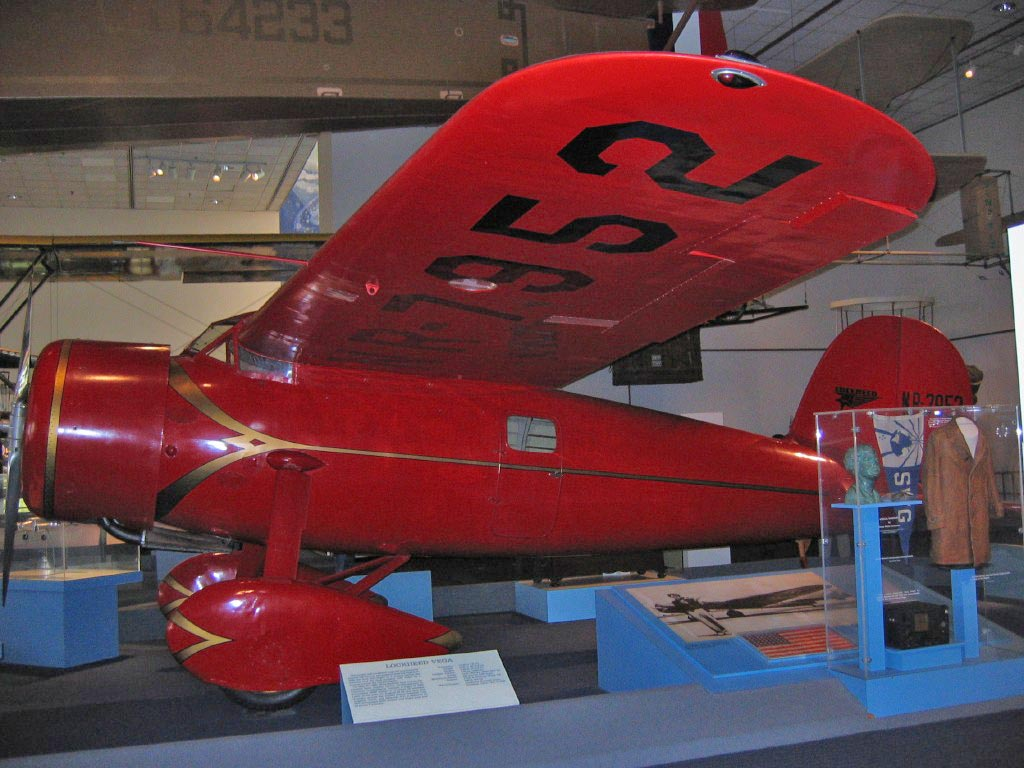
Red Lockheed Vega 5b flown by Amelia Earhart in breaking two world records.
The Lockheed Vega is an American six-passenger high-wing monoplane airliner built by the Lockheed Corporation starting in 1927. It became famous for its use by a number of record-breaking pilots who were attracted to the rugged and very long-range design. Amelia Earhart became the first woman to fly solo across the Atlantic Ocean in one, and Wiley Post used his to prove the existence of the jet stream after having flown around the world twice.
The first Vega 1, named the Golden Eagle, flew from Lockheed's Los Angeles plant on July 4, 1927. It could cruise at a then-fast 120 mph (193 km/h), and had a top speed of 135 mph (217 km/h). The four-passenger (plus one pilot) load was considered too small for airline use. A number of private owners placed orders for the design, and by the end of 1928, 68 of this original design had been produced. In the 1929 National Air Races in Cleveland, Vegas won every speed award.
In 1928, Vega Yankee Doodle (NX4769) was used to break transcontinental speed records. On August 19–20, Hollywood stunt flier Arthur C. Goebel broke the coast-to-coast record of Russell Maughan by flying from Los Angeles, California, to Garden City, New York, in 18 hours and 58 minutes, in what was also the first nonstop flight from west to east. On October 25, barnstormer and former mail pilot Charles B.D. Collyer broke the nonstop east to west record set in 1923 by the U.S. Army Air Service in 24 hours and 51 minutes. Trying to break the new West-to-East record on November 3, Collyer crashed near Prescott, Arizona, killing him and the aircraft owner, Harry J. Tucker.