Earth Circumnavigation Record
Voyager's world flight takeoff took place on the longest runway at Edwards AFB at 8:01 am local time on December 14, 1986, with 3,500 of the world's press in attendance. As the plane accelerated, the tips of the wings, which were heavily loaded with fuel, were damaged as they unexpectedly flew down and scraped against the runway, ultimately causing pieces (winglets) to break off at both ends. (The pilot had wanted to gain enough speed that the inner wings, rather than the fragile outer wings, would lift the plane; in 67 test flights, the plane had never been loaded to capacity.) The aircraft accelerated very slowly and needed approximately 14,200 feet (2.7 mi; 4.3 km) of the runway to gain enough speed to lift from the ground, the wings arching up dramatically just before take-off. The two damaged winglets remained attached to the wings by only a thin layer of carbon fiber and were removed by flying the Voyager in a slip, which introduced side-loading, tearing the winglets off completely. Some of the carbon fiber skin was pulled off in the process, exposing the blue foam core. Burt Rutan following with pilot Mike Melvill determined that Voyager was still within its performance specifications despite the damage and decided to allow the flight to continue. During the flight, the two pilots had to deal with extremely cramped quarters. To reduce stress, the two had originally intended to fly the plane in three-hour shifts, but flight handling characteristics while the plane was heavy prevented routine changeovers, and they became very fatigued. Dick Rutan reportedly stayed at the controls without relief for almost the first three days of the flight.
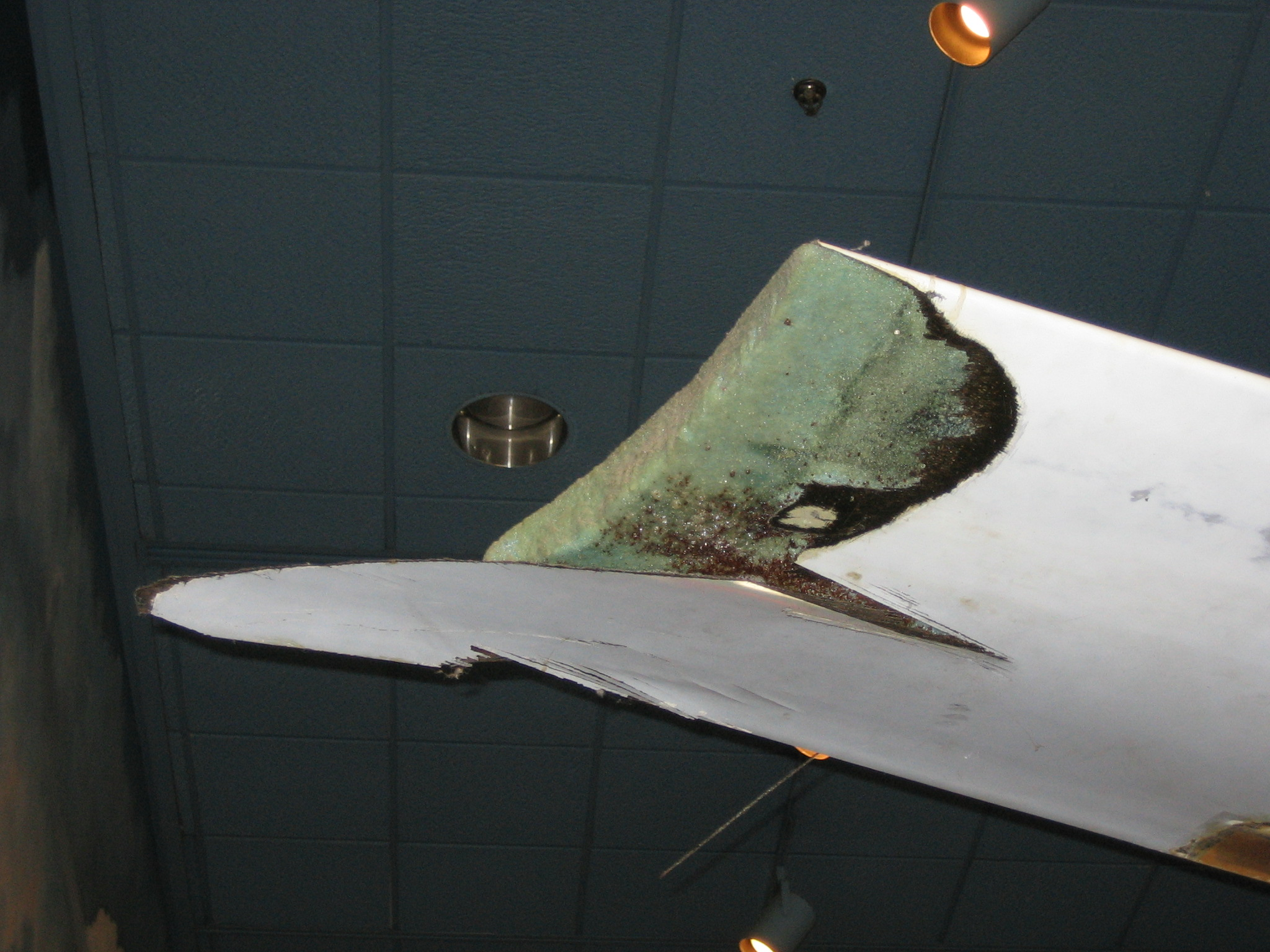
Damaged Left Wingtip
The plane also continuously reminded the pilots of its pitch instability and fragility. They had to maneuver around bad weather numerous times, most perilously around the 600-mile-wide (1,000 km) Typhoon Marge. Libya denied access to the country's airspace in response to Operation El Dorado Canyon earlier that year. There were contentious radio conversations between the Rutan brothers as Dick flew around weather and, at one time, turned around and began doubling back. As they neared California to land, a fuel pump failed and had to be replaced with its twin pumping fuel from the other side of the aircraft.
In front of 55,000 spectators and a large press contingent, including 23 live feeds breaking into scheduled broadcasting across Europe and North America, the plane safely came back to earth, touching down at 8:06 a.m. at the same airfield 9 days after take-off. Rutan made three low passes over the landing field before putting Voyager down. The average speed for the flight was 116 miles per hour (187 km/h). There were 106 pounds (48 kg) of fuel remaining in the tanks, only about 1.5% of the fuel they had at take-off.
Sanctioned by the FAI and the AOPA, the flight was the first successful aerial nonstop, non-refueled circumnavigation of the Earth that included two passes over the Equator (as opposed to shorter ostensible "circumnavigations" circling the North or South Pole). This feat has since been accomplished only one other time, by Steve Fossett in the Global Flyer (also designed by Rutan). For the feat, Yeager, the Rutans, and crew chief/builder Bruce Evans received the 1986 Collier Trophy.