Concorde
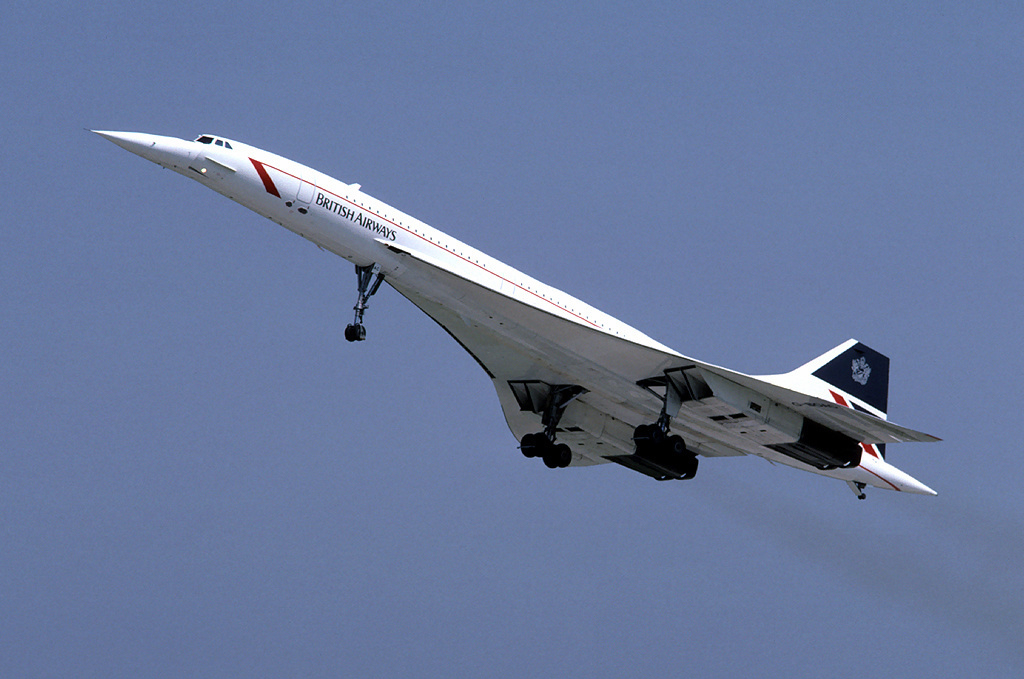
British Airways Concorde in 1986
While subsonic commercial jets took eight hours to fly from New York to Paris, the average supersonic flight time on the transatlantic routes was just under 3.5 hours. Concorde had a maximum cruising altitude of 18,300 metres (60,000 ft) and an average cruise speed of Mach 2.02 (2,150 km/h; 1,330 mph), more than twice the speed of conventional aircraft.
The Aérospatiale/BAC Concorde (/ˈkɒŋkɔːrd/) is a British–French turbojet-powered supersonic passenger airliner that was operated from 1976 until 2003. It had a maximum speed over twice the speed of sound, at Mach 2.04 (1,354 mph or 2,180 km/h at cruise altitude), with seating for 92 to 128 passengers. First flown in 1969, Concorde entered service in 1976 and operated for 27 years. It is one of only two supersonic transports to have been operated commercially; the other is the Soviet-built Tupolev Tu-144, which operated in the late 1970s.
Concorde was jointly developed and manufactured by Sud Aviation (later Aérospatiale) and the British Aircraft Corporation (BAC) under an Anglo-French treaty. Twenty aircraft were built, including six prototypes and development aircraft. Air France and British Airways were the only airlines to purchase and fly Concorde. The aircraft was used mainly by wealthy passengers who could afford to pay a high price in exchange for the aircraft's speed and luxury service. For example, in 1997, the round-trip ticket price from New York to London was $7,995 (equivalent to $12,700 in 2019), more than 30 times the cost of the cheapest option to fly this route.
The original programme cost estimate was £70 million. The programme experienced huge overruns and delays, with the program eventually costing £1.3 billion. It was this extreme cost that became the main factor in the production run being much smaller than anticipated. Later, another factor, which affected the viability of all supersonic transport programmes, was that supersonic flight could be used only on ocean-crossing routes, to prevent sonic boom disturbance over populated areas. With only seven airframes each being operated by the British and French, the per-unit cost was impossible to recoup, so the French and British governments absorbed the development costs. British Airways and Air France were able to operate Concorde at a profit after purchasing their aircraft from their respective governments at a steep discount in comparison to the program's development and procurement costs.
Among other destinations, Concorde flew regular transatlantic flights from London's Heathrow Airport and Paris's Charles de Gaulle Airport to John F. Kennedy International Airport in New York, Washington Dulles International Airport in Virginia and Grantley Adams International Airport in Barbados; it flew these routes in less than half the time of other airliners. You can tour a Concorde at the National Air and Space Museum in Chantilly, VA.