Gas Balloon
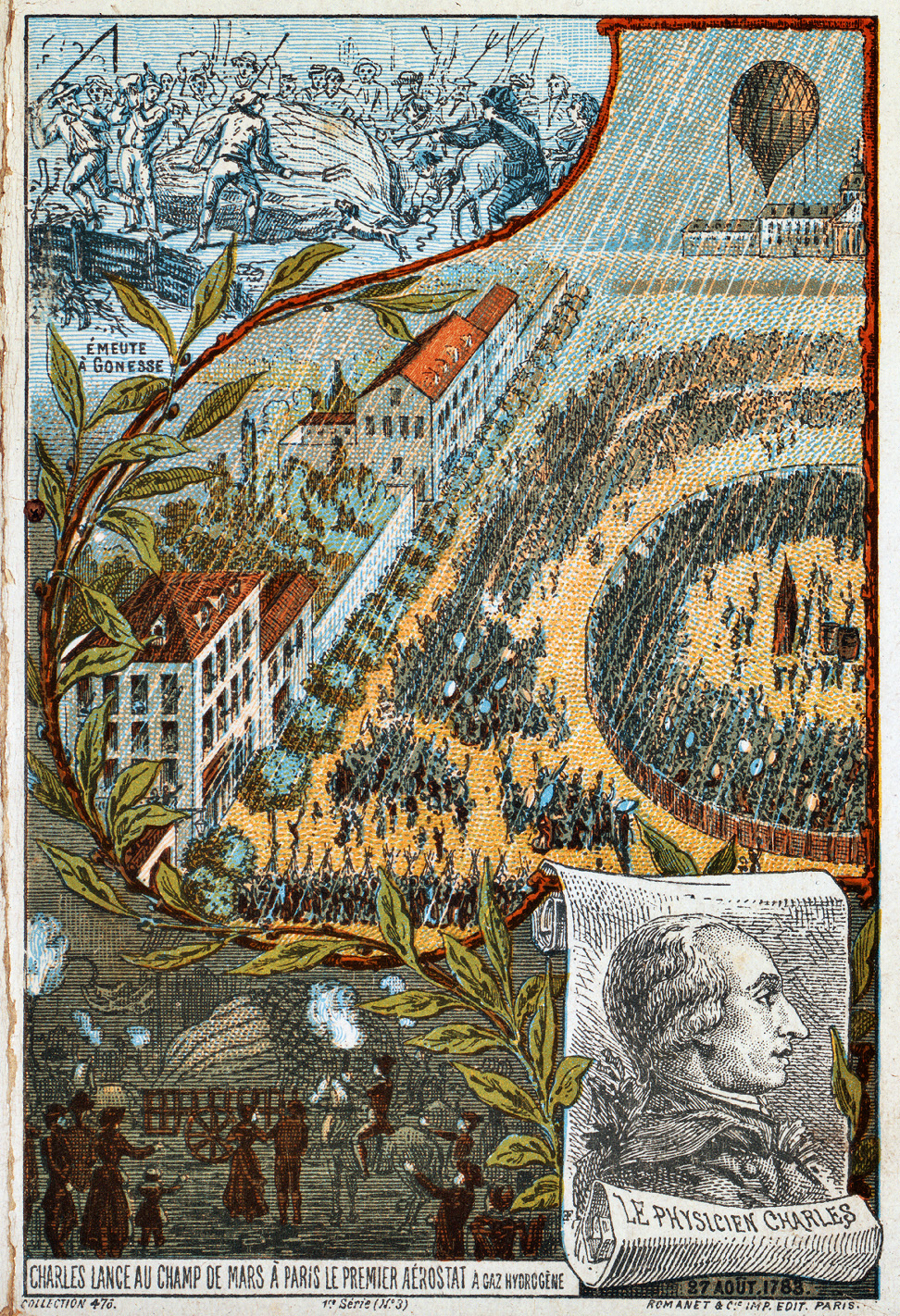
The first launch of a gas balloon by Jacques Charles and Les Frères Robert, 27 August 1783, at the Champ de Mars, Paris. Illustration from the late 19th century.
A gas balloon is a balloon that rises and floats in the air because it is filled with a gas lighter than air (such as helium or hydrogen). When not in flight, it is tethered to prevent it from flying away and is sealed at the bottom to prevent the escape of gas. A gas balloon may also be called a Charlière for its inventor, the Frenchman Jacques Charles. Today, familiar gas balloons include large blimps and small latex party balloons. For nearly 200 years, well into the 20th century, manned balloon flight utilized gas balloons before hot-air balloons became dominant. Without power, heat or fuel, untethered flights of gas balloons depended on the skill of the pilot. Gas balloons have greater lift for a given volume, so they do not need to be so large, and they can stay up for much longer than hot air balloons.
The first gas balloon made its flight in August 1783. Designed by professor Jacques Charles and Les Frères Robert, it carried no passengers or cargo. It was destroyed by terrified townspeople in Gonesse (a commune in the north-eastern suburbs of Paris) upon his landing. On 1 December 1783, their second hydrogen-filled balloon made a manned flight piloted by Jacques Charles and Nicolas-Louis Robert. This occurred ten days after the first manned flight in a Montgolfier hot air balloon.
The next project of Jacques Charles and the Robert brothers was La Caroline, an elongated steerable craft that followed Jean Baptiste Meusnier's proposals for a dirigible balloon, incorporating internal ballonnets (air cells), a rudder and a method of propulsion. On September 19, 1784 the brothers and M. Collin-Hullin flew for 6 hours 40 minutes, covering 186 km from Paris to Beuvry near Béthune. This was the first flight over 100 km.
Gas balloons remained popular throughout the age before powered flight. Filled with hydrogen or coal gas, they were able to fly higher, further and more economically than hot-air balloons. The altitude was controlled with ballast weights that were dropped if the balloon got too low; in order to land some lifting gas was vented through a valve. Tethered manned gas balloons were used for observation purposes in the Napoleonic Wars (to very limited extent), in the American Civil War (flown by Thaddeus Lowe) and in World War I by aviators wearing parachutes. Throughout the 19th century, they were popular as objects of public fascination among hobbyists and show performers, such as the Blanchards.
Gas ballooning has been popular in Europe, most notably in Germany, using hydrogen as a lifting gas. Gas balloon clubs exist throughout the country. Rough estimates show 150 active gas pilots in Europe. In contrast, gas ballooning in the USA might have at most 30 active pilots who typically fly only once a year at the Albuquerque International Balloon Fiesta in October.
Aerophile is the world's largest lighter-than-air carrier, flying 300,000 passengers every year through its eight tethered gas balloon operations in Walt Disney World, San Diego Zoo Safari Park, Smoky Mountains & Irvine in the US and Paris, Disneyland Paris and Parc du Petit Prince in France.