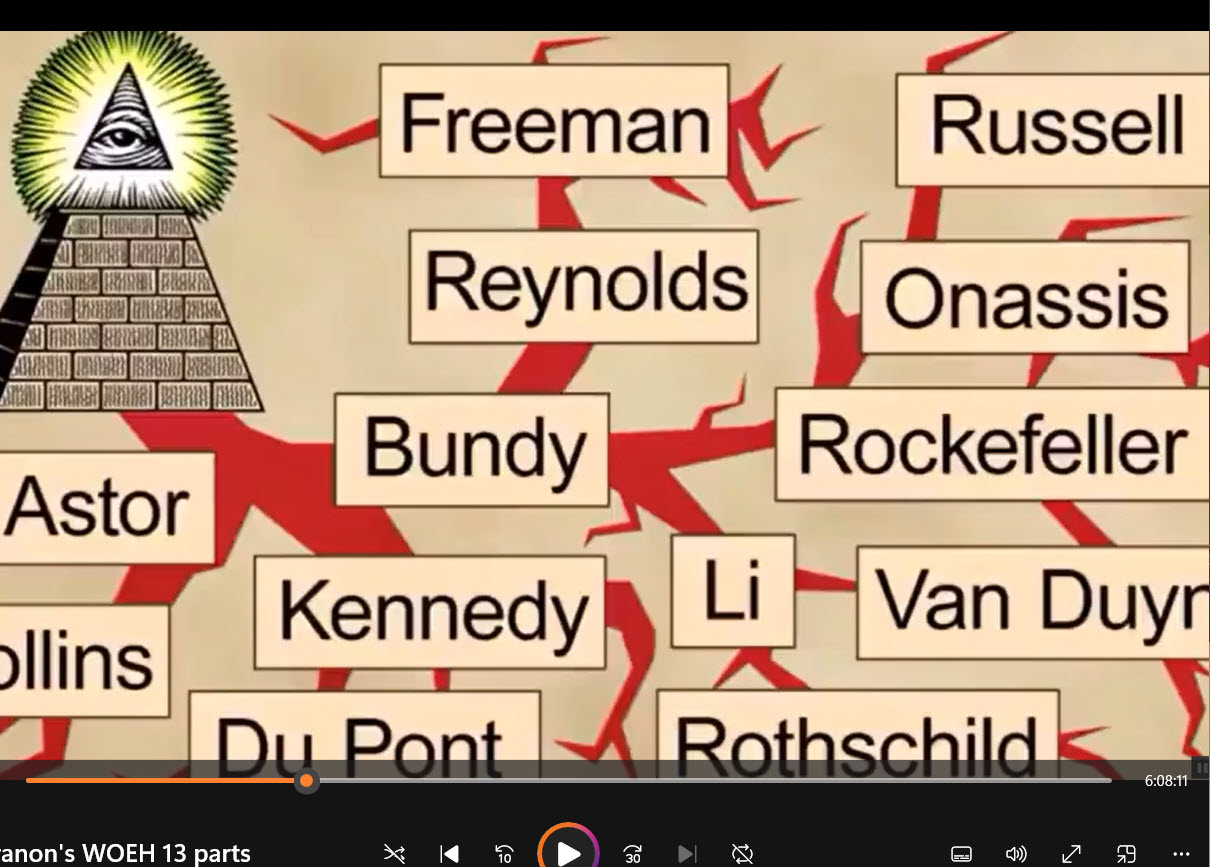
BLOODLINES
Photo source:
Ewaranon's: 13 part series = What On Earth Happened?
The symbol is that of the Illuminati. rk.
#457). Ewaranon’s 13 part “What on Earth Happened?” videos: https://bra.in/3vA7J3
found in MindMap:
Watching the Republic Restored:
https://bra.in/5qEG68
From: Wikipedia:
This article is about the transfer of characteristics from parent to offspring.
For the academic journal, see *Heredity* (journal).
For other uses,
see Heredity (disambiguation).
"Bloodline" redirects here.
For other uses,
see Bloodline (disambiguation).
"Hereditary" redirects here.
For the 2018 horror film,
see *Hereditary* (film).
Not to be confused with Heritability,
a statistic estimating the degree of genetic variation.
Heredity, also called inheritance or biological inheritance,
Is the passing on of
- genetic information from parents to their offspring.
- It may occur through sexual or asexual reproduction,
- where new cells are produced
- from either individual cells underdoing cell division or
- two cells combining genomes, respectively.
- Through heredity,
in populations
can accumulate and
The study of heredity in biology is genetics.
In humans,
- eye color is an example of an inherited characteristic:
- an individual might inherit
- the "brown-eye trait" from one of the parents.[1]
- Inherited traits are
- controlled by genes and
- the complete set of genes
- within an organism's genome is
- called its genotype.[2]
- The complete set of observable traits
- of the structure and
- behavior
- of an organism is
- called its phenotype.
- These traits arise from
- the interaction of the organism's genotype
- with the environment.[3]
- As a result,
- many aspects of an organism's phenotype
- are not inherited.
- For example, suntanned skin
- derives from the interaction between a person's genotype and sunlight;[4]
- thus, suntans are not passed on to people's children.
- However, some people tan more easily than others,
- due to differences in their genotype:[5]
- a striking example is people with the inherited trait of albinism,
- who do not tan at all and
- are very sensitive to sunburn.[6]
Heritable traits
- are known to be passed
- from one generation to the next via DNA,
- a molecule that encodes genetic information.[2]
- DNA is a long polymer that
- incorporates four types of bases,
- which are interchangeable.
- The Nucleic acid sequence
- (the sequence of bases along a particular DNA molecule)
- specifies the genetic information:
- this is comparable to
- a sequence of letters
- spelling out a passage of text.[7]
- Before a cell divides through mitosis,
- the DNA is copied,
- so that each of the resulting two cells
- will inherit the DNA sequence.
- A portion of a DNA molecule
- that specifies a single functional unit
- is called a gene;
- different genes have different sequences of bases.
- Within cells,
- the long strands of DNA
- form condensed structures called chromosomes.
- Organisms
- inherit genetic material
- from their parents
- in the form of homologous chromosomes,
- containing a unique combination of
- DNA sequences
- that code for genes.
- The specific location of a DNA sequence
- within a chromosome
- is known as a locus.
- If the DNA sequence
- at a particular locus
- varies between individuals,
- the different forms of this sequence are called alleles.
- DNA sequences can change through mutations,
- producing new alleles.
- If a mutation occurs
- within a gene,
- the new allele
- may affect the trait
- that the gene controls,
- altering the phenotype
- of the organism.[8]
WORDPLAY ON "allele: ALL/EL/E
REMEMBER I TOLD YOU THAT "EL" IS A SATANIC god?
Is that what happened when they turned up WIFI at CERN? ALL the MUTANTS woke up with the mutated DNA?
However, while this simple correspondence between an allele and a trait works in some cases, most traits are more complex and are controlled by multiple interacting genes within and among organisms.[9][10]
Developmental biologists suggest that complex interactions in genetic networks and communication among cells can lead to heritable variations that may underlie some of the mechanics in developmental plasticity and canalization.[11]
Recent findings have confirmed important examples of heritable changes that cannot be explained by direct agency of the DNA molecule. These phenomena are classed as epigenetic inheritance systems that are causally or independently evolving over genes. Research into modes and mechanisms of epigenetic inheritance is still in its scientific infancy, but this area of research has attracted much recent activity as it broadens the scope of heritability and evolutionary biology in general.[12] See PDF for who these experimentors are. rk
highlighting to be continued:
DNA methylation marking chromatin, self-sustaining metabolic loops, gene silencing by RNA interference, and the three dimensional conformation of proteins (such as prions) are areas where epigenetic inheritance systems have been discovered at the organismic level.[13][14]
Heritability may also occur at even larger scales. For example, ecological inheritance through the process of niche construction is defined by the regular and repeated activities of organisms in their environment. This generates a legacy of effect that modifies and feeds back into the selection regime of subsequent generations. Descendants inherit genes plus environmental characteristics generated by the ecological actions of ancestors.[15] Other examples of heritability in evolution that are not under the direct control of genes include the inheritance of cultural traits, group heritability, and symbiogenesis.[16][17][18] These examples of heritability that operate above the gene are covered broadly under the title of multilevel or hierarchical selection, which has been a subject of intense debate in the history of evolutionary science.[17][19]
Relation to theory of evolution
See also: Evolution
When Charles Darwin proposed his theory of evolution in 1859, one of its major problems was the lack of an underlying mechanism for heredity.[20] Darwin believed in a mix of blending inheritance and the inheritance of acquired traits (pangenesis). Blending inheritance would lead to uniformity across populations in only a few generations and then would remove variation from a population on which natural selection could act.[21] This led to Darwin adopting some Lamarckian ideas in later editions of On the Origin of Species and his later biological works.[22] Darwin's primary approach to heredity was to outline how it appeared to work (noticing that traits that were not expressed explicitly in the parent at the time of reproduction could be inherited, that certain traits could be sex-linked, etc.) rather than suggesting mechanisms.[citation ^needed]
Darwin's initial model of heredity was adopted by, and then heavily modified by, his cousin Francis Galton, who laid the framework for the biometric school of heredity.[23] Galton found no evidence to support the aspects of Darwin's pangenesis model, which relied on acquired traits.[24]
The inheritance of acquired traits was shown to have little basis in the 1880s when August Weismann cut the tails off many generations of mice and found that their offspring continued to develop tails.[25]
Common genetic disorders
The description of a mode of biological inheritance consists of three main categories:
1. Number of involved loci
- Monogenetic (also called "simple") – one locus
- Oligogenic – few loci
- Polygenetic – many loci
2. Involved chromosomes
- Autosomal – loci are not situated on a sex chromosome
- Gonosomal – loci are situated on a sex chromosome
- X-chromosomal – loci are situated on the X-chromosome (the more common case)
- Y-chromosomal – loci are situated on the Y-chromosome
- Mitochondrial – loci are situated on the mitochondrial DNA
3. Correlation genotype–phenotype
- Dominant
- Intermediate (also called "codominant")
- Recessive
- Overdominant
- Underdominant
These three categories are part of every exact description of a mode of inheritance in the above order. In addition, more specifications may be added as follows:
4. Coincidental and environmental interactions
- Penetrance
- Complete
- Incomplete (percentual number)
- Expressivity
- Invariable
- Variable
- Heritability (in polygenetic and sometimes also in oligogenetic modes of inheritance)
- Maternal or paternal imprinting phenomena (also see epigenetics)
5. Sex-linked interactions
- Sex-linked inheritance (gonosomal loci)
- Sex-limited phenotype expression (e.g., cryptorchism)
- Inheritance through the maternal line (in case of mitochondrial DNA loci)
- Inheritance through the paternal line (in case of Y-chromosomal loci)
6. Locus–locus interactions
- Epistasis with other loci (e.g., overdominance)
- Gene coupling with other loci (also see crossing over)
- Homozygotous lethal factors
- Semi-lethal factors
Determination and description of a mode of inheritance is also achieved primarily through statistical analysis of pedigree data. In case the involved loci are known, methods of molecular genetics can also be employed.
Dominant and recessive alleles
An allele is said to be dominant if it is always expressed in the appearance of an organism (phenotype) provided that at least one copy of it is present. For example, in peas the allele for green pods, G, is dominant to that for yellow pods, g. Thus pea plants with the pair of alleles either GG (homozygote) or Gg (heterozygote) will have green pods. The allele for yellow pods is recessive. The effects of this allele are only seen when it is present in both chromosomes, gg (homozygote). This derives from Zygosity, the degree to which both copies of a chromosome or gene have the same genetic sequence, in other words, the degree of similarity of the alleles in an organism.
See also
- Weismann barrier
- Hard inheritance
- Lamarckism
- Heritability
- Particulate inheritance
- Non-Mendelian inheritance
- Epigenetic inheritance
- Structural inheritance
- Blending inheritance
SEE PDF for complete Wikipedia article with pix and references, downloaded:l
Friday, October 09, 2026 10:01AM