Measure Earth Ground
 The Four Primary Testing Methods
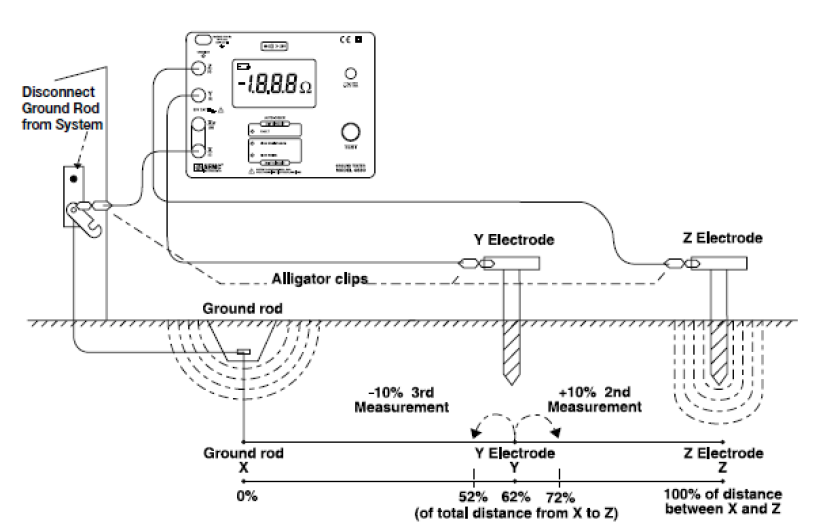
Fall-of-Potential (Traditional / 3-Point): The most established method. It involves driving two temporary test probes into the soil at fixed distances in a straight line from the grounding rod. An AC current is injected into one probe, and voltage is measured using the middle probe to calculate the resistance. [1]
Selective Testing: Similar to the fall-of-potential method but uses an extra current clamp to isolate the specific grounding rod being measured. This eliminates the need to disconnect the ground rod from the electrical system for testing. [1, 2, 3, 4]
Stakeless Testing: Measures loop resistance using two clamps (or a single specialized clamp meter) wrapped around the grounding conductor without requiring physical stakes. This method only works in highly specific multi-grounded parallel systems (e.g., utility poles or commercial buildings). [1, 2]
Soil Resistivity (4-Point): Used before designing and installing a new grounding system. Four small stakes are driven into the earth at equal distances and depths to measure the inherent resistance of the soil itself. [1, 2]
 The Four Primary Testing Methods
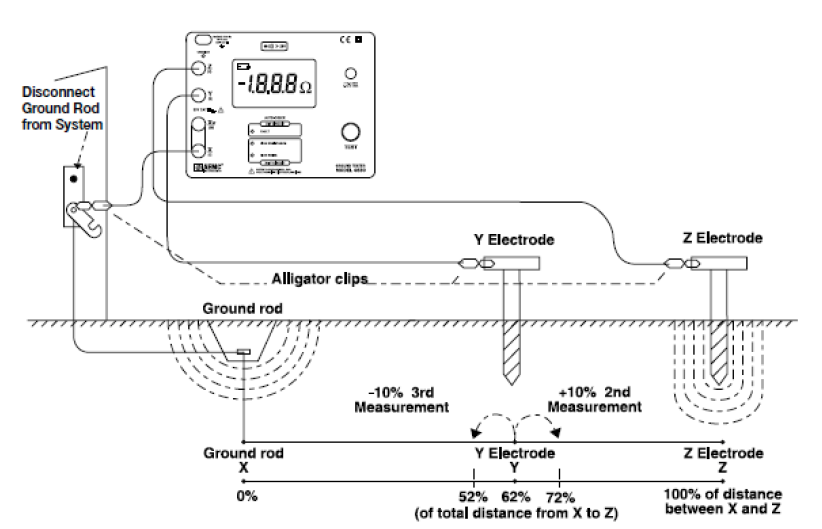
Fall-of-Potential (Traditional / 3-Point): The most established method. It involves driving two temporary test probes into the soil at fixed distances in a straight line from the grounding rod. An AC current is injected into one probe, and voltage is measured using the middle probe to calculate the resistance. [1]
Selective Testing: Similar to the fall-of-potential method but uses an extra current clamp to isolate the specific grounding rod being measured. This eliminates the need to disconnect the ground rod from the electrical system for testing. [1, 2, 3, 4]
Stakeless Testing: Measures loop resistance using two clamps (or a single specialized clamp meter) wrapped around the grounding conductor without requiring physical stakes. This method only works in highly specific multi-grounded parallel systems (e.g., utility poles or commercial buildings). [1, 2]
Soil Resistivity (4-Point): Used before designing and installing a new grounding system. Four small stakes are driven into the earth at equal distances and depths to measure the inherent resistance of the soil itself. [1, 2]