Amydala Highjack
What is an amygdala hijack?
Amygdala hijack is an emotional response to stress, often thought of as losing control of one’s emotions. An example of this is where you are talking to a friend and they do not appear to be listening to you, ignore what you say, or maybe talk over the top of you.
This kind of interaction can make you ‘snap’. You may suddenly have an outburst such as shouting at them for not listening. Afterwards, you may realize that you overreacted and that the way you acted was unnecessary and you may say to yourself ‘what was I thinking?’.
You may not have been thinking at all as what actually happened is that your amygdala hijacked you.
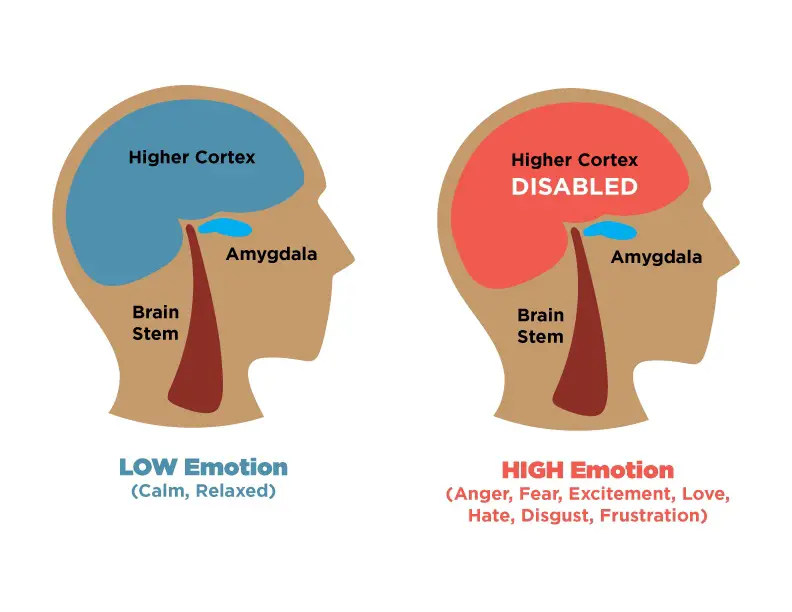
Amygdala hijack refers to the situations where the amygdala overrides control of a person’s ability to respond rationally to a perceived threat – the logical brain gets impaired due to emotional outbursts caused by the amygdala.
\
The amygdala is an almond-shaped structure situated in the mid-brain, forming part of the limbic system. This structure is known as the emotional hub of the human brain and plays a role in fear and the fight-or-flight response.
The amygdala is primarily involved in the processing of emotions and memories associated with fear. The amygdala is considered to be a part of the limbic system within the brain and is key to how we process strong emotions like fear or pleasure.
Causes
In the normal context, when sensing something in the environment, the sensory information gets sent to the thalamus, a primitive part of the brain which acts as the brain’s relay station.
The thalamus relays the sensory information to the frontal lobes of the cortex, a center for higher brain functions such as perception, decision-making, and language.
The cortex then processes the sensory signals from the thalamus and applies logical reasoning. For the involvement of the emotions, this processes signal is sent to the amygdala.
The amygdala will then produce appropriate emotional responses followed by a flood of hormones and enzymes released to create suitable emotions and actions. When a threat is sensed, the amygdala may automatically activate the fight-or-flight response.
However, the frontal lobes process the information to determine if the threat is real and what a logical response would be. If the threat is determined to be not serious, the frontal lobes tend to take control, and this results in people responding in a thought-out way.
How to prevent amygdala hijack
Eternal Vigilance !!!!!
Goleman proposed that in order to prevent amygdala hijacks, people must increase their emotional intelligence.
He proposed 5 basic competencies that are essential for increasing emotional intelligence: self-awareness, self-regulation, motivation, empathy, and social skills.
Self-awareness: Being self-aware is the ability to recognize a feeling as it is happening. In order to prevent the amygdala from overriding rational thought, a person must identify an emotional response and manage its control over the situation. Self-awareness gives people the skills to distinguish between accurate and inaccurate expressions of emotions.
Self-regulation : To be able to self-regulate means that emotions can be managed. It is the ability to connect or disconnect from an emotion depending on its usefulness to a situation. People who can self-regulate can respond logically with cognitive thought, opposed to reacting emotionally without forethought. An emotionally intelligent person can recognize when a hijack is coming and attempt to prevent an undesired reaction.
Motivation: An emotionally intelligent person, according to Goleman, is someone who strives to satisfy their intrinsic motivation in work and other activities, regardless of external incentives.
Empathy: An empathetic person can recognize emotions in others. Through this, people can be understanding, aware of, and sensitive to other’s feelings and work to utilize this ability to manage their own emotions, promote good emotions, as well as coming to a positive result in a conflict.
Social skills: Those who are emotionally intelligent are good at interpersonal communication according to Goleman. Those with strong social skills should be able to have good conflict resolution skills. Thus, in times where a conflict may arise, those with strong social skills can react and respond to others in a positive way.
Mindfulness
Mindfulness is another method that can be utilized to prevent amygdala hijack. Mindfulness is the ability to be fully present in the moment, aware of the self, where one is, and what one feels.
In a way, mindfulness employs similar techniques to the competencies of emotional intelligence proposed by Goleman. In this way, mindfulness could also improve upon a person’s emotional intelligence.
Mindfulness is usually a technique which needs practicing regularly for better effects, rather than just implementing the techniques when about to experience an amygdala hijack.
One way to help to focus during mindfulness practice is to actively control breathing, focusing on how the body responds to the breath.
Practicing mindfulness can help people to better control the body’s responses when experiencing a reaction and helps individuals to feel more present in the moment and engaged in responses.
Stress management
Being able to manage stress in general may help prevent amygdala hijacks from occurring. It may be useful for some to make themselves aware of what their stressors or triggers are.
These could be small or large triggers. Making a note of when everyday stressor turn into chronic stress can help with identifying ways to manage this stress.
Effective stress management can include fast-acting relievers such as breathing exercises, which can bring immediate relief. As well as this, general healthy habits can be utilized to reduce overall stress such as regular exercise, meditation, and using a journal.
How to cope with amygdala hijack
Whilst using preventative measures to ensure amygdala hijacks do not happen, there are times where these situations can still occur.
When someone may feel that an amygdala hijack may be happening, there are some methods to help cope with the situation.
Name the emotion: Recognising and naming the emotion when it happens can shift connections back to the frontal lobes since this requires the use of language and analysis. Even simply stating ‘I am mad’ could be enough to make this feeling less intense and bring back a rational mindset.
6-second rule: It can take the chemical involved in an amygdala response to dissipate. Therefore, delaying any kind of response for about 6 seconds could prevent the amygdala from taking control and causing an emotional reaction. Whilst delaying the response, this time could be used for taking the time to think about something positive or to focus on breathing.
Breathing: Breathing can be a powerful tool during a heightened situation as it can trigger the parasympathetic nervous system to bring about a restful bodily response. Taking control of breathing in stressful situations can allow thoughtful decisions which are not driven be emotions.
Change the setting: By getting up and moving around in stressful situations, the surroundings are automatically being considered which reactivate the thinking part of the brain. Also, taking some time out away from the stressful situation in times of feeling out of control can help individuals to get a better hold of their emotions and see things from a rational perspective.
Share the mental lode: When feeling a lot of emotions, sharing feelings with a trusted person can split the mental lode and help our amygdala feel less threatened. Likewise, the use of language in highly emotional situations encourages the use of the thinking part of the brain.
Draw on mindfulness: Whilst it may be important to practice mindfulness, drawing on the techniques used in practice can help someone move away from negative internal feelings and back to the present through paying attention to the surroundings.
It is important to remember that amygdala hijack may not be preventable in every situation and that it is realistic to expect setbacks. When these happen, it may be useful to take some time to acknowledge the actions of what happened and reflect on this.
This can help shift towards a mindful way of viewing the experience and to may provide some useful insight into how to avoid this situation again next time.