Anthrax letters
Funny thing the White House was put on cypro before the “attacks.” The largest crime of the centry remains unsolved. Funny thing as the investigation pointed toward the Army Fr Dietrich and Doug-way proving grounds in Utah, the sames were destroyed... Oops. Not unlike the destroyed DOJ original ENRON prosecution files stored in WTC-7 that magically came down from “thermal expansion” in 10 seconds without being hit by a plane on 9-11. Or the Gulf War Vets medical files stored in Federal Oklahoma city building, that magically was destroyed from a “truck Bomb”, later finding two more bombs in the building. See a pattern?
amerithrax-or-anthrax-investigation
Amerithrax or Anthrax Investigation
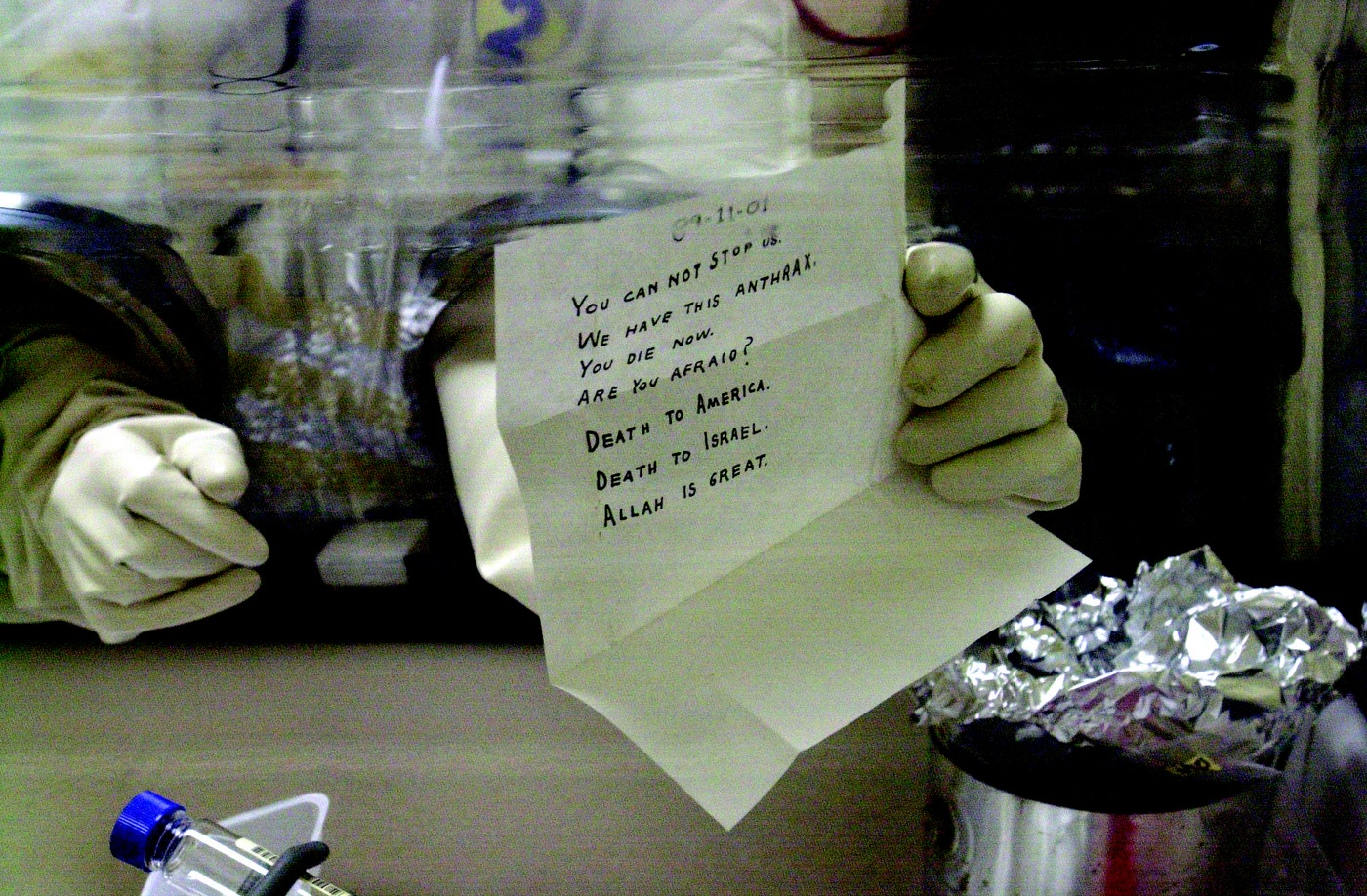
Laboratory technician holding the anthrax-laced letter addressed to Senator Leahy after safely opening it at the U.S. Army's Fort Detrick bio-medical research laboratory in November 2001.
Soon after the terrorist attacks of 9/11, letters laced with anthrax began appearing in the U.S. mail. Five Americans were killed and 17 were sickened in what became the worst biological attacks in U.S. history.
The ensuing investigation by the FBI and its partners—code-named “Amerithrax”—has been one of the largest and most complex in the history of law enforcement.
In August 2008, Department of Justice and FBI officials announced a breakthrough in the case and released documents and information showing that charges were about to be brought against Dr. Bruce Ivins, who took his own life before those charges could be filed. On February 19, 2010, the Justice Department, the FBI, and the U.S. Postal Inspection Service formally concluded the investigation into the 2001 anthrax attacks and issued an Investigative Summary.
The Amerithrax Task Force—which consisted of roughly 25 to 30 full-time investigators from the FBI, the U.S. Postal Inspection Service, and other law enforcement agencies, as well as federal prosecutors from the District of Columbia and the Justice Department’s Counterterrorism Section—expended hundreds of thousands of investigator work hours on this case. Their efforts involved more than 10,000 witness interviews on six different continents, the execution of 80 searches, and the recovery of more than 6,000 items of potential evidence during the course of the investigation.
The case involved the issuance of more than 5,750 grand jury subpoenas and the collection of 5,730 environmental samples from 60 site locations. In addition, new scientific methods were developed that ultimately led to the break in the case—methods that could have a far-reaching impact on future investigations.
For more information on the Amerithrax investigation:
- FBI Response to Independent Expert Behavioral Analysis Panel Report on Anthrax Mailings – March 23, 2011
- FBI and Justice Department Response to NAS Review of Scientific Approaches Used During the Investigation of the 2001 Anthrax Letters – February 15, 2011
- DOJ Announcement Formally Closing the Case – February 19, 2010
- FOIA Documents – February 19, 2010
- Science Briefing on the Investigation — August 18, 2008
- Release of Affidavits — August 6, 2008
- Closing a Chapter on Anthrax — August 6, 2008
- Amerithrax Fact Sheet — September 2006
- Letter to Congressman Rush-Holt (pdf) — September 28, 2006
- Letter Addressed to Senator Patrick Leahy — November 2001:
- Linguistic/Behavioral Analysis of the Anthrax Letters — November 9, 2001
- Statement of Director Mueller — October 16, 2001
Photo Galleries: