AnxietyE xistential
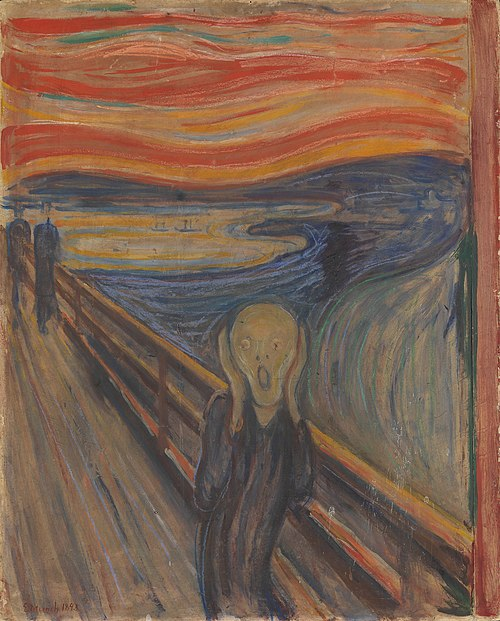
Anxiety underlies The Scream (1893) by Edvard Munch, which grapples with a complex human experience.
Anxiety is an emotion characterized by an unpleasant state of inner turmoil and includes feelings of dread over anticipated events.[1][2][3] Anxiety is different from fear in that fear is defined as the emotional response to a present threat, whereas anxiety is the anticipation of a future one.[4] It is often accompanied by nervous behavior such as pacing back and forth, somatic complaints, and rumination.[5]
Anxiety is a feeling of uneasiness and worry, usually generalized and unfocused as an overreaction to a situation that is only subjectively seen as menacing.[6] It is often accompanied by muscular tension,[7] restlessness, fatigue, inability to catch one's breath, tightness in the abdominal region, nausea, and problems in concentration. Anxiety is closely related to fear,[3] which is a response to a real or perceived immediate threat (fight-or-flight response); anxiety involves the expectation of a future threat including dread.[7] People facing anxiety may withdraw from situations which have provoked anxiety in the past.[8]
The emotion of anxiety can persist beyond the developmentally appropriate time-periods in response to specific events, and thus turning into one of the multiple anxiety disorders (e.g., generalized anxiety disorder, panic disorder).[9][10] The difference between anxiety disorder and anxiety (as normal emotion), is that people with an anxiety disorder experience anxiety excessively or persistently during approximately 6 months, or even during shorter time-periods in children.[7] Anxiety disorders are among the most persistent mental problems and often last decades.[11] Anxiety can also be experienced within other mental disorders (e.g., obsessive–compulsive disorder, post-traumatic stress disorder).[12][13]
Anxiety vs. fear
Anxiety is distinguished from fear, which is an appropriate cognitive and emotional response to a perceived threat.[14] Anxiety is related to the specific behaviors of fight-or-flight responses, defensive behavior or escape.[15] There is a false presumption that often circulates that anxiety only occurs in situations perceived as uncontrollable or unavoidable, but this is not always so.[16] David Barlow defines anxiety as "a future-oriented mood state in which one is not ready or prepared to attempt to cope with upcoming negative events,"[17] and that it is a distinction between future and present dangers which divides anxiety and fear. Another description of anxiety is agony, dread, terror, or even apprehension.[18] In positive psychology, anxiety is described as the mental state that results from a difficult challenge for which the subject has insufficient coping skills.[3][19]
Fear and anxiety can be differentiated into four domains: (1) duration of emotional experience, (2) temporal focus, (3) specificity of the threat, and (4) motivated direction. Fear is short-lived, present-focused, geared towards a specific threat, and facilitating escape from threat. On the other hand, anxiety is long-acting, future-focused, broadly focused towards a diffuse threat, and promoting excessive caution while approaching a potential threat and interferes with constructive coping.[20]
Joseph E. LeDoux and Lisa Feldman Barrett have both sought to separate automatic threat responses from additional associated cognitive activity within anxiety.[21][22]
Evolutionary perspectives
Evolutionary psychiatry and Evolutionary psychology interprets anxiety as an evolved defence that helps organisms avoid potential threats; by design, such defenses can produce "false alarms" when the cost of a missed danger would be high (sometimes described as a "smoke‑detector" principle). Contemporary reviews stress that this framing does not treat anxiety disorders as adaptive, but rather as dysregulations or context‑insensitive activation of otherwise useful systems; the perspective is used for explanation and psychoeducation, not as a specific therapy.[23]
Symptoms
Anxiety can be experienced with long, drawn-out daily symptoms that reduce quality of life, known as chronic (or generalized) anxiety, or it can be experienced in short spurts with sporadic, stressful panic attacks, known as acute anxiety.[24] Symptoms of anxiety can range in number, intensity, and frequency, depending on the person. However, most people do not suffer from chronic anxiety.[25]
Anxiety can induce several psychological pains (e.g., depression) or mental disorders, and may lead to self-harm or suicide.[26][27]
The behavioral effects of anxiety may include withdrawal from situations which have provoked anxiety or negative feelings in the past.[8] Other effects may include changes in sleeping patterns, changes in habits, increase or decrease in food intake, and increased motor tension (such as foot tapping).[8]
The emotional effects of anxiety may include feelings of apprehension or dread, trouble concentrating, feeling tense or jumpy, anticipating the worst, irritability, restlessness, watching for signs of danger, and a feeling of empty mindedness.[28] It may also include feeling of helplessness.[29]
The cognitive effects of anxiety may include thoughts about suspected dangers, such as an irrational fear of dying or having a heart attack, when in reality all one is experiencing is mild chest pain, for example.[30]
The physiological symptoms of anxiety may include:[26][27]
- Neurological, as headache, paresthesias, fasciculations, vertigo, or presyncope.
- Digestive, as abdominal pain, nausea, diarrhea, indigestion, dry mouth, or globus. Stress hormones released in an anxious state have an impact on bowel function and can manifest physical symptoms that may contribute to or exacerbate IBS.
- Respiratory, as shortness of breath or sighing breathing.
- Cardiac, as palpitations, tachycardia, or chest pain.
- Muscular, as fatigue, tremors, or tetany.
- Cutaneous, as perspiration, or itchy skin.
- Uro-genital, as frequent urination, urinary urgency, dyspareunia, or impotence, chronic pelvic pain syndrome.
Friday, December 12, 2025 06:07PM