Assyria
Not to be confused with Syria.
This article is about ancient Assyria.
For its geographic and cultural heartland, see Assyrian homeland. For the modern people, see Assyrians. For other uses, see Assyria (disambiguation).
"Assyrian Empire" redirects here.
For the most powerful stage of the ancient Assyrian state, see Neo-Assyrian Empire.
Assyria[e] was a major ancient Mesopotamian civilization that existed from the 21st to 7th centuries BC which conquered and administered most of West Asia from the Assyrian heartland in Upper Mesopotamia.[4] Assyria is called the first true military superpower in human history, and pioneered major inventions and advancements in the first libraries and large-scale preservation and accumulation of knowledge, statecraft, centralised government, bureaucracy, warfare, military organisation, propaganda, art, and architecture. Assyrian imperial history spans the early Bronze Age to the late Iron Age, from its beginning as small Akkadian settlements in northern Mesopotamia to its zenith and collapse as the largest empire to date at the time, and is typically divided into the Early Assyrian (c. 2600–2025 BC), Old Assyrian (c. 2025–1364 BC), Middle Assyrian (c. 1363–912 BC), Neo-Assyrian (911–609 BC), and post-imperial (609 BC–c. 240 AD) periods.[5][6]
The Assyrian people survive to this day and continue to live and practice their culture in their ancient heartland and in the diaspora.
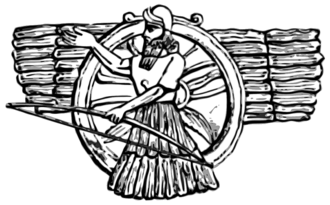
Symbol of Ashur, the ancient Assyrian national deity
Sunday, August 02, 2026, 6:17 PM