Marduk
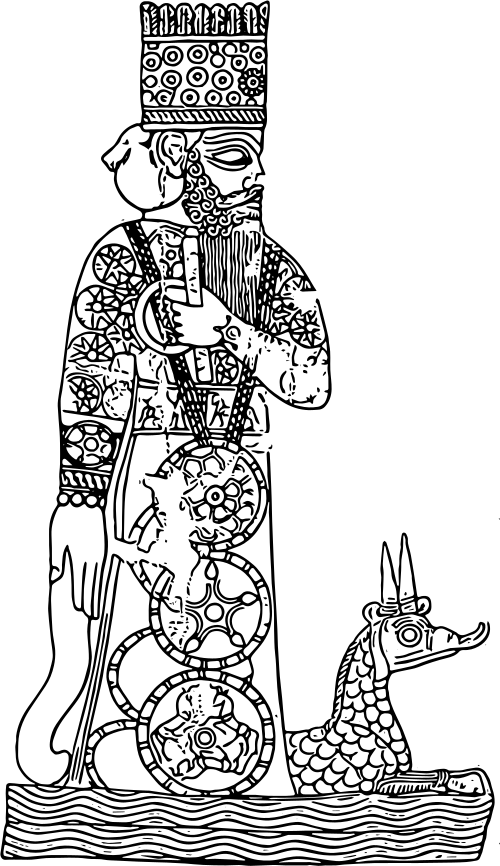
9th-century BC depiction of the Statue of Marduk, with his servant dragon Mušḫuššu. This was Marduk's main cult image in Babylon.
Marduk (/ˈmɑːrdʊk/;[2] cuneiform: 𒀭𒀫𒌓 ^dAMAR.UTU; Sumerian: amar utu.k "calf of the sun; solar calf"; Hebrew: מְרֹדַךְ, Modern: Merōdaḵ, Tiberian: Mərōḏaḵ) was a god from ancient Mesopotamia, patron deity of Babylon. First sparsely attested in the 3rd millennium BC, Marduk slowly rose to prominence before being enshrined as leader of the Mesopotamian pantheon under Nebuchadnezzar I in the 2nd millennium BC. In Babylon, Marduk was worshipped in the Esagila temple.
Believed to have originated as an underworld god, a storm god or an agriculture deity, Marduk came to be worshipped as a god of creation, justice, water, agriculture, magic and medicine.
His symbol was the spade and he was associated with the Mušḫuššu.[3]
By the 1st millennium BC, Marduk had become astrologically associated with the planet Jupiter.
He was a prominent figure in Babylonian cosmology, especially in the Enūma Eliš creation myth.
The deity had many epithets and around 50 symbolic names, which include "highest in the house of gods", "king of the gods of heaven and earth", "omniscient one", "giver of life", "the creator of the Annunaki" and "creator of mankind".
These were not just titles, but statements about Marduk's theological supremacy and his role as the cosmic ruler and divine counsellor.[4]
Name
The name of Marduk was solely spelled as ^dAMAR.UTU in the Old Babylonian Period, although other spellings such as MES and ^dŠA.ZU were also in use since the Kassite Period. In the 1st millennium BC, the ideograms ^dŠU and KU were regularly used.[5] The logogram for Adad is also occasionally used to spell Marduk.[6]
Texts from the Old Babylonian period support the pronunciation Marutu or Marutuk, with the shortened spelling Martuk or Marduk attested starting from the Kassite period. His name in Hebrew, Merodak, supports the longer version,[7] and First Millennium Assyrian and Babylonian texts employ the long spelling when the circumstances call for the precise form of the name.[8]
The personal name Martuku is not to be confused with the god Marduk.[9] Marduk was commonly called Bēl (lord) in the First Millennium BC.[10]
The etymology for the name Marduk is generally understood to be derived from damar-utu-(a)k, meaning "bull-calf of Utu".[8]
Sommerfield suggests this is used to explain the name Marduk in the Enuma Elish as "He is the 'son of the sun[a]' of the gods, radiant is he."[12]
While the name may suggest a relationship with Shamash, Marduk has no genealogy with the sun god.[13]
However, Babylon was closely associated with the city of Sippar in this period, which may have been the reason for the name.[14]
also see:
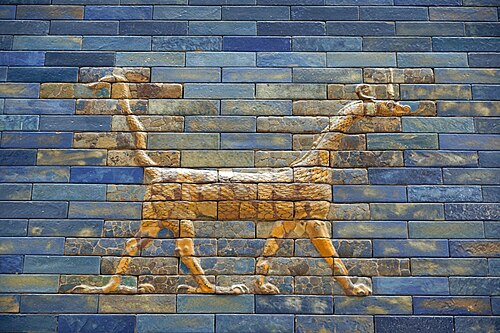
Mušḫuššu, a dragon-like creature,
was associated with Marduk.
Symbol
His symbol is the spade, and he is associated with the Mušḫuššu, a dragon-like creature from Mesopotamian mythology.[3]
Original role
Since sources pertaining to Marduk in the early periods are sparse, Marduk's original role is unknown.
However, since Marduk appears in the Abu Salabikh list behind three minor deities whose names suggest a possible connection to the underworld, Johandi suggests that Marduk may have been a minor god associated with the underworld.[83]
Similarly, Oshima recently proposed that Marduk may have originally had a role similar to Nergal, which may even explain why the logogram dAMAR.UTU is used in Hittite texts to write the name of the god Šanta,[84] who was similar in nature to Nergal.[85]
In the earlier forerunners to the Udug Hul, where both Marduk and Asalluhi appear together in a passage, Marduk, in contrast to Asalluhi, does not help the victim but instead captures him, either because of his powerlessness or because he simply refused to help.[86]
Oshima interpreted the passage as supporting the idea that Marduk's original role was illness and death.[87]
Similarly, in Sin-iddinam's prayer to Ninisina, Asalluhi (here identified with Marduk) imposes an evil spell on Sin-iddinam (the king of Larsa), causing him to become sick[88] may reflect that Marduk's power to cause illness extended beyond the dominion of Babylon.[89]
However Sommerfield, who previously believed that there was little evidence for Marduk being related to magic,[90] more recently suggested that Marduk was originally a god of incantations before his syncretism with Asalluhi.[91]
Jacobsen suggests that Marduk was originally a storm god, based on the storm imagery in the Enuma Elish, wielding the four winds and storms as weapons and assigning to himself the rain and clouds that came from Tiamat's corpse.[92]
Abusch, citing Jacobsen, also believes that Marduk was a storm god, and may have been associated with water and vegetation before joining the pantheon of Eridu, as it is improbable to suppose that all of Marduk's traits with water were taken from the circle of Enki.[93]
However, there is no other evidence suggesting that Marduk was originally a local storm god, and the usage of wind and storm as weapons is not limited to storm gods.
Schwemer points to Ninurta, who is not a storm god, as the original model for Marduk using storms, winds and floods as weapons.[94]
Schwemer also summarizes that although Marduk has characteristics that overlap with the storm god profile, it does not mean that Marduk or other gods in similar position (such as Ninurta, Martu, Telepinu and Tishpak) are necessarily storm gods.[95]
Marduk's symbol, the spade, may point to him originally being a god of agriculture, or, more likely, a god of canals and, by extension, fertility.[96]
Unlike Abusch, Oshima believes that Marduk's association with water came from his association with canals. He is depicted as the supplier of water in Prayer to Marduk no.2, dating to the Kassite period, and was praised as the bringer of water from rivers, seasonal floods, and rains to the fields.[97]
Various prayers to Marduk refer to his connection with springs and rivers, and Ashurbanipal applies the epithet "the canal inspector of the heavens and the earth" to Marduk.[98][c]
Marduk's anger and mercy
Sin-iddinam's prayer to Ninisina shares motifs with the Prayer to Marduk no. 1 and Ludlul bel nemeqi, in which Marduk's anger is blamed for a certain ailment affecting the sufferer and can only be remedied when Marduk has mercy and forgives them.
In the Prayer to Marduk no. 1, Marduk is asked not to kill his client,[101] and in Ludlul, Marduk is praised for his mercy after forgiving his client.[102]
As such, some scholars claim that Marduk was being praised for his wrath,[103] and others claim that Marduk comes off as having "unpredictable mood swings.[104]"
Lambert also points to one of Marduk's names in the Enuma Elish, Meršakušu ("savage, yet relenting"), suggests that the Babylonians may have stressed Marduk's mercy so he could be less savage,[7] although Oshima proposes that the Babylonians had to stress both his wrath and mercy to appease him.[102]
Others believe that the purpose of the poem was to stress that Marduk's true inner quality was mercy and benevolence.[105]
The Prayer to Marduk no.2, on the other hand, praises Marduk's power to heal, which may have been as a result of syncretism with Asalluhi.[106]
Connections to the River Ordeal
Due to being the son of Ea, Marduk had connections with the River Ordeal.[107] Sin-iddinam's prayer to Ninisina also identified Idlurugu (the river ordeal) as the father of Marduk/Asalluhi, in contrast to the standard genealogy.[87]
Incantations
Marduk features in incantations of the Marduk-Ea type formula, in which the god Ea/Enki engages in dialogue with his son Marduk/Asalluhi.
The formula begins with Marduk/Asalluhi noticing a problem and reporting it to his father.
Ea reassures his son about his knowledge, then instructs him on the procedures.[108]
In later incantations from the First Millennium BC, the
priests usually claim to be direct representations of Marduk/Asalluhi, replacing the divine dialogue between father and son,[109]
for example in Marduk's Address to the Demons the priest starts by declaring themselves to be Marduk.[110]
In Neo-Assyrian Assyria, Marduk was one of the major gods that incantation-prayers were directed at, with only Shamash being invoked more than Marduk.[111]
It is difficult to tell whether Marduk originally had a role in incantations before being identified with Asalluhi.[112]
Marduk sometimes appears in the Sumerian-Akkadian bilinguals as the Akkadian name for Asalluhi,[108][113] although Marduk and Asalluhi were also attested to appear separately in two different texts:
- one being the incantation against the evil Udug where Marduk captured the victim instead of helping in contrast to Asalluhi who sought out Enki,[86][112]
- the other being an incantation against Lamashtu that listed Marduk and Asalluhi separately as deterrence to the demon.[114]
Syncretisms
Asalluhi
The earliest evidence of Asalluhi's syncretism with Marduk is Sin-iddinam's prayer to Ninisina,[132] where Asalluhi was called the "king of Babylon.[133]"
An Old Babylonian text substitutes "son of Eridu" for "lord of Tintir" as a title for Asalluhi[134] (Tintir being another attested name for Babylon.[135])
In Hammurabi's prayer to Asalluhi, he is clearly viewed as synonymous with Marduk.[136]
However, in a prayer for Samsu-iluna, Marduk and Asalluhi were mentioned as separate gods, suggesting that the syncretism Marduk = Asalluhi was not yet fully established as canonical in the Old Babylonian period.[137]
Johandi also suggests that keeping Marduk and Asalluhi separate was a deliberate act on the part of Samsu-iluna to reclaim authority over the southern cities,[138] which were centers of rebellion during the early years of his reign.
Sommerfield suggested that the syncretism may have been due to both having a similar role as a god of incantations,[139] or because Asalluhi was more well known in Southern Babylonia compared to Marduk, who was still a local god.[90]
Lambert also believes the syncretism to be a means to elevate Marduk to a more respectable position.[32]
Johandi proposes that Marduk and Asalluhi were identified for some other reason other than magic, and Marduk only became a god associated with magic after being syncretized with Asalluhi.[140]
Enlil
The syncretism of Babylon and Nippur was in place from the Isin II period, and the names of the city walls were switched, with Imgur-Enlil and Nimit-Enlil in Babylon while Imgur-Marduk and Nimit-Marduk were in Nippur.[47] By extension, Marduk was also identified with Enlil, and in the Isin II period Marduk was attested with Enlil's titles. Marduk was often called the "Enlil of the gods" in the First Millennium.
A statue of Marduk, conveniently named "King of the gods of Heaven and the Underworld" was placed in Enlil's sanctuary in Babylon, and Marduk receives the title bēl mātāti "king of the lands" in the Enuma Elish.[118]
Tutu
The previous patron deity of Borsippa. Although Hammurabi recognized Tutu's dominion as extending over Borsippa and E-zida,[141]
Tutu became another name for Marduk after Hammurabi, but became a byname for Nabu in the First Millennium.[142]
Tutu was also a name for Marduk in the Enuma Elish.[143]
In the bird call text, the bird of Enmesharra calls that he sinned against Tutu, here meaning Marduk.[142]
See also
Notes
- The original text is lu-ú ma-ru Šamši ša ilāni né-bu-ú šu-ma. This is reading maru ("son") as being in the possessive case. Lambert reads the same passage as "he is the son, the sun god of the gods, he is dazzling" separating the two clauses[11]
- In line with the Mesopotamian idea that the gods can abandon their cities, this is referring to the narrative that Marduk can and will abandon Babylon and may even direct a foreign power to rule over it until he decides to return.[73] Similarly, Marduk-apla-iddina II also claimed that the Assyrian rule over Babylonia was due to Marduk's anger over the people, until he was satisfied and appointed him to throw off the Assyrians and rule Babylonia[74]
- Similar epithets are also attested for Teshub,[99] Adad, and Ninurta[100]
- In the Ninevite version of the Marduk Ordeal, it is Sarpanit who prays to let Marduk live[126]
See PDF for complete article downloaded
Tuesday, July 21, 2026, 09:24 AM

updated:
Tuesday, July 21, 2026, 15:21 PM