Ashkenaz
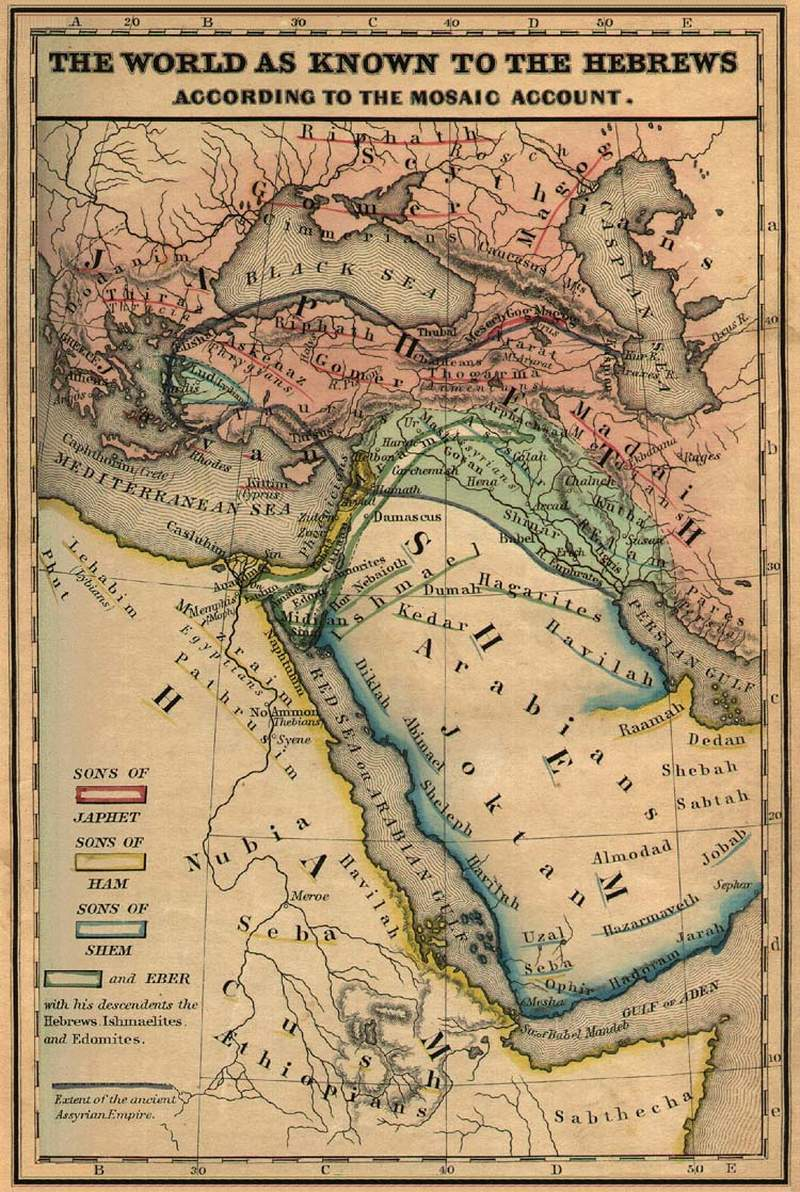
Ashkenaz is shown in Phrygia in this 1854 map of "The World as known to the Hebrews" (Lyman Coleman, Historical Textbook and Atlas of Biblical Geography)
In the genealogies of the Hebrew Bible, Ashkenaz (Hebrew: אַשְׁכְּנַז, ’Aškənaz; Greek: Ἀσχανάζ, romanized: Askhanáz) was a descendant of Noah. He was the first son of Gomer and brother of Riphath and Togarmah (Genesis 10:3, 1 Chronicles 1:6), with Gomer being the grandson of Noah through Japheth.
In Jeremiah 51:27, a kingdom of Ashkenaz was to be called together with Ararat and Minni against Babylon, which reads:
Set ye up a standard in the land, blow the trumpet among the nations, prepare the nations against her [i.e. Babylon], call together against her the kingdoms of Ararat, Minni, and Ashchenaz; appoint a captain against her; cause the horses to come up as the rough caterpillars.
According to the Encyclopaedia Biblica, "Ashkenaz must have been one of the migratory peoples which in the time of Esar-haddon, burst upon the northern provinces of Asia Minor, and upon Armenia.
One branch of this great migration appears to have reached Lake Urumiyeh; for in the revolt which Esar-haddon chastised, the Mannai, who lived to the SW of that lake, sought the help of Ispakai 'of the land of Asguza,' a name (originally perhaps Asgunza) which the skepticism of Dillmann need not hinder us from identifying with Ashkenaz, and from considering as that of a horde from the north, of Indo-Germanic origin, which settled on the south of Lake Urumiyeh."
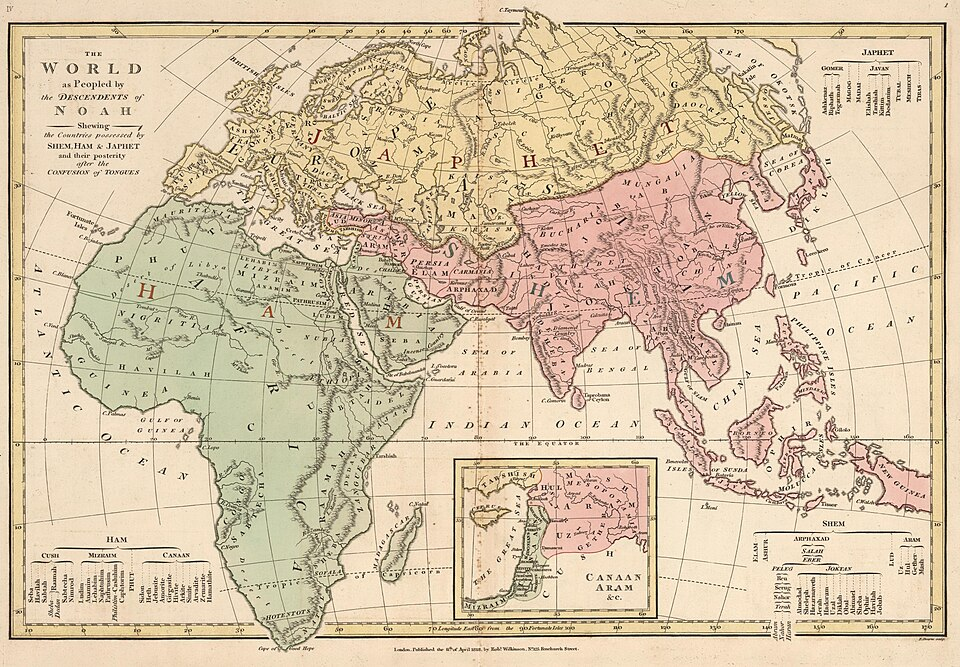
Robert Wilkinson's 1823 map of the descendants of Noah's sons, showing Ashkenaz as France
Ashkenaz (Hebrew: אַשְׁכְּנָז ʾAškənāz) in the Hebrew Bible is one of the descendants of Noah.
Ashkenaz is the first son of Gomer, and a Japhetic patriarch in the Table of Nations.
In rabbinic literature, the descendants of Ashkenaz were first associated with the Scythian cultures, then later with the Slavic territories,[1] and, from the 11th century onwards, with Germany and northern Europe, or the Indo-European people, in a manner similar to Tzarfat or Sefarad.
His name is related to the Assyrian Aškūza (Aškuzai, Iškuzai), the Scythians who expelled the Gimirri (Gimirrāi) from the Armenian highland of the Upper Euphrates area.[2]
Hebrew Bible
In the genealogies of the Hebrew Bible, Ashkenaz (Hebrew: אַשְׁכְּנַז, ’Aškənaz; Greek: Ἀσχανάζ, romanized: Askhanáz) was a descendant of Noah. He was the first son of Gomer and brother of Riphath and Togarmah (Genesis 10:3, 1 Chronicles 1:6), with Gomer being the grandson of Noah through Japheth.
In Jeremiah 51:27, a kingdom of Ashkenaz was to be called together with Ararat and Minni against Babylon, which reads:
Set ye up a standard in the land, blow the trumpet among the nations, prepare the nations against her [i.e. Babylon], call together against her the kingdoms of Ararat, Minni, and Ashchenaz; appoint a captain against her; cause the horses to come up as the rough caterpillars.
According to the Encyclopaedia Biblica, "Ashkenaz must have been one of the migratory peoples which in the time of Esar-haddon, burst upon the northern provinces of Asia Minor, and upon Armenia. One branch of this great migration appears to have reached Lake Urumiyeh; for in the revolt which Esar-haddon chastised, the Mannai, who lived to the SW of that lake, sought the help of Ispakai 'of the land of Asguza,' a name (originally perhaps Asgunza) which the skepticism of Dillmann need not hinder us from identifying with Ashkenaz, and from considering as that of a horde from the north, of Indo-Germanic origin, which settled on the south of Lake Urumiyeh."
The Karaite philologist David ben Abraham al-Fāsi, writing around the year 1000 CE, identified Ashkenaz as the ancestor of the Khazars.[3]
Rabbinic Judaism
In rabbinic literature, the kingdom of Ashkenaz was first associated with the Scythian region, then later with the Slavic territories,[1] and, from the 11th century onwards, with northern Europe and Germany.[4]
The region of Ashkenaz was centred on the Rhineland and the Palatinate (notably Worms and Speyer), in what is now the westernmost part of Germany.[citation needed]
Its geographic extent did not coincide with the German Christian principalities of the time, and it included northern France.
How the name of Ashkenaz came to be associated in the rabbinic literature with the Rhineland is a subject of speculation.[4]
In rabbinic literature from the 11th century, Ashkenaz was considered the ruler of a kingdom in the North and of the Northern and Germanic people.[citation needed] (See below.)
Ashkenazi Jews
Main article: Ashkenazi Jews
Sometime in the Early Middle Ages, the Jews east of France came to be called by the name Ashkenazim,[5] in conformity with the custom of designating areas of Jewish settlement with biblical names:
- Spain as Sepharad (Obadiah 1:20),
- France as Tzarfat (1 Kings 17:9), and
- Bohemia as Canaan.[6]
By the High Middle Ages, Talmudic commentators like Rashi began to use
- Ashkenaz/Eretz Ashkenaz to designate Germany, earlier known as Loter,[5][7] where, especially in the Rhineland communities of Speyer, Worms, and Mainz, the most important Jewish communities arose.[8]
- Rashi uses leshon Ashkenaz (Ashkenazi language) to describe the German language, and Byzantium and Syrian Jewish letters referred to the Crusaders as Ashkenazim.[7]
Given the close links between the Jewish communities of France and Germany following the Carolingian unification, the term Ashkenazi came to refer to both the Jews of medieval Germany and France.[9]
Ashkenazi Jewish culture later spread in the 16th century into Eastern Europe, where their rite replaced that of existing Jewish communities whom some scholars believe to have been larger in demographics than the Ashkenazi Jews themselves,[10] and then to all parts of the world with the migrations of Jews who identified as "Ashkenazi Jews".
Sunday, August 02, 2026, 5:51 PM