Who was John Maynard Keynes?
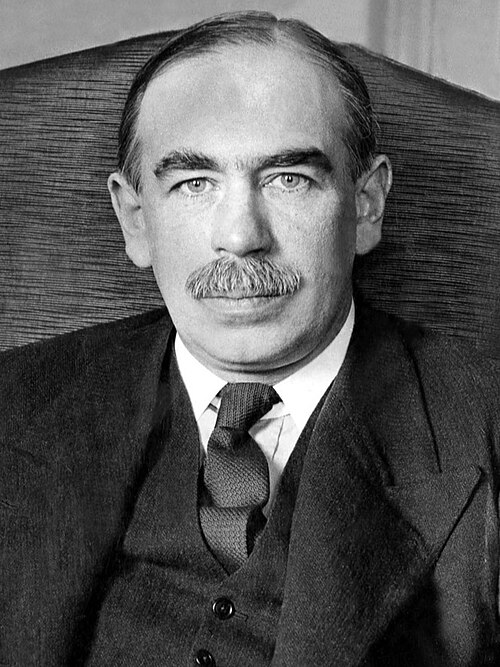
Keynes in 1929
John Maynard Keynes, 1st Baron Keynes[6] (/keɪnz/ KAYNZ; 5 June 1883 – 21 April 1946), was an English economist whose writings are considered the basis for the school of thought known as Keynesian economics, as well as its various offshoots.[7]
Originally trained in mathematics, he built on and refined earlier work on the causes of business cycles.[8] His ideas, further developed after his death as New Keynesianism, are seen as foundational to mainstream macroeconomics.
He has been referred to as the "father of macroeconomics"[9] and is considered one of the most influential economists of the 20th century.[10][11][12]
Keynes was educated at King's College at the University of Cambridge, where he graduated in 1904 with a B.A. in mathematics. During the Great Depression of the 1930s,
Keynes spearheaded the Keynesian Revolution, challenging the ideas of neoclassical economics that held that free markets would, in the short to medium term, automatically provide full employment, as long as workers were flexible in their wage demands. He argued that aggregate demand (total spending in the economy) determined the overall level of economic activity, and that inadequate aggregate demand could lead to prolonged periods of high unemployment, and since wages and labour costs are rigid downwards, the economy will not automatically rebound to full employment.[13]
Keynes advocated the use of fiscal and monetary policies to mitigate the adverse effects of economic recessions and depressions. After the 1929 crisis, Keynes also turned away from free trade, a fundamental pillar of neoclassical economics. He criticised Ricardian comparative advantage theory (the foundation of free trade), considering the theory's initial assumptions unrealistic, and became definitively protectionist.[14][15][16]
He detailed these ideas in his major work, The General Theory of Employment, Interest and Money, published in early 1936. By the late 1930s, leading Western economies had begun adopting Keynes's policy recommendations.
Almost all capitalist governments had done so by the end of the two decades following Keynes's death in 1946. As a leader of the British delegation, Keynes participated in the design of the international economic institutions established after the end of World War II but was overruled by the American delegation on several aspects.
His influence began to wane in the 1970s, partly as a result of the stagflation that plagued the British and American economies during that decade, and partly because of criticism of Keynesian policies by Milton Friedman and other monetarists,[17] who disputed the ability of government to favourably regulate the business cycle with fiscal policy.[18]
The 2008 financial crisis sparked the 2008–2009 Keynesian resurgence; Keynesian economics provided the theoretical underpinning for economic policies undertaken in response to the 2008 financial crisis by President Barack Obama of the United States, Prime Minister Gordon Brown of the United Kingdom, and other heads of governments.[19]
When Time magazine included Keynes among its Most Important People of the Century in 1999, it reported that "his radical idea that governments should spend money they don't have may have saved capitalism".[20] The Economist has described Keynes as "Britain's most famous 20th-century economist".[21]
In addition to being an economist, Keynes was also a civil servant, a director of the Bank of England, and a part of the Bloomsbury Group of intellectuals.[22]
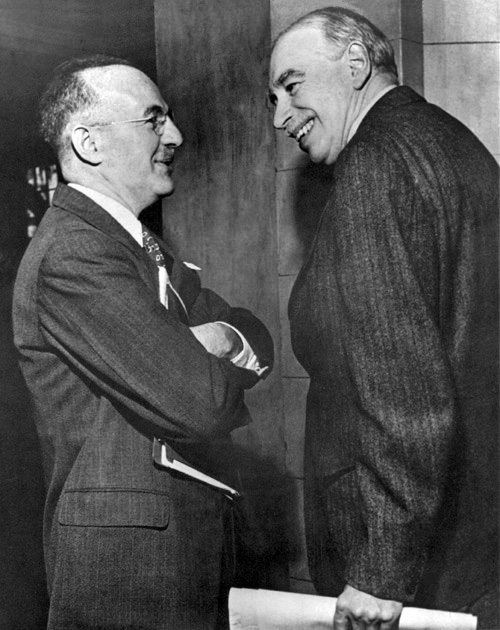
Keynes (right) and the US representative Harry Dexter White at the inaugural meeting of the International Monetary Fund's Board of Governors in Savannah, Georgia in 1946
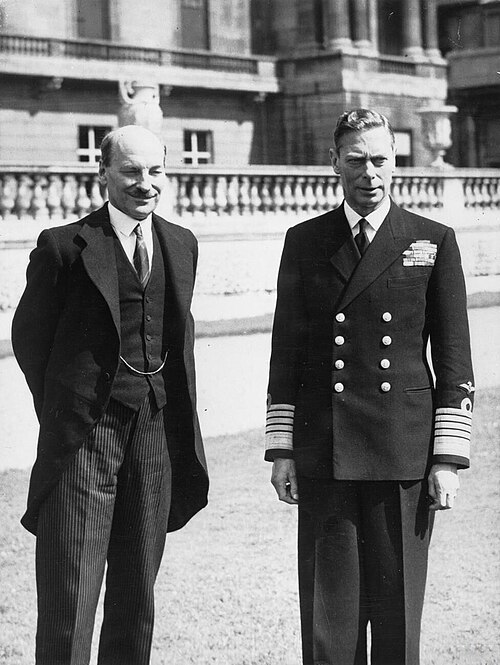
Prime Minister Clement Attlee with King George VI after Attlee won the 1945 election
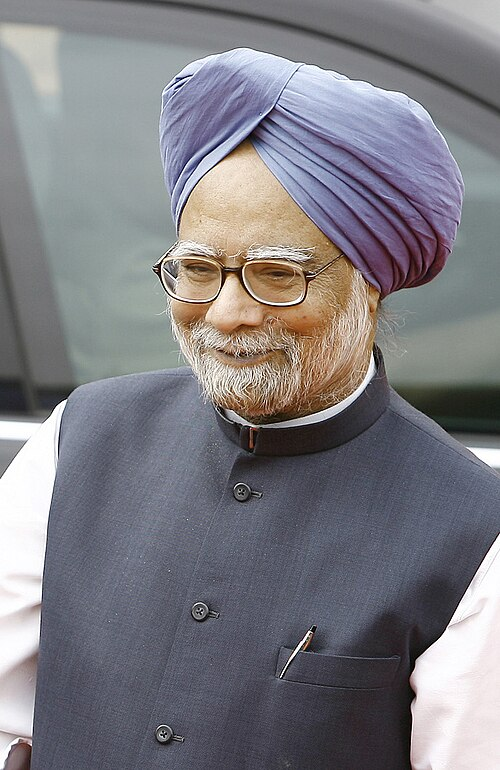
The economist Manmohan Singh, the then-prime minister of India, spoke strongly in favour of Keynesian fiscal stimulus at the 2008 G-20 Washington summit.[102]
The 2008 financial crisis led to public scepticism about the free market consensus even from some on the economic right. In March 2008, Martin Wolf, chief economics commentator at the Financial Times, announced the death of the dream of global free-market capitalism.[103] In the same month macroeconomist James K. Galbraith used the 25th Annual Milton Friedman Distinguished Lecture to launch a sweeping attack against the consensus for monetarist economics and argued that Keynesian economics were far more relevant for tackling the emerging crises.[104] Economist Robert J. Shiller had begun advocating robust government intervention to tackle the financial crises, specifically citing Keynes.[105][106][107] Nobel laureate Paul Krugman also actively argued the case for vigorous Keynesian intervention in the economy in his columns for The New York Times.[108][109][110] Other prominent economic commentators who have argued for Keynesian government intervention to mitigate the 2008 financial crisis included George Akerlof,[111] J. Bradford DeLong,[112] Robert Reich[113] and Joseph Stiglitz.[114] Newspapers and other media have also cited work relating to Keynes by Hyman Minsky,[35] Robert Skidelsky,[24] Donald Markwell[115] and Axel Leijonhufvud.[116]
A series of major bailouts were pursued during the 2008 financial crisis, starting on 7 September 2008 with the announcement that the US Government was to nationalise the two government-sponsored enterprises which oversaw most of the US subprime mortgage market – Fannie Mae and Freddie Mac. In October, Alistair Darling, the British Chancellor of the Exchequer, referred to Keynes as he announced plans for substantial fiscal stimulus to head off the worst effects of recession, in accordance with Keynesian economic thought.[117][118] Similar policies have been adopted by other governments worldwide.[119][120] This was in stark contrast to the action imposed on Indonesia during the 1997 Asian financial crisis, when it was forced by the IMF to close 16 banks at the same time, prompting a bank run.[121] Much of the post-crisis discussion reflected Keynes's advocacy of international coordination of fiscal or monetary stimulus, and of international economic institutions such as the IMF and the World Bank, which many had argued should be reformed as a "new Bretton Woods", and should have been even before the crises broke out.[122] The IMF and United Nations economists advocated a coordinated international approach to fiscal stimulus.[123] Donald Markwell argued that in the absence of such an international approach, there would be a risk of worsening international relations and possibly even world war arising from economic factors similar to those present during the depression of the 1930s.[115]
By the end of December 2008, the Financial Times reported that "the sudden resurgence of Keynesian policy is a stunning reversal of the orthodoxy of the past several decades."[124] In December 2008, Paul Krugman released his book The Return of Depression Economics and the Crisis of 2008, arguing that economic conditions similar to those that existed during the earlier part of the 20th century had returned, making Keynesian policy prescriptions more relevant than ever. In February 2009 Robert J. Shiller and George Akerlof published Animal Spirits, a book where they argue the current US stimulus package is too small as it does not take into account Keynes's insight on the importance of confidence and expectations in determining the future behaviour of businesspeople and other economic agents.
In the March 2009 speech entitled Reform the International Monetary System, Zhou Xiaochuan, the governor of the People's Bank of China, came out in favour of Keynes's idea of a centrally managed global reserve currency. Zhou argued that it was unfortunate that part of the reason for the Bretton Woods system breaking down was the failure to adopt Keynes's bancor. Zhou proposed a gradual move towards increased use of IMF special drawing rights (SDRs).[125][126] Although Zhou's ideas had not been broadly accepted, leaders meeting in April at the 2009 G-20 London summit agreed to allow $250 billion of special drawing rights to be created by the IMF, to be distributed globally. Stimulus plans were credited for contributing to a better-than-expected economic outlook by both the OECD[127] and the IMF,[128][129] in reports published in June and July 2009. Both organisations warned global leaders that recovery was likely to be slow, so counter-recessionary measures ought not be rolled back too early.
While the need for stimulus measures was broadly accepted among policymakers, there had been much debate over how to fund the spending. Some leaders and institutions, such as Angela Merkel[130] and the European Central Bank,[131] expressed concern over the potential impact on inflation, national debt and the risk that a too-large stimulus will create an unsustainable recovery.
Among professional economists the revival of Keynesian economics has been even more divisive. Although many economists, such as George Akerlof, Paul Krugman, Robert Shiller and Joseph Stiglitz, supported Keynesian stimulus, others did not believe higher government spending would help the United States economy recover from the Great Recession. Some economists, such as Robert Lucas, questioned the theoretical basis for stimulus packages.[132] Others, like Robert Barro and Gary Becker, say that empirical evidence for beneficial effects from Keynesian stimulus does not exist.[133] However, there is a growing academic literature that shows that fiscal expansion helps an economy grow in the near term, and that certain types of fiscal stimulus are particularly effective.[134][135]
On a personal level, Keynes's charm was such that he was generally well received wherever he went – even those who found themselves on the wrong side of his occasionally sharp tongue rarely bore a grudge.[141] Keynes's speech at the closing of the Bretton Woods negotiations was received with a lasting standing ovation, rare in international relations, as the delegates acknowledged the scale of his achievements made despite poor health.[32]
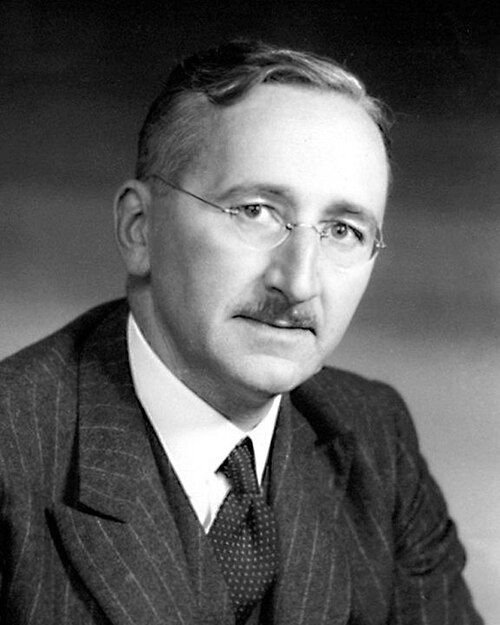
Friedrich Hayek, one of Keynes's most prominent critics
In 1931, Friedrich Hayek extensively critiqued Keynes's 1930 Treatise on Money.[146] After reading Hayek's The Road to Serfdom, Keynes wrote to Hayek: "Morally and philosophically I find myself in agreement with virtually the whole of it."[147] He concluded the letter with the recommendation:
What we need therefore, in my opinion, is not a change in our economic programmes, which would only lead in practice to disillusion with the results of your philosophy; but perhaps even the contrary, namely, an enlargement of them. Your greatest danger is the probable practical failure of the application of your philosophy in the United States.
See also
- Animal spirits (Keynes) – Factors that influence human behaviour
- Effective demand – Demand in a constrained marketplace
- Embedded liberalism – Global economic system, 1945 to 1970s
- Global financial system – Global framework for capital flows
- Liberalism in the United Kingdom
- Keynes family – Noted English family
- Mariana Mazzucato – Italian-American economist and professor (born 1968)
- Post-war consensus – Period in British political history, 1945 to 1970s
- Stockholm School (economics) – School of economic thought (1930s)
See PDF for complete Wikipedia article downloaded:
Tuesday, August 11, 2026 12:49PM