Ashkenazim
{Note: Each racial subdivision of “Jewish” as a term could also describe a unique Jewish culture. Whilst I may point out cultural elements collective shared by a specific Jewish race, this label refers to genetically Ashkenazi individuals only.}
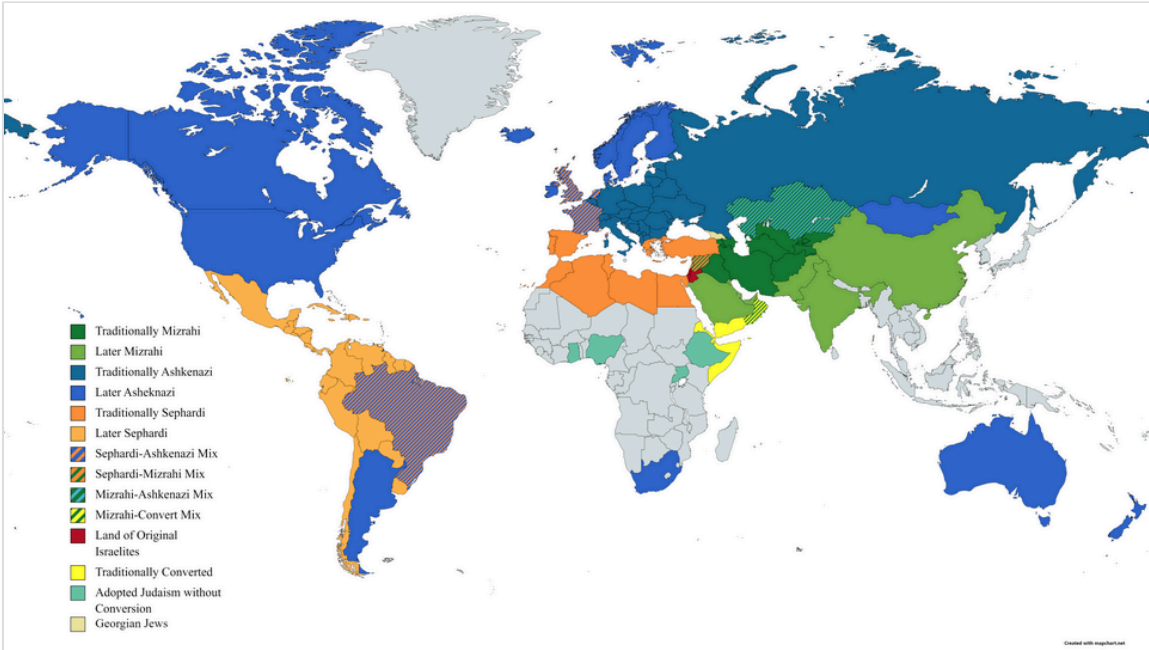
Image: Rough overview of the original location of each main Jewish subtype and their spread. [44, p.2]
800 - 1000
Jews living in central Europe (Germany and Northern France) formed the race of Ashkenazi Jews (the Ashkenazim), at this time they were a minority of the Jews. Later on, they migrated towards Eastern Europe [44, p.1; 44, p.8]
Ashkenazi Jews from the Congress Kingdom of Poland (now central Poland) maintained Ashkenazi culture for centuries and spoke eastern Yiddish. [44, p.8]
Whilst other Ashkenazi Jews spoke Western Yiddish (less slavic influence) but lost this when assimilating.
For instance:
Yekkes (Jews from Germany, Switzerland, and Scandinavia) dropped Yiddish in the early 20th century.
Oberlanders (Jews from the Oberland region of Hungary and near Bratislava in Slovakia) dropped Yiddish for German or Hungarian when moving to the urban centres of Austrio-Hungarian empire in ‘modern times’.
1501-1600
Many Ashkenazi kabbalists were drawn to Jerusalem {44, p.2}