Gentleman
Friday, November 07, 2025 11:59AM
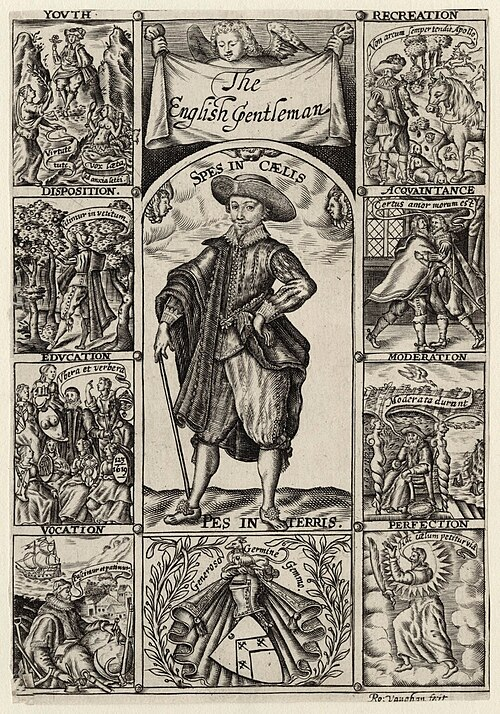
The Complete English Gentleman (1630), by Richard Brathwait, shows the exemplary qualities of a gentleman.
Gentleman (Old French: gentilz hom, "gentle man"; colloquial: gent) is a term for a chivalrous, courteous, or honorable man.[1] Originally, gentleman was the lowest rank of the landed gentry of England, ranking below an esquire and above a yeoman; by definition, the rank of gentleman comprised the younger sons of the younger sons of peers, and the younger sons of a baronet, a knight, and an esquire, in perpetual succession. As such, the connotation of the term gentleman captures the common denominator of gentility (and often a coat of arms); a right shared by the peerage and the gentry, the constituent classes of the British nobility.
Thus, the English social category of gentleman corresponds to the French gentilhomme (nobleman), which in Great Britain meant a member of the peerage of England.[2] English historian Maurice Keen further clarifies this point, stating that, in this context, the social category of gentleman is "the nearest contemporary English equivalent of the noblesse of France."[3] In the 14th century, the term gentlemen comprised the hereditary ruling class, which is whom the rebels of the Peasants' Revolt (1381) meant when they repeated:
When Adam delved and Eve span,
Who was then the gentleman?[4]
In the 17th century, in Titles of Honour (1614), the jurist John Selden said that the title gentleman likewise speaks of "our English use of it" as convertible with nobilis (nobility by rank or personal quality)[5] and describes the forms of a man's elevation to the nobility in European monarchies.[2] In the 19th century, James Henry Lawrence explained and discussed the concepts, particulars, and functions of social rank in a monarchy, in the book On the Nobility of the British Gentry, or the Political Ranks and Dignities of the British Empire, Compared with those on the Continent (1827).[6]
Gentleman by conduct
In The Tale of Melibee (c. 1386), Geoffrey Chaucer says: "Certes he sholde not be called a gentil man, that . . . ne dooth his diligence and bisynesse, to kepen his good name"; and in The Wife of Bath's Tale (1388-1396):
Loke who that is most vertuous alway
Prive and apert, and most entendeth ay
To do the gentil dedes that he can
And take him for the gretest gentilman
In the French allegorical poem The Romance of the Rose (ca. 1400), Guillaume de Lorris and Jean de Meun described the innate character of a gentleman: "He is gentil bycause he doth as longeth to a gentilman."[7] That definition develops until the 18th century, when in 1710, in the Tatler No. 207, Richard Steele said that "the appellation of Gentleman is never to be affixed to a man's circumstances, but to his Behaviour in them." Hence, the apocryphal reply of King James II of England to a lady's petition to elevate her son to the rank of gentleman: "I could make him a nobleman, but God Almighty could not make him a gentleman."
Selden said "that no Charter can make a Gentleman, which is cited as out of the mouth of some great Princes [who] have said it," because "they, without question, understood Gentleman for Generosus in the antient sense, or as if it came from Genii/[Geni] in that sense." The word gentilis identifies a man of noble family, a gentleman by birth, for "no creation could make a man of another blood than he is."[7] In contemporary usage, the word gentleman is ambiguously defined, because "to behave like a gentleman" communicates as little praise or as much criticism as the speaker means to imply; thus, "to spend money like a gentleman" is criticism, but "to conduct a business like a gentleman" is praise.[7]
Southern United States
Main article: Southern chivalry
The Southern gentleman of the Antebellum South was expected to protect the honor and property of both himself and his family members, acting as a chivalric ideal of the white planter class supposedly descended from the knights and cavaliers of the medieval and colonial eras.[8][9]
Robert E. Lee's definition speaks only to conduct.
The forbearing use of power does not only form a touchstone, but the manner in which an individual enjoys certain advantages over others is a test of a true gentleman.
The power which the strong have over the weak, the employer over the employed, the educated over the unlettered, the experienced over the confiding, even the clever over the silly—the forbearing or inoffensive use of all this power or authority, or a total abstinence from it when the case admits it, will show the gentleman in a plain light.
The gentleman does not needlessly and unnecessarily remind an offender of a wrong he may have committed against him. He can not only forgive, he can forget; and he strives for that nobleness of self and mildness of character which impart sufficient strength to let the past be but the past. A true man of honor feels humbled himself when he cannot help humbling others. As quoted by Bradford 1912, p. 233
Lee's conception is one of the better known expositions in favor of the Southern culture of honor.
downloaded from wikipedia:
Friday, November 07, 2025 12:01PMFriday, November 07, 2025 12:01PM
rk