A Theorem
Lingual
- (mathematics) A mathematical statement of some importance that has been proven to be true. Minor theorems are often called propositions. Theorems which are not very interesting in themselves but are an essential part of a bigger theorem's proof are called lemmas.
- (mathematics, colloquial, nonstandard) A mathematical statement that is expected to be trueFermat's Last Theorem was known thus long before it was proved in the 1990s.
- (logic) A syntactically correct expression that is deducible from the given axioms of a deductive system.
Synonyms
- (proven statement): lemma, proposition, statement
- (unproven statement): conjecture
Mathematics
Calculus
L'Hôpital's Rule
is a theorem in calculus used to evaluate limits of fractions that result in indeterminate forms. It states that if the limit of a quotient of two functions produces an indeterminate form, the limit can be evaluated by taking the derivative of the numerator and the derivative of the denominator independently.
The Theorem
If \(\lim_{x \to c} f(x) = 0\) and \(\lim_{x \to c} g(x) = 0\) (or if both limits approach \(\pm\infty\)), then:
\[\lim_{x \to c} \frac{f(x)}{g(x)} = \lim_{x \to c} \frac{f'(x)}{g'(x)}\]
This applies whether \(c\) is a finite number, \(+\infty\), or \(-\infty\).
Conditions for Application
To correctly apply L'Hôpital's rule, the following criteria must be met:
- Strict Indeterminate Form: The initial limit must evaluate directly to either \(\frac{0}{0}\) or \(\frac{\pm\infty}{\pm\infty}\).
- Differentiability: Both \(f(x)\) and \(g(x)\) must be differentiable on an open interval containing \(c\) (except possibly at \(c\) itself).
- Non-Zero Denominator Derivative: \(g'(x) \neq 0\) on that open interval (except possibly at \(c\)).
- Existence of the New Limit: The new limit \(\lim_{x \to c} \frac{f'(x)}{g'(x)}\) must exist or equal \(\pm\infty\). If taking the derivative results in a limit that oscillates infinitely without settling, L'Hôpital's rule fails, and another method must be used.
Other Indeterminate Forms
L'Hôpital's rule cannot be applied directly to other indeterminate forms such as \(0 \cdot \infty\), \(\infty - \infty\), \(1^\infty\), \(0^0\), or \(\infty^0\). These expressions must first be algebraically manipulated into either \(\frac{0}{0}\) or \(\frac{\pm\infty}{\pm\infty}\).
- Products (\(0 \cdot \infty\)): Rewrite \(f(x) \cdot g(x)\) as a fraction, such as \(\frac{f(x)}{1/g(x)}\).
- Exponents (\(1^\infty, 0^0, \infty^0\)): Use the natural logarithm (\(y = \dots\), then \(\ln y = \dots\)) to bring the exponent down and create a product, which is then turned into a fraction.
Mean Value Theorem
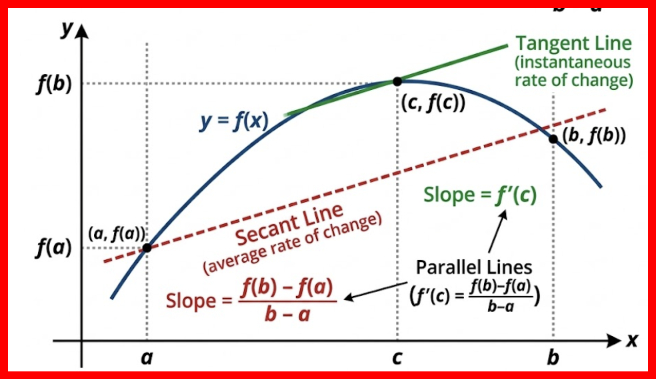
The Mean Value Theorem (MVT) connects the average rate of change to the instantaneous rate of change (the derivative).
The Theorem and Its Conditions:
If a function \(f(x)\) satisfies two main conditions:
- Continuous on the closed interval \([a, b]\).
- Differentiable on the open interval \((a, b)\).
Then, there exists at least one point \(c\) within the open interval \((a, b)\) such that:
\[f'(c) = \frac{f(b) - f(a)}{b - a}\]
Geometric Interpretation:
The right side of the equation, \(\frac{f(b) - f(a)}{b - a}\), calculates the slope of the secant line that connects the start and end points of the interval, \((a, f(a))\) and \((b, f(b))\). The left side, \(f'(c)\), is the slope of the tangent line at a specific point \(c\). Geometrically, the theorem guarantees that there is at least one point on the curve where the tangent line is perfectly parallel to the secant line.
Physical Interpretation:
Velocity e.g. the right side of the equation represents the average velocity whiles The left side represents instantaneous velocity (the exact number on your speedometer at a specific fraction of a second). The theorem states that if the average speed of a car for a one-hour trip was 80 km/h, there must have been at least one exact moment \(c\) during that hour where the speedometer read exactly 80 km/h.
Clairaut's Theorem
Clairaut's theorem (also known as Schwarz's theorem) states that for a function of multiple variables, the order of differentiation does not matter when calculating mixed second-order partial derivatives, provided those derivatives are continuous.
For a function \(f(..,x_i,..)\), this is expressed as:
\[f_{x_ix_j} = f_{x_jx_i}\]
Or, written in Leibniz notation:
\[\frac{\partial^2 f}{\partial x_i \partial x_j} = \frac{\partial^2 f}{\partial x_j \partial x_i}\]
Key Implications and Applications:
- Calculation Efficiency: when working with a complex function and need to build a Hessian matrix for optimization, the only need is to compute one of the mixed partial derivatives. The theorem guarantees the other will be identical.
- Thermodynamics: This theorem is the mathematical engine behind Maxwell's relations. Because thermodynamic state functions (like internal energy, enthalpy, and entropy) are continuous and smooth, their mixed partial derivatives are equal. This allows you to relate difficult-to-measure quantities (like entropy changes) to easily measurable ones (like pressure, volume, and temperature).
- Conservative Vector Fields: In physics and mechanics, Clairaut's theorem dictates why conservative force fields (such as gravity or electrostatic fields) have zero curl. It proves that the work done moving a mass or charge through these fields is entirely independent of the path taken.