Limit of a Function
The limit of a function describes the value that f(x) approaches as x approaches a particular value.
\[\\lim_{\\x\rightarrow a} f(x)=L\]
This means that as x gets closer and closer to a, the value of f(x) gets closer and closer to L.
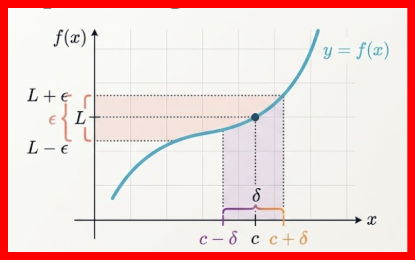
The formal algebraic definition of a limit is known as the\( \epsilon-\delta\) (epsilon-delta) definition. It rigorously quantifies what it means for a function \(f(x)\) to approach a specific value L as x approaches a point c, without relying on intuitive concepts like "getting closer to."
Let \(f(x)\) be a function defined on an open interval containing c (except possibly at c itself). The limit of f(x) as x approaches c is L, written as:
Mohammed Alhamoud 2026-10-20 13:32 UTC
\(\iff \forall \epsilon \in R ,\epsilon >0 \implies€ \delta >0\) \( \epsilon > 0\) there exists a real number \delta > 0 such that:
Mohammed Alhamoud 2026-10-19 10:38 UTC
\(\iff \forall \epsilon \in R ,\epsilon >0 \rightarrow € \delta >0\) \( \epsilon > 0\) there exists a real number \delta > 0 such that:
Breakdown of the Components
*\( \epsilon\) (epsilon): The allowed error margin for the output. Any positive number, no matter how microscopically small.
* \(\delta\) (delta): The required target window for the input. This value depends entirely on the value og \(\epsilon\).
*\( \vert{}f(x) - L\vert{} < \epsilon\): The distance between the function's output and the limit L is strictly less than the error margin \epsilon.
* \(0 < \vert{}x - c\vert{} < \delta\): The distance between x and c is less than \delta. The 0 < part is crucial—it means \(x \neq c\). A limit only cares about what happens near c, not what happens at c.
In plain terms: No matter how close the demanded output f(x) to L (defined by \(\epsilon\)), There is always a tight enough boundary around the input c (defined by \(\delta\)) that guarantees the output stays within the demanded range.
Limit of Sum
if:
- \[\lim_{x \to c} f(x) = L\]
- \[\lim_{x \to c} g(x) = M\]
So: \(\lim_{x \to c} [f(x) + g(x)] = L + M\).
\(\forall \epsilon > 0\), there exists a corresponding \(\delta > 0\) such that:
\[0 < \vert{}x - c\vert{} < \delta \rightarrow \vert{}[f(x) + g(x)] - (L + M)\vert{} < \epsilon\]
\[\lim_{x \to c} [f(x) + g(x)] = \lim_{x \to c} f(x) + \lim_{x \to c} g(x)\]
The Proof
Let \(\epsilon > 0\) be an arbitrary given real number .
Due to the eventually result is a sum of two separate error bounds together, the target error margin is half.
Since \(\epsilon > 0\), so \(\frac{\epsilon}{2} > 0\).
\(\lim_{x \to c} f(x) = L\), the definition guarantees that for \(\frac{\epsilon}{2}\), there exists some \(\delta_1 > 0\) such that:
\[ 0 < \vert{}x - c\vert{} < \delta_1 \rightarrow \vert{}f(x) - L\vert{} < \frac{\epsilon}{2}\]
Similarly, because \(\lim_{x \to c} g(x) = M\), there exists some \(\delta_2 > 0\) such that:
\[ 0 < \vert{}x - c\vert{} < \delta_2 \rightarrow \vert{}g(x) - M\vert{} < \frac{\epsilon}{2}\]
For the both conditions hold true at the same time the bounds have to be unified:
\[\delta = \min(\delta_1, \delta_2)\]
Assuming that \(0 < \vert{}x - c\vert{} < \delta\), it is guaranteed that both \(0 < \vert{}x - c\vert{} < \delta_1\) and \(0 < \vert{}x - c\vert{} < \delta_2\) are true simultaneously.
Evaluating the distance between the combined function and the combined limit:
\[\vert{}[f(x) + g(x)] - (L + M)\vert{}= \vert{}(f(x) - L) + (g(x) - M)\vert{}\]
Applying the **Triangle Inequality, which states that \(\vert{}a + b\vert{} \le \vert{}a\vert{} + \vert{}b\vert{}\):
\[\vert{}(f(x) - L) + (g(x) - M)\vert{} \le \vert{}f(x) - L\vert{} + \vert{}g(x) - M\vert{}\]
The established \(\delta\) guarantees both \(\vert{}f(x) - L\vert{} < \frac{\epsilon}{2}\) and \(\vert{}g(x) - M\vert{} < \frac{\epsilon}{2}\), and transforms the inequality to:
\[\vert{}f(x) - L\vert{} + \vert{}g(x) - M\vert{} < \frac{\epsilon}{2} + \frac{\epsilon}{2} = \epsilon\]
Therefore, for any \(\epsilon > 0\), there exists a \(\delta > 0\) such that if \(0 < \vert{}x - c\vert{} < \delta\), then \(\vert{}[f(x) + g(x)] - (L + M)\vert{} < \epsilon\).
Limit of Product
If \(\lim_{x \to c} f(x) = L\ \& \lim_{x \to c} g(x) = M \implies \lim_{x \to c} [f(x)g(x)] = LM\)
By the \(\epsilon-\delta\) definition, for any \(\epsilon > 0\), we must find a \(\delta > 0\) such that:
\[\text{If } 0 < \vert{}x - c\vert{} < \delta \text{, then } \vert{}f(x)g(x) - LM\vert{} < \epsilon\]
The Proof
Connecting the target expression \(f(x)g(x) - LM\) to (\(f(x)-L\) and \(g(x)-M\)), adding and subtracting a "cross term" like \(f(x)M\) in the middle.
\[\vert{}f(x)g(x) - LM\vert{} = \vert{}f(x)g(x) - f(x)M + f(x)M - LM\vert{}\]
Factoring the terms by grouping:
\[= \vert{}f(x)[g(x) - M] + M[f(x) - L]\vert{}\]
Apply the Triangle Inequality (\(\vert{}a + b\vert{} \le \vert{}a\vert{} + \vert{}b\vert{}\)):
\[\le \vert{}f(x)\vert{}\vert{}g(x) - M\vert{} + \vert{}M\vert{}\vert{}f(x) - L\vert{}\]
To make this entire expression less than \(\epsilon\), each half must be less than \(\frac{\epsilon}{2}\).
Step 2: Bound the moving target, \(\vert{}f(x)\vert{}\)
In the first term (\(\vert{}f(x)\vert{}\vert{}g(x) - M\vert{}\)), \(M\) is a constant, but \(f(x)\) is a variable. We need to lock \(f(x)\) inside a constant boundary.
Because \(\lim_{x \to c} f(x) = L\), we know \(f(x)\) gets close to \(L\). Let's set a strict margin of \(1\). There must exist some \(\delta_1 > 0\) such that:
\[\text{If } 0 < \vert{}x - c\vert{} < \delta_1 \text{, then } \vert{}f(x) - L\vert{} < 1\]
By the triangle inequality, \(\vert{}f(x)\vert{} - \vert{}L\vert{} \le \vert{}f(x) - L\vert{} < 1\), which means:
\[\vert{}f(x)\vert{} < \vert{}L\vert{} + 1\]
Now we have a constant upper bound for \(\vert{}f(x)\vert{}\).
Step 3: Establish constraints for \(f(x)\) and \(g(x)\)
Now we dictate how close \(f(x)\) and \(g(x)\) must be to their limits to ensure our two halves are each less than \(\frac{\epsilon}{2}\).
For \(g(x)\): We want \(\vert{}f(x)\vert{}\vert{}g(x) - M\vert{} < \frac{\epsilon}{2}\). Since \(\vert{}f(x)\vert{} < \vert{}L\vert{} + 1\), we require:
\[\vert{}g(x) - M\vert{} < \frac{\epsilon}{2(\vert{}L\vert{} + 1)}\]
Because \(\lim_{x \to c} g(x) = M\), there exists a \(\delta_2 > 0\) that guarantees this.
For \(f(x)\): We want \(\vert{}M\vert{}\vert{}f(x) - L\vert{} < \frac{\epsilon}{2}\). To avoid the risk of dividing by zero (in case \(M = 0\)), we divide by \(\vert{}M\vert{} + 1\):
\[\vert{}f(x) - L\vert{} < \frac{\epsilon}{2(\vert{}M\vert{} + 1)}\]
Because \(\lim_{x \to c} f(x) = L\), there exists a \(\delta_3 > 0\) that guarantees this.
Step 4: Define a universal \(\delta\)
We need all three conditions to be true at once, so we choose the tightest window:
\[\delta = \min(\delta_1, \delta_2, \delta_3)\]
Step 5: Put it all together
If \(0 < \vert{}x - c\vert{} < \delta\), all our established bounds hold. We substitute them back into our inequality from Step 1:
\[\vert{}f(x)g(x) - LM\vert{} \le \vert{}f(x)\vert{}\vert{}g(x) - M\vert{} + \vert{}M\vert{}\vert{}f(x) - L\vert{}\]
Substitute the bounds we created:
\[< (\vert{}L\vert{} + 1) \cdot \left[ \frac{\epsilon}{2(\vert{}L\vert{} + 1)} \right] + \vert{}M\vert{} \cdot \left[ \frac{\epsilon}{2(\vert{}M\vert{} + 1)} \right]\]
Simplify the terms. Notice that \(\frac{\vert{}M\vert{}}{\vert{}M\vert{} + 1}\) is strictly less than 1, so:
\[< \frac{\epsilon}{2} + 1 \cdot \left(\frac{\epsilon}{2}\right)\]
\[= \epsilon\]
Therefore, for any \(\epsilon > 0\), there is a \(\delta > 0\) that guarantees \(\vert{}f(x)g(x) - LM\vert{} < \epsilon\).
This confirms that \(\lim_{x \to c} [f(x)g(x)] = \lim_{x \to c} f(x) \cdot \lim_{x \to c} g(x)\).
The Given Information
Let \(\lim_{x \to c} f(x) = L\) and \(\lim_{x \to c} g(x) = M\). Crucially, for a quotient limit to exist, we must stipulate that \(M \neq 0\).
The Goal
We must prove that \(\lim_{x \to c} \left[ \frac{f(x)}{g(x)} \right] = \frac{L}{M}\).
By the \(\epsilon-\delta\) definition, for any \(\epsilon > 0\), we must find a \(\delta > 0\) such that:
\[\text{If } 0 < \vert{}x - c\vert{} < \delta \text{, then } \left\vert{} \frac{f(x)}{g(x)} - \frac{L}{M} \right\vert{} < \epsilon\]
The Proof
Step 1: The Algebraic Trick
First, we find a common denominator to combine our target expression into a single fraction:
\[\left\vert{} \frac{f(x)}{g(x)} - \frac{L}{M} \right\vert{} = \left\vert{} \frac{f(x)M - g(x)L}{g(x)M} \right\vert{}\]
Just like with the product rule, we add and subtract a cross term in the numerator. We will use \(LM\):
\[= \frac{\vert{}f(x)M - LM + LM - g(x)L\vert{}}{\vert{}g(x)\vert{}\vert{}M\vert{}}\]
Factor by grouping and apply the Triangle Inequality (\(\vert{}a + b\vert{} \le \vert{}a\vert{} + \vert{}b\vert{}\)):
\[= \frac{\vert{}M[f(x) - L] - L[g(x) - M]\vert{}}{\vert{}g(x)\vert{}\vert{}M\vert{}} \le \frac{\vert{}M\vert{}\vert{}f(x) - L\vert{} + \vert{}L\vert{}\vert{}g(x) - M\vert{}}{\vert{}g(x)\vert{}\vert{}M\vert{}}\]
We can split this into two separate fractions:
\[= \frac{\vert{}f(x) - L\vert{}}{\vert{}g(x)\vert{}} + \frac{\vert{}L\vert{}\vert{}g(x) - M\vert{}}{\vert{}g(x)\vert{}\vert{}M\vert{}}\]
Step 2: Bound the denominator, \(\vert{}g(x)\vert{}\)
Because \(g(x)\) is in the denominator, we must ensure it doesn't get arbitrarily close to zero, which would cause our fraction to blow up to infinity.
Since \(M \neq 0\), we can choose to restrict \(g(x)\) to be at least halfway to \(M\). We set a strict margin of \(\frac{\vert{}M\vert{}}{2}\). Because \(\lim_{x \to c} g(x) = M\), there exists some \(\delta_1 > 0\) such that:
\[\text{If } 0 < \vert{}x - c\vert{} < \delta_1 \text{, then } \vert{}g(x) - M\vert{} < \frac{\vert{}M\vert{}}{2}\]
By the properties of absolute values, this guarantees that \(\vert{}g(x)\vert{} > \frac{\vert{}M\vert{}}{2}\).
If we invert both sides, we get a constant upper bound for our fractions:
\[\frac{1}{\vert{}g(x)\vert{}} < \frac{2}{\vert{}M\vert{}}\]
Step 3: Establish constraints for \(f(x)\) and \(g(x)\)
Now we dictate how close \(f(x)\) and \(g(x)\) must be to their limits to ensure both halves of our expression from Step 1 are less than \(\frac{\epsilon}{2}\). We substitute our new bound \(\frac{1}{\vert{}g(x)\vert{}} < \frac{2}{\vert{}M\vert{}}\) into the split fractions.
For \(f(x)\): We want \(\frac{2}{\vert{}M\vert{}}\vert{}f(x) - L\vert{} < \frac{\epsilon}{2}\).
Rearranging this, we require:
\[\vert{}f(x) - L\vert{} < \frac{\epsilon \vert{}M\vert{}}{4}\]
Because \(\lim_{x \to c} f(x) = L\), there exists a \(\delta_2 > 0\) that guarantees this.
For \(g(x)\): We want \(\left( \frac{2\vert{}L\vert{}}{\vert{}M\vert{}^2} \right) \vert{}g(x) - M\vert{} < \frac{\epsilon}{2}\).
To avoid dividing by zero in the rare case that \(L = 0\), we divide by \(\vert{}L\vert{} + 1\) instead of \(\vert{}L\vert{}\). We require:
\[\vert{}g(x) - M\vert{} < \frac{\epsilon \vert{}M\vert{}^2}{4(\vert{}L\vert{} + 1)}\]
Because \(\lim_{x \to c} g(x) = M\), there exists a \(\delta_3 > 0\) that guarantees this.
Step 4: Define a universal \(\delta\)
We need all three of these conditions (the denominator bound and the two error bounds) to hold simultaneously, so we choose the tightest window:
\[\delta = \min(\delta_1, \delta_2, \delta_3)\]
Step 5: Put it all together
If \(0 < \vert{}x - c\vert{} < \delta\), all bounds hold. We substitute them back into our expanded inequality from Step 1:
\[\left\vert{} \frac{f(x)}{g(x)} - \frac{L}{M} \right\vert{} \le \frac{1}{\vert{}g(x)\vert{}}\vert{}f(x) - L\vert{} + \frac{\vert{}L\vert{}}{\vert{}g(x)\vert{}\vert{}M\vert{}}\vert{}g(x) - M\vert{}\]
Substitute the upper bound for \(\frac{1}{\vert{}g(x)\vert{}}\):
\[< \frac{2}{\vert{}M\vert{}}\vert{}f(x) - L\vert{} + \frac{2\vert{}L\vert{}}{\vert{}M\vert{}^2}\vert{}g(x) - M\vert{}\]
Substitute the bounds we created for \(f(x)\) and \(g(x)\):
\[< \frac{2}{\vert{}M\vert{}} \left[ \frac{\epsilon \vert{}M\vert{}}{4} \right] + \frac{2\vert{}L\vert{}}{\vert{}M\vert{}^2} \left[ \frac{\epsilon \vert{}M\vert{}^2}{4(\vert{}L\vert{} + 1)} \right]\]
Simplify the terms (noting that \(\frac{\vert{}L\vert{}}{\vert{}L\vert{} + 1} < 1\)):
\[< \frac{\epsilon}{2} + \frac{\epsilon}{2}\]
\[= \epsilon\]
Therefore, for any \(\epsilon > 0\), there is a \(\delta > 0\) that guarantees \(\left\vert{} \frac{f(x)}{g(x)} - \frac{L}{M} \right\vert{} < \epsilon\).
This confirms that \(\lim_{x \to c} \left[ \frac{f(x)}{g(x)} \right] = \frac{\lim_{x \to c} f(x)}{\lim_{x \to c} g(x)}\).
Squeeze Theorem
The Squeeze Theorem (also known as the Sandwich Theorem or Pinch Theorem) is a strategy used to find the limit of a complex, messy, or oscillating function that you can't evaluate directly. You do this by "trapping" the difficult function between two simpler functions whose limits you do know.
If the two outer functions converge on the exact same value at a specific point, the trapped function in the middle has no choice but to be squeezed into that same value.
The Formal Algebraic Rule
Let \(f(x)\), \(g(x)\), and \(h(x)\) be functions defined on an open interval containing \(c\) (except possibly at \(c\) itself).
If the target function \(g(x)\) is bounded such that:
\[f(x) \le g(x) \le h(x)\]
for all \(x\) near \(c\), AND you can prove that the outer functions share a limit:
\[\lim_{x \to c} f(x) = L\]
\[\lim_{x \to c} h(x) = L\]
THEN the limit of the middle function must also be \(L\):
\[\lim_{x \to c} g(x) = L\]
Example
The core mathematical principle, often called the "Zero Times Bounded" theorem, requires only two broad conditions to guarantee the limit is zero.
The "Zero Times Bounded" Theorem
If the following two conditions are met for functions \(f(x)\) and \(g(x)\) as \(x\) approaches a value \(c\) (where \(c\) can be a real number, \(\infty\), or \(-\infty\)):
- \[\lim_{x \to c} f(x) = 0\]
- \(g(x)\) is a bounded function near \(c\) (meaning there exists a positive real number \(M\) such that \(\vert{}g(x)\vert{} \le M\))
Conclusion:
Then, the limit of their product is always zero:
\[\lim_{x \to c} [f(x) \cdot g(x)] = 0\]
Proof via Squeeze Theorem:
Because \(\vert{}g(x)\vert{} \le M\), we can multiply the absolute value inequality by \(\vert{}f(x)\vert{}\) to establish the upper and lower bounds:
\[-M\vert{}f(x)\vert{} \le f(x)g(x) \le M\vert{}f(x)\vert{}\]
Since \(\lim_{x \to c} f(x) = 0\), both of the outer bounding functions approach \(0\):
\[\lim_{x \to c} -M\vert{}f(x)\vert{} = 0 \quad \text{and} \quad \lim_{x \to c} M\vert{}f(x)\vert{} = 0\]
Because the target function \(f(x)g(x)\) is trapped between two functions that both converge to zero, it must also converge to zero.
Example
If \(\lim_{x \to c} [(f(x)-a) \cdot (g(x)-b)] = 0\), it indicates that as \(x\) gets infinitely close to \(c\), the product of these two factors vanishes. This specific condition implies that at least one of three mathematical scenarios is occurring regarding the behavior of \(f(x)\) and \(g(x)\):
- Scenario 1: The Standard Case (Both Limits Exist)
If both \(f(x)\) and \(g(x)\) have standard, finite limits as \(x \to c\), the standard limit laws apply. Because their product is zero, the Zero Product Property dictates that either \(\lim_{x \to c} f(x) = a\), or \(\lim_{x \to c} g(x) = b\), or both. At least one function successfully hits its respective target constant.
- Scenario 2: The Squeeze Theorem Case (Zero Times Bounded)
Tying back to the generalized theorem, one function might converge while the other behaves unpredictably but remains trapped within limits. If \(\lim_{x \to c} f(x) = a\), the first term \((f(x)-a)\) becomes exactly \(0\). As long as \(g(x)\) is strictly bounded near \(c\) (meaning it doesn't shoot off to infinity, even if it oscillates wildly and has no limit itself), the entire product is squeezed to \(0\).
- Scenario 3: The Asymptotic Race (Zero Times Infinity)
One function might approach its target value (e.g., \(f(x) \to a\)) so rapidly that it physically overpowers the other function diverging to infinity. For instance, if \(f(x) - a = (x-c)^2\) (which goes to \(0\)) and \(g(x) - b = \frac{1}{\vert{}x-c\vert{}}\) (which diverges to \(\infty\)), their product simplifies to \(\vert{}x-c\vert{}\). The limit of \(\vert{}x-c\vert{}\) as \(x \to c\) is \(0\). In this case, \(g(x)\) completely breaks away from \(b\), but \(f(x)\) forces the product to \(0\) anyway.