A Circle
Lingual Usage
- (geometry) A two-dimensional geometric figure, a line, consisting of the set of all those points in a plane that are equally distant from a given point (center).Synonyms: coil (not in mathematical use), ring (not in mathematical use), loop (not in mathematical use)
- A two-dimensional geometric figure, a disk, consisting of the set of all those points of a plane at a distance less than or equal to a fixed distance (radius) from a given point.Synonyms: disc, disk (in mathematical and general use), round (not in mathematical use; UK & Commonwealth only)
- Any thin three-dimensional equivalent of the geometric figures.
- A curve that more or less forms part or all of a circle.Synonyms: arc, curve
- Orbit.Synonym: orbit
- A specific group of persons; especially one who shares a common interest. Synonyms: bunch, gang, group
- (cricket) A line comprising two semicircles of 30 yards radius centred on the wickets joined by straight lines parallel to the pitch used to enforce field restrictions in a one-day match.
- (Wicca) A ritual circle that is cast three times deosil and closes three times widdershins either in the air with a wand or literally with stones or other items used for worship.
- (South Africa) A traffic circle or roundabout.
- (obsolete) Compass; circuit; enclosure.
- (astronomy) An instrument of observation, whose graduated limb consists of an entire circle. When fixed to a wall in an observatory, it is called a mural circle; when mounted with a telescope on an axis and in Y's, in the plane of the meridian, a meridian or transit circle; when involving the principle of reflection, like the sextant, a reflecting circle; and when that of repeating an angle several times continuously along the graduated limb, a repeating circle.
- A series ending where it begins, and repeating itself.
- (logic) A form of argument in which two or more unproved statements are used to prove each other; inconclusive reasoning.
- Indirect form of words; circumlocution.
- A territorial division or district.
- (in the plural) A bagginess of the skin below the eyes from lack of sleep.
Mathematics
Definition
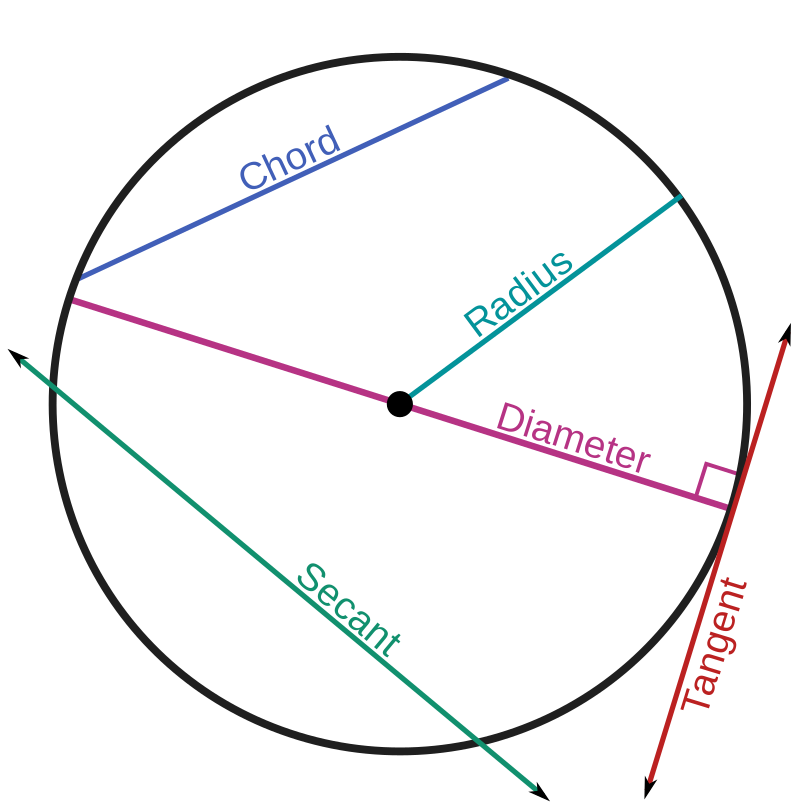
A circle is a shape consisting of all points in a plane that are at a given distance from a given point, the centre. The distance between any point of the circle and the centre is called the radius.
Terminology
- Annulus: a ring-shaped object, the region bounded by two concentric circles.
- Arc: any connected part of a circle. Specifying two end points of an arc and a centre allows for two arcs that together make up a full circle.
- Center: the point equidistant from all points on the circle.
- Chord: a line segment whose endpoints lie on the circle, thus dividing a circle into two segments.
- Diameter: a line segment whose endpoints lie on the circle and that passes through the centre; or the length of such a line segment. This is the largest distance between any two points on the circle. It is a special case of a chord, namely the longest chord for a given circle, and its length is twice the length of a radius.
- Disc: the region of the plane bounded by a circle. In strict mathematical usage, a circle is only the boundary of the disc, while in everyday the terms "circle" and "disc" may be used interchangeably.
- Lens: the region common to (the intersection of) two overlapping discs.
- Radius: a line segment joining the centre of a circle with any single point on the circle itself; or the length of such a segment, which is half (the length of) a diameter. Usually, the radius is denoted r and required to be a positive number. A circle with r=0 is a degenerate case consisting of a single point.
- Sector: a region bounded by two radii of equal length with a common centre and either of the two possible arcs, determined by this centre and the endpoints of the radii.
- Segment: a region bounded by a chord and one of the arcs connecting the chord's endpoints. The length of the chord imposes a lower boundary on the diameter of possible arcs. Sometimes the term segment is used only for regions not containing the centre of the circle to which their arc belongs to.
- Secant: an extended chord, a coplanar straight line, intersecting a circle in two points.
- Semicircle: one of the two possible arcs determined by the endpoints of a diameter, taking its midpoint as centre. In non-technical common usage it may mean the interior of the two-dimensional region bounded by a diameter and one of its arcs, that is technically called a half-disc. A half-disc is a special case of a segment, namely the largest one.
- Tangent: a coplanar straight line that has one single point in common with a circle ("touches the circle at this point").
Circumference:
\[C=2\pi r=\pi d\]
Area:
\[S=\pi r^2\]
Equations
Cartesian coordinates
Equation of a circle
\[(x-x_0)^2+(y-y_0)^2=r^2\]
Parametric form
\[x=a+r\cos t\]
\[y=b+r\sin t\]
An alternative parametrisation of the circle is:
\[x=a+r\frac {1-t^2}{1+t^2}\]
\[x=b+r\frac {2t}{1+t^2}\]
In this A Parameterization, the ratio of t to r can be interpreted geometrically as the stereographic projection of the line passing through the centre parallel to the x axis (see Tangent half-angle substitution). However, this parameterisation works only if t is made to range not only through all reals but also to a point at infinity; otherwise, the leftmost point of the circle would be omitted.
3-point form
The equation of the circle determined by three points \((x_1,y_1)\), \((x_2,y_2)\), \((x_3,y_3)\) not on a line:
\[\frac {(x-x_1)(x-x_2)+(y-y_1)(y-y_2)}{(y-y_1)(x-x_2)-(y-y_2)(x-x_1)}=\frac{(x_3-x_1)(x_3-x_2)+(y_3-y_1)(y_3-y_2)}{(y_3-y_1)(x_3-x_2)-(y_3-y_2)(x_3-x_1)}\]
Derivation:
three points \((x_1,y_1)\), \((x_2,y_2)\), \((x_3,y_3)\) are not on a line, so:
\[\frac {y_1-y_2}{x_1-x_2}\ne \frac {y_2-y_3}{x_2-x_3}\]
The perpendicular bisector of \(A_1A_2\)in its middle is:
\[y=\frac {x_2-x_1}{y_1-y_2} x+\frac {(x_2-x_1)(x_2+x_1)+(y_2-y_1)(y_2+y_1)}{2(y_1-y_2)}\]
The perpendicular bisector of \(A_2A_3\)in its middle is :
\[y=\frac {x_3-x_2}{y_2-y_3} x+\frac {(x_3-x_2)(x_3+x_2)+(y_3-y_2)(y_3+y_2)}{2(y_2-y_3)}\]
the center of the circle is the section point between this to lines:
\[A_0(-\frac {b_2-b_1}{a_2-a_1},\frac {b_1(a_2-a_1)-a_1(b_2-b_1)}{a_2-a_1})\]
\[b_2-b_1=\frac {(x_3-x_2)(x_3+x_2)+(y_3-y_2)(y_3+y_2)}{2(y_2-y_3)}-\frac {(x_2-x_1)(x_2+x_1)+(y_2-y_1)(y_2+y_1)}{2(y_1-y_2)}\]
to be continued
\[a_2-a_1=\frac {x_3-x_2}{y_2-y_3}-\frac{x_2-x_1}{y_1-y_2}\]
\[a_2-a_1=\frac {(x_3-x_2)(y_1-y_2)-(x_2-x_1)(y_2-y_3)}{(y_2-y_3)(y_1-y_2)}\]
\[\frac {b_2-b_1}{a_2-a_1}=\frac{(x_3-x_2)(x_3+x_2)(y_1-y_2)+(y_1-y_2)(y_3-y_2)(y_3+y_2)-(x_2-x_1)(x_2+x_1)(y_2-y_3)+(y_2-y_1)(y_2+y_1)(y_2-y_3)}{2(x_3-x_2)(y_1-y_2)-2(x_2-x_1)(y_2-y_3)}\]
the radius:
\[r^2=[A_1A_0]^2\]
\[r^2=(x_1+\frac {b_2-b_1}{a_2-a_1})^2+[y_1-\frac {b_1(a_2-a_1)-a_1(b_2-b_1)}{a_2-a_1}]^2\]
\[r^2=[\frac {x_1(a_2-a_1)+(b_2-b_1)}{a_2-a_1}]^2+[\frac {(y_1-b_1)(a_2-a_1)+a_1(b_2-b_1)}{a_2-a_1}]^2\]
\[r^2=[\frac {x_1(a_2-a_1)+(b_2-b_1)}{a_2-a_1}]^2+[\frac {(y_1-b_1)(a_2-a_1)+a_1(b_2-b_1)}{a_2-a_1}]^2\]
Homogeneous form
In homogeneous coordinates, each conic section with the equation of a circle has the form
\[x^2+y^2-2axz-2byz+cz^2=0\]
It can be proven that a conic section is a circle exactly when it contains (when extended to the complex projective plane) the points I(1: i: 0) and J(1: −i: 0). These points are called the circular points at infinity.
Polar coordinates
In polar coordinates, the equation of a circle is:
\[r^2-2rr_0\ \cos(\theta-\phi)+r_0^2=a^2\]
where a is the radius of the circle, \((r,\theta)\) are the polar coordinates of a generic point on the circle, and \((r_0,\phi)\) are the polar coordinates of the centre of the circle (i.e., r0 is the distance from the origin to the centre of the circle, and φ is the anticlockwise angle from the positive x axis to the line connecting the origin to the centre of the circle). For a circle centred on the origin, i.e. r0 = 0, this reduces to r = a. When r0 = a, or when the origin lies on the circle, the equation becomes
\[r=2a\ \cos(\theta-\phi)\]
In the general case, the equation can be solved for r, giving
\[r=r_0\ \cos(\theta -\phi)\pm \sqrt {a^2-r_0^2\ \sin^2 (\theta -\phi)}\]
Without the ± sign, the equation would in some cases describe only half a circle.
Complex plane
In the complex plane, a circle with a centre at c and radius r has the equation
\[|z-c|=r\]
In parametric form, this can be written as
\[z=re^{it}+c\]
The slightly generalised equation
\[pz\bar z +gz+\bar {gz}=q\]
for real p, q and complex g is sometimes called a generalised circle. This becomes the above equation for a circle with p=1, \(g=-\bar c\), \(q=r^2-|c|^2\), since \(|z-c|^2=z\bar z-\bar cz- c\bar z+c\bar c\). Not all generalised circles are actually circles: a generalised circle is either a (true) circle or a line.
Tangent lines
If \(P(x_1,y_1)\) and the circle has center \(O(x_0,y_0)\) and radius r, then the tangent line is:
\[(x_1-x_0)x+(y_1-y_0)y=(x_1-x_0)x_1+(y_1-y_0)y_1\]
Derivaton
The tangent line through a point P on the circle is perpendicular to the diameter passing through P.
\(\Delta\):\(y-y_1=-\frac {x_1-x_0}{y_1-y_0}(x-x_1)+c\)
\[(y-y_1)(y_1-y_0)=-(x_1-x_0)(x-x_1)+c(y_1-y_0)\]
\[(y_1-y_0)y-(y_1-y_0)y_1=-(x_1-x_0)x+(x_1-x_0)x_1+c(y_1-y_0)\]
\[(x_1-x_0)x+(y_1-y_0)y-(x_1-x_0)x_1-(y_1-y_0)y_1-c(y_1-y_0)=0\]
\[\Delta; Ax+By+C=0\]
Applying the distance between a point and a line, the center \(O(x_0,y_0)\) and tha tangent line \(\Delta\):
\[d = \frac{\left|Ax_0 + By_0 + C\right|}{\sqrt{A^2 + B^2}}\]
\[A=x_1-x_0\]
\[B=y_1-y_0\]
\[C=-(x_1-x_0)x_1-(y_1-y_0)y_1-c(y_1-y_0)\]
\[\sqrt{A^2 + B^2}=\sqrt {(x_1-x_0)^2+(y_1-y_0)^2}=r=d\]
\[d \sqrt{A^2 + B^2}= \left|Ax_0 + By_0 + C\right|=r^2=(x_1-x_0)^2+(y_1-y_0)^2\]
\[\left|Ax_0 + By_0 + C\right|=(x_1-x_0)^2+(y_1-y_0)^2\]
Substituting A, B, and C:
\[\left|(x_1-x_0)x_0 + (y_1-y_0)y_0 - (x_1-x_0)x_1-(y_1-y_0)y_1-c(y_1-y_0)\right|=(x_1-x_0)^2+(y_1-y_0)^2\]
\[\left|x_1x_0-x_0^2 + y_1y_0-y_0^2 - x_1^2+x_1x_0-y_1^2+y_1y_0-c(y_1-y_0)\right|=(x_1-x_0)^2+(y_1-y_0)^2\]
\[\left|- x_1^2+2x_1x_0-x_0^2 -y_1^2+ 2y_1y_0-y_0^2 -c(y_1-y_0)\right|=(x_1-x_0)^2+(y_1-y_0)^2\]
\[\left|-(x_1-x_0)^2-(y_1-y_0)^2-c(y_1-y_0)\right|=(x_1-x_0)^2+(y_1-y_0)^2\]
\[\left|-[(x_1-x_0)^2+(y_1-y_0)^2]-c(y_1-y_0)\right|=(x_1-x_0)^2+(y_1-y_0)^2\]
\[\left|-r^2-c(y_1-y_0)\right|=r^2\]
\[\left|-r^2-c(y_1-y_0)\right|^2=r^4\]
\[r^4+2r^2c(y_1-y_0)+[c(y_1-y_0)]^2=r^4\]
\[2r^2c(y_1-y_0)+[c(y_1-y_0)]^2=0\]
\(c(y_1-y_0)[2r^2+c(y_1-y_0)]=0\); \(c(y_1-y_0)\ne0 \)so:
\[2r^2+c(y_1-y_0)=0\]
\[c(y_1-y_0)=-2r^2\]
\[c=-2\frac{r^2}{y_1-y_0}\]
\[c=-2\frac{(x_1-x_0)^2+(y_1-y_0)^2}{y_1-y_0}\]
so \(\Delta\)is given by :
\[(y_1-y_0)y-(y_1-y_0)y_1=-(x_1-x_0)x+(x_1-x_0)x_1+-2\frac{(x_1-x_0)^2+(y_1-y_0)^2}{y_1-y_0}(y_1-y_0)\]
\[(y_1-y_0)y-(y_1-y_0)y_1=-(x_1-x_0)x+(x_1-x_0)x_1+-2{(x_1-x_0)^2-2(y_1-y_0)^2}\]
\[(x_1-x_0)x+(y_1-y_0)y=(x_1-x_0)[x_1-2(x_1-x_0)]+(y_1-y_0)[y_1-2(y_1-y_0)]\]
\[(x_1-x_0)x+(y_1-y_0)y=(x_1-x_0)[x_1-2(x_1-x_0)]+(y_1-y_0)[y_1-2(y_1-y_0)]\]
\[(x_1-x_0)x+(y_1-y_0)y=(x_1-x_0)[2x_0-x_1]+(y_1-y_0)[2y_0-y_1]\]
perpendicular to the line from (a, b) to (x1, y1), so it has the form (x1 − a)x + (y1 – b)y = c. Evaluating at (x1, y1) determines the value of c, and the result is that the equation of the tangent is
or
(�1−�)(�−�)+(�1−�)(�−�)=�2.
If y1 ≠ b, then the slope of this line is