A Refraction
In physics refraction is the change in direction of a wave passing from one medium to another or from a gradual change in the medium. Refraction of light is the most commonly observed phenomenon, but other waves such as sound waves and water wavesalso experience refraction. How much a wave is refracted is determined by the change in wave speed and the initial direction of wave propagation relative to the direction of change in speed
- (physics) The turning or bending of any wave, such as a light or sound wave, when it passes from one medium into another of different optical density.
- (metallurgy) The degree to which a metal or compound can withstand heat
Astrophysics:
When light passes through the atmosphere from above, it is passing through increasingly dense air. As the density of air increases, its index of refraction increases. Therefore, the light encounters an increasing index of refraction as it passes through the atmosphere.
Assuming that the Earth’s atmosphere has a large number of thin layers, each with a slightly different refraction index. As the light passes from one layer to the next it is bent slightly towards the vertical. The star appears to be higher above the horizon than it actually is.
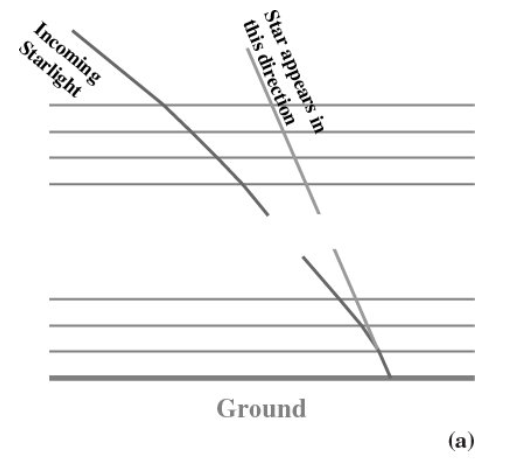
(a) Bending of a light ray as it passes through the atmosphere. The amount of bending is actually much less than in this picture.