A Friction
Lingual
(friction)
Etymology
From Latin frictiō ("a rubbing"), from fricāre ("to rub"), from Proto-Indo-European bʰreyH-* ("to cut, rub, scrape").
Meanings
- (physics) The force resisting the relative motion of solid surfaces, fluid layers, and material elements sliding against each other.
- The act of rubbing two bodies together.
- (figurative) Conflict, clash, or disagreement between persons, factions, or nations.
Synonyms
rubbing, resistance, conflict, tension, discord, dissension
Translations
Arabic: احْتِكَاك, خِلَاف
German: (die Reibung), (der Konflikt)
Norwegian Bokmål: (en friksjon), (en motstand), (en gnisning)
Linguistics
The English word friction and the Arabic فَرَكَ (faraka, the verb "to rub") and فَرْك (farak, the verbal noun "rubbing") share an uncanny phonetic and semantic alignment. Both are anchored by the consonant sequence f-r-k, and both describe the mechanical action of two surfaces grinding against each other.
Despite this near-perfect overlap, conventional historical linguistics treats them as parallel evolutionary tracks rather than direct descendants of a single recent ancestor.
The Indo-European Trajectory
The English term arrives via the 16th-century French friction, drawn directly from the Latin frictionem (a rubbing). This stems from the Latin verb fricare, meaning to rub or rub down.
- Morphological Extensions: Fricare is closely related to the Latin friare (to rub away, crumble into small pieces), which evolved into the English word friable (easily crumbled).
- Proto-Indo-European (PIE): These Latin terms are generally traced back to a PIE root, often reconstructed as bhreiH-* (to cut, break, or scrape), demonstrating an early semantic link between the physical act of rubbing and the resulting fragmentation of material.
The Semitic Trajectory
In Arabic, the root ف-ر-ك (f-r-k) specifically denotes rubbing, with the original or extended idea of rubbing a material until it separates or crumbles—such as rubbing an ear of wheat to remove the husk.
In comparative Semitic linguistics, this root is viewed as a triconsonantal extension of an older Proto-Semitic biliteral base. The biconsonantal framework p-r (or Arabic f-r) overwhelmingly relates to concepts of separating, parting, or breaking apart. The third consonant modifies the root to dictate the specific mechanical method of that separation:
| Root | Arabic | Core Meaning (The f-r base = "separation") |
|---|---|---|
| ف-ر-ك | f-r-k | Separation by rubbing or crumbling |
| ف-ر-ج | f-r-j | Separation by parting or opening |
| ف-ر-د | f-r-d | Separation by isolating or being alone |
| ف-ر-ز | f-r-z | Separation by sorting or detaching |
Convergent Evolution or Ancient Connection?
When an Indo-European root (fric-) and an Afroasiatic root (f-r-k) align so cleanly in both form and meaning, linguists generally point to two primary mechanisms:
- Phonesthesia (Sound Symbolism): The physical mechanics of producing these sounds mechanically mirror the physical action they describe. A voiceless fricative (blowing air for /f/ or /p/) followed by an alveolar trill (the vibrating /r/) and ending in a sharp, hard velar stop (/k/) acoustically mimics the scraping, grinding, and sudden breaking of rough surfaces. This sound-to-meaning mapping causes independent language families to organically build identical phonetic structures for abrasive forces.
- The Nostratic Hypothesis: Linguists who study deep macro-families argue that these are not independent inventions, but remnants of a pre-Neolithic "Boreal" or "Nostratic" proto-language. Under this debated framework, the PIE and Proto-Semitic forms are incredibly distant cousins that retained a shared ancient root for physical division and abrasion.
Physics
Friction is a force that resists the movement between two contacting surfaces that slide relative to one another. This force always acts tangent to the surface at the points of contact and is directed so as to oppose the possible or existing motion between the surfaces.
Angle of repose (slip angle)
An object on an inclinable plane
The Vector Decomposition
When the plane is horizontal (\(\theta = 0^\circ\)), the weight vector (\(W\)) points straight down, and the normal force (\(N\)) points straight up. \(N = W\), and there is no horizontal force trying to push the block, so friction (\(F_s\)) is zero.
Once the plane get inclined to an angle \(\theta\), the weight vector still points straight down to the center of the earth, but the plane itself has tilted. To solve the static equilibrium, we decompose the weight (\(W\)) into two components relative to the new tilted axis:
- Perpendicular to the plane: \(W \cos(\theta)\). This is the component of gravity pulling the block into the surface. Because the block isn't falling through the ramp, the normal force must perfectly balance this:
\[N = W \cos(\theta)\]
- Parallel to the plane: \(W \sin(\theta)\). This is the component of gravity pulling the block down the ramp. Because the block is still static, the friction force must perfectly oppose this to keep the sum of forces at zero:
\[F_s = W \sin(\theta)\]
The Proof of Proportionality
If you continue to slowly increase the angle \(\theta\), the parallel force pulling it down (\(W \sin(\theta)\)) gets stronger, and the normal force pushing it into the ramp (\(W \cos(\theta)\)) gets weaker.
Eventually, you hit a critical angle (\(\theta_s\)) where the block just starts to slip. At this exact threshold, the friction force has reached its absolute maximum limit, which is defined as
\[F_{max} = \mu_s N\]
If we substitute our equations into this limit state:
\[W \sin(\theta_s) = \mu_s (W \cos(\theta_s))\]
\[\mu_s = \frac{\sin(\theta_s)}{\cos(\theta_s)} = \tan(\theta_s)\]
This proves that the mass of the object doesn't matter; the point of slipping is determined entirely by the proportional relationship between friction and the normal force.
This elegant formula shows that the coefficient of static friction is exactly equal to the tangent of the angle at which the object begins to slide.
Dry Friction (Coulomb friction)
Dry friction is the resisting force that opposes the relative lateral motion of two solid, unlubricated surfaces in contact.
It is defined by three core properties:
- Directional Resistance: It always acts tangentially (parallel) to the contacting surfaces, in the exact opposite direction of the impending or active motion.
- Absence of Lubrication: It explicitly assumes there is no fluid, oil, or boundary layer separating the two solid bodies (unlike fluid friction).
- Proportionality to Normal Force: The maximum frictional force is directly proportional to the normal force pressing the two surfaces together, expressed by the equation \(F = \mu N\), where \(\mu\) is the coefficient of friction and \(N\) is the normal force.
Dry friction is further divided into two distinct regimes:
- Static Friction (\(\mu_s\)): The force that must be overcome to initiate movement. It builds continuously to match the applied pulling force until it reaches a maximum threshold (\(F_s = \mu_s N\)).
- Kinetic Friction (\(\mu_k\)): The constant force that resists the ongoing movement once the object is already sliding. It is almost always lower than the maximum static friction, which is why an object requires more force to start moving than to keep moving.
\[\mu _s \gt \mu _k\]
Origin of Friction
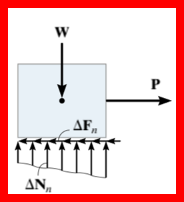
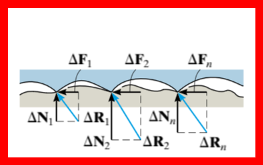
- The Microscopic Reality: No material is perfectly smooth. Under a microscope, both the bottom of the block and the floor look like jagged mountain ranges (called asperities). Because of this, the block doesn't sit flush against the floor; it only makes contact at the highest peaks.
- Reactive Forces (\(\Delta R_n\)): At every single point where those microscopic peaks crash into each other, the floor pushes back against the block. Because the peaks are jagged, this reactive force pushes back at an angle.
- Vector Decomposition: To make the physics workable, we break every single angled reactive force down into two standard components:
- \(\Delta N_n\) (Normal Force): The vertical component that pushes straight up to support the block's weight (\(W\)).
- \(\Delta F_n\) (Frictional Force): The horizontal component that resists the pulling force (\(P\)).
- The "Uneven" Distribution: When you pull horizontally on the block, it naturally wants to pitch forward. To keep the block in equilibrium and prevent it from rotating, the microscopic normal forces (\(\Delta N_n\)) shift and become much stronger toward the front edge of the block.
Translating this to Statics
This paragraph transitions from the forces of sliding to the mechanics of tipping (moment equilibrium). It explains why a block might tip over before it ever has a chance to slide, depending on where you push it.
Here is a breakdown of what the text is explaining about the shifted normal force:
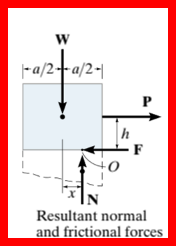
- The Tipping Moment: When you apply a pulling force (\(P\)) at a certain height (\(h\)) above the surface, you aren't just trying to drag the block forward. You are also creating a moment (torque) that wants to rotate the block forward around its front bottom corner.
- The Counter-Moment: To prevent the block from tipping, the surface must provide an opposing moment. It does this by shifting the resultant normal force (\(N\)) forward by a distance \(x\) from the center of gravity.
- Moment Equilibrium: For the block to remain perfectly stable (not rotating), the overturning moment (\(P \times h\)) must be exactly equal to the stabilizing moment caused by the shifted normal force and gravity (\(W \times x\)).
This gives us the equilibrium equation:
\[W x = P h\]
Solving for \(x\), we find how far the normal force must shift to keep the block flat:
\[x = \frac{P h}{W}\]
Tipping vs. Sliding
This shift (\(x\)) is the key to determining if an object will tip over before it slides.
The normal force can only shift as far forward as the physical edge of the block. If the block has a total width \(a\), the maximum distance \(x\) can shift from the center is \(a/2\).
- If \(x < a/2\): The normal force shifts enough to balance the torque. The block remains flat, and if you keep pulling harder, it will eventually slide.
- If \(x > a/2\): The math requires the normal force to shift completely outside the block's physical footprint to maintain equilibrium. This is physically impossible. The stabilizing moment fails, and the block tips over.
When you are solving a structural mechanics problem, you don't draw thousands of microscopic arrows. You integrate them.
You sum up all the tiny \(\Delta F_n\) horizontal components into one total Frictional force (\(F = \mu_s N\)), and all the tiny \(\Delta N_n\) vertical components into one resultant Normal force (\(N\)). Because of the uneven distribution mentioned above, that resultant Normal force (\(N\)) doesn't act perfectly in the center—it shifts forward by a distance \(x\) to counteract the tipping moment caused by pulling force \(P\).
The limiting Static Frictional Force.
In cases where the surfaces of contact are rather “slippery,” the frictional force F may not be great enough to balance P, and consequently the block will tend to slip. In other words, as P is slowly increased, F correspondingly increases until it attains a certain maximum value \(F_s\), called the limiting static frictional force.
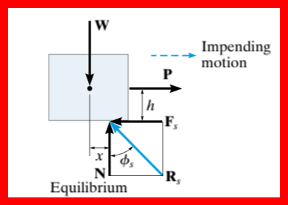
\[F_s=\mu _s N\]
where the constant of proportionality, \(\mu _s\)(mu “sub” s), is called the coefficient of static friction. Thus, when the block is on the verge of sliding, the normal force N and frictional force \(F_s\)combine to create a resultant \(R_s\). The angle \(\phi _s\)(phi “sub” s) that Rs makes with N is called the angle of static friction.