A Diffraction
https://en.wikipedia.org/wiki/Diffraction
Astrophysics:
Diffraction is the bending or spreading of waves when they strike a barrier or pass through an aperture. As they spread out, waves from different parts of the aperture or barrier interfere with one another, producing maxima and minima.
As the aperture size, relative to the wavelength, increases, there are more waves to interfere, so the pattern is less spread out. Most of the power is in the central maximum, whose angular width Δθ (in radians) is related to the wavelength of the wave λ and the diameter of the aperture, D, by:
\[\Delta \theta \approx \lambda /D\]
Diffraction results in the images of stars being smeared out by this angle. That means that if two stars are closer than Δθ, their images will blend together.
We consider the images of two stars to just be resolved when the maximum of one diffraction pattern falls on the first minimum of the other. This condition is called the Rayleigh criterion. While the previous equation is an approximation good for all shapes of aperture, the actual size of the diffraction pattern depends on the shape of the aperture. For circular apertures, the resolution is given by:
\[\Delta \theta =1.22\ \lambda /D\]
This equation shows that the resolution can be improved by using a larger aperture. A larger telescope will give better resolution.
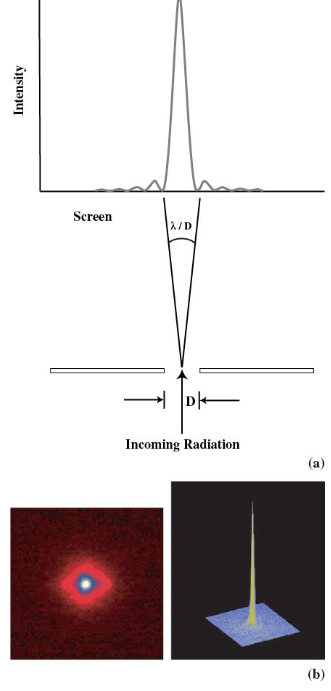
(a) A light ray enters from the bottom, and passes through a slit of length D. Diffraction spreads the beam out and it falls on a screen. The intensity as a function of position on the screen is shown at the top. Most of the energy is in the main peak, whose angular width is approximately λ/D (in radians). Smaller peaks occur at larger angles. (b) The effect in a real image.