A Sum
Lingual
- A quantity obtained by addition or aggregation.
- (often plural) An arithmetic computation, especially one posed to a student as an exercise (not necessarily limited to addition).
- A quantity of money.
- A summary; the principal points or thoughts when viewed together; the amount; the substance; compendium.
- A central idea or point.
- The utmost degree.
- (obsolete) An old English measure of corn equal to the quarter.
Synonyms
- (quantity obtained by addition or aggregation): amount, sum total, summation, total, totality
- (arithmetic computation): calculation, computation
- (quantity of money): amount, quantity of money, sum of money
- (summary): See summary
- (central idea or point): center/centre, core, essence, gist, heart, heart and soul, inwardness, kernel, marrow, meat, nub, nitty-gritty, pith substance
- (utmost degree): See summit
- (obsolete: old English measure of corn): quarter
Hyponyms
Mathematics
Calculus
Riemann Sum
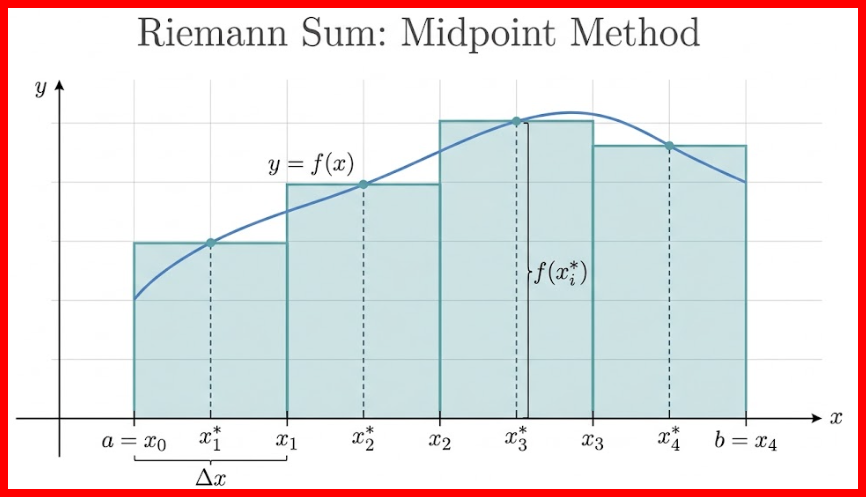
A Riemann sum is a method for approximating the total area under a curve by dividing a region into simpler geometric shapes—typically rectangles—and summing their areas. It forms the foundational definition of the definite integral in calculus.
To approximate the area under a continuous function \(f(x)\) across the closed interval \([a, b]\):
- Partition the interval into \(n\) sub-intervals of equal width:
\[\Delta x = \frac{b - a}{n}\]
- Select sample points \(x_i^*\) within each sub-interval \([x_{i-1}, x_i]\).
- Sum the rectangular areas:
\[S = \sum_{i=1}^{n} f(x_i^*) \Delta x\]
As the number of sub-intervals approaches infinity (\(n \to \infty\)), the width \(\Delta x \to 0\), giving the exact definite integral:
\[\int_{a}^{b} f(x) \, dx = \lim_{n \to \infty} \sum_{i=1}^{n} f(x_i^*) \Delta x\]
Common Variants
The choice of sample point \(x_i^*\) determines the type of Riemann sum:
- Left Riemann Sum (\(L_n\)): Takes the left endpoint of each subinterval:
\[x_i^* = a + (i - 1)\Delta x\]
- Right Riemann Sum (\(R_n\)): Takes the right endpoint:
\[x_i^* = a + i\Delta x\]
- Midpoint Rule (\(M_n\)): Evaluates the function at the center of each interval:
\[x_i^* = \frac{x_{i-1} + x_i}{2} = a + \left(i - \frac{1}{2}\right)\Delta x\]
- Trapezoidal Rule: Averages the left and right sums, approximating each slice with a trapezoid rather than a flat rectangle:
\[T_n = \frac{L_n + R_n}{2} = \frac{\Delta x}{2} \left[ f(x_0) + 2f(x_1) + 2f(x_2) + \dots + f(x_n) \right]\]
Over- vs. Under-Estimation
For monotonic functions, the shape of the curve dictates whether an endpoint sum over- or under-estimates the true area:
| Function Behavior | Left Sum (\(L_n\)) | Right Sum (\(R_n\)) |
|---|---|---|
| Strictly Increasing (\(f'(x) > 0\)) | Underestimate | Overestimate |
| Strictly Decreasing (\(f'(x) < 0\)) | Overestimate | Underestimate |
For the Midpoint and Trapezoidal rules, estimation error depends on curvature (concavity):
- If concave up (\(f''(x) > 0\)), the Midpoint rule underestimates while the Trapezoidal rule overestimates.
- If concave down (\(f''(x) < 0\)), the Midpoint rule overestimates while the Trapezoidal rule underestimates.