A Supernova
Core evolution of high mass stars
In the core of a high-mass star, the accumulation of heavier elements, notably iron (56Fe), occurs. Iron's high binding energy per nucleon makes it the most stable nucleus, requiring energy input for any reaction involving 56Fe, be it fission or fusion. When the entire core mass is converted to stable elements like 56Fe and nickel, nuclear reactions cease. Subsequently, the core cools, and if its iron mass exceeds the Chandrasekhar limit, electron degeneracy pressure can no longer support it, leading to collapse. During collapse, liberated gravitational potential energy is used by 56Fe, preventing a rise in core temperature. A runaway collapse ensues as iron and nickel consume liberated energy, leading to the destruction of iron and the liberation of protons. Electrons combine with these protons to form neutrons and neutrinos:
\[e^-+\ ^1H\rightarrow \ n+\nu\]
The core is driven to a very dense state in a short time, about one second. What happens next is not completely understood, but the collapse results in an explosion in which most of the mass of the star is blown away. The neutrons created in last reaction probably play a role in this. They also obey the exclusion principle, and exert a degeneracy pressure. This pressure can stop the collapse and cause the material to bounce back. In addition, so many neutrinos are created, and the material is so dense, that a sufficient number of neutrinos interact with the matter forcing the material outward.
Such an exploding star is called a supernova. This type of supernova is actually called a type II supernova. Another type of supernova, type I, seems to be associated with older objects in the galaxy. (The mechanism for type I supernovae probably involves white dwarfs in close binary systems.) During the explosion, nuclear reactions take place very rapidly, and elements much heavier than iron are created. This material is then spread out into interstellar space, along with the results of the normal nucleosynthesis during the main sequence life of the star. This enriched material is then incorporated into the next generation of stars.
The light from a supernova explosion can exceed that of an entire galaxy. The energy output in a type II supernova is very high. A fracture of this shows up as kinetic energy of the shell, another fracture as light. (Most of the energy is in the escaping neutrinos.) After a rapid increase in brightness, the supernova fades gradually, on a time scale of several months.
Supernova remnants
The material expelled during a supernova explosion forms a structure known as a supernova remnant, containing most of the original star's material.
Young remnants display visible expansion of ejected material, playing a crucial role in spreading nucleosynthesis products, enriched in metals, throughout the interstellar medium. This enrichment contributes to the higher metal abundance in recently formed stars compared to older ones in the galaxy.
A Synchrotron radiation
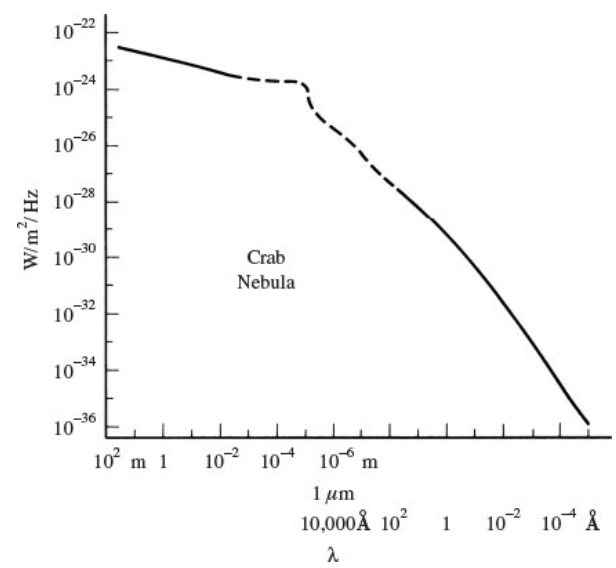
Supernova remnants typically exhibit strong magnetic fields and house high-energy electrons. These electrons, moving in a magnetic field, emit synchrotron radiation due to their accelerated motion. The Crab Nebula is a well-studied example of a supernova remnant, with all its radiation being synchrotron radiation.
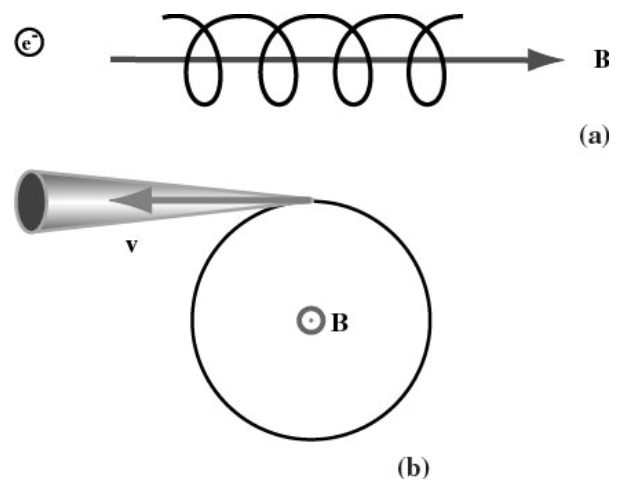
(a) Electrons spiral around magnetic field lines. (b) In their circular motion, they are constantly accelerating, and therefore give off radiation. At any instant, most of the radiation is emitted in a small cone centered on the velocity of the electron. The beaming of the radiation is a relativistic effect.
Synchrotron radiation is distinctive for its polarized nature across various wavelengths, and it follows a power law spectrum, with most energy emitted at long wavelengths. Despite the expectation that high-energy electrons should rapidly lose their energy, synchrotron radiation from these electrons in supernova remnants persists for extended periods, such as observed 1000 years after the supernova explosion in the case of the Crab Nebula.