Falmari, Falathrim
| Falmari | Falmari |
|---|---|
| People | People |
[ ](http://tolkiengateway.net/wiki/File:Ted_Nasmith_-_The_Ships_of_the_Teleri_Drawn_by_Swans.jpg) | [](http://tolkiengateway.net/wiki/File:Ted_Nasmith_-_The_Ships_of_the_Teleri_Drawn_by_Swans.jpg) |
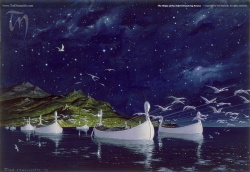
| "The Ships of the Teleri Drawn by Swans" by Ted Nasmith | "The Ships of the Teleri Drawn by Swans" by Ted Nasmith |
| General Information | General Information |
| Pronunciation | Q, [ˈfalmari] |
| Other names | Sea-elves, Teleri of Valinor |
| Origins | Teleri who completed the Great Journey into Aman |
| Locations | Alqualondë, Tol Eressëa |
| Languages | Telerin |
| Members | Olwë, Eärwen |
| Physical Description | Physical Description |
| Lifespan | Immortal |
| Distinctions | Great singers and mariners |
| Hair color | Dark, sometimes silver |
| Gallery | Images of Falmari |
The Falmari were the Teleri who followed the Great Journey into Beleriand and reached Valinor.[1][2]
Contents[hide] |
[edit] Origins
[ ](http://tolkiengateway.net/wiki/File:Steamey_-_Oss%C3%AB_and_the_Teleri.jpg)
[ ](http://tolkiengateway.net/wiki/File:Steamey_-_Oss%C3%AB_and_the_Teleri.jpg "Enlarge")
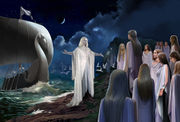
Ossë and the Teleri by Steamey
Main article: Lindar
The Teleri were the most numerous Elven clan and also the most slow and reluctant of the Great Journey; many turned back or stayed behind. Their leaders were the brothers Elwë and Olwë, but when Elwë became lost in Beleriand, many of his people refused to carry on to Aman until he had been found; it was Olwë who led the rest to the shores of Beleriand.[1]
As they waited for Ulmo's floating island, they lingered at the Bay of Balar where they were befriended and taught by Ulmo's vassal, Ossë. When Ulmo returned to take the bulk of the Teleri with Olwë to the West, Ossë convinced some of them to forsake Valinor and stay behind with him. These afterwards became the Falathrim.[1]
[edit] History
As Ulmo ferried the floating island to the West, the Teleri again heard Ossë's song and begged Ulmo to stop off the shore, which he did. Ossë fastened the island to the bottom, and it became Tol Eressëa, the lonely isle off the Bay of Eldamar. These Teleri became known as Falmari and their language eventually diverged from that of the Vanyar and the Noldor.[1]
However soon the Falmari of the island longed for the splendour and Light of Valinor and wished to see their kindred there, the Vanyar and the Noldor. Grieving, Ossë submitted to the will of the Valar and Ulmo, and taught them ship-building and offered them swans to draw them to Valinor. There they built the city haven of Alqualondë with Olwë their king.[1]
[ ](http://tolkiengateway.net/wiki/File:Ted_Nasmith_-_Alqualond%C3%AB.jpg)
[ ](http://tolkiengateway.net/wiki/File:Ted_Nasmith_-_Alqualond%C3%AB.jpg "Enlarge")
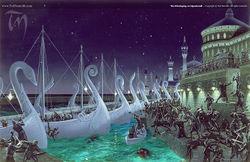
"The Kinslaying at Alqualondë" by Ted Nasmith
The Teleri were mostly close to the Noldor. However during the Flight of the Noldor, the Telerin mariners refused to join the host of Feanor in leaving Valinor. They attempted to protect their swan-ships from the Noldor, however they were armed only with bows. Many of them were cruelly slain in the Kinslaying at Alqualondë.[3]
In the later years of the First Age, Alqualonde was visited by Eärendil and Elwing who had reached Valinor. Elwing stayed a little there and told stories to the Teleri about the griefs of Beleriand and they were filled with pity and wonder. Because of their bitterness against the Noldor few or none of the Teleri joined the Host of the Valar which set out to capture Morgoth for good.[4]
After the War of Wrath, the Elves of Middle-earth were admitted to the Lonely Isle and Valinor. The Teleri eventually forgave the Ñoldor for the Kinslaying, the Curse of Mandos was lifted and the two kindreds were at peace again.[4]
[edit] Culture
Having been taught by Ossë, the Teleri were masters of music, the sea and shipbuilding, and they used Swan-ships. When the Falmari reached Eldamar, they were close to the Noldor, who offered them many jewels and crystals, which they used to adorn their pools and beaches; the Falmari prized the pearls which they found from the sea and used for their halls.[1] The Teleri also prized silver (which they called telpe) above gold.[5]
Although they spoke a different language, the closeness of the two peoples resulted in a sprachbund, and the speech of the Noldor had some influence from Telerin.[6]
[edit] Etymology
Falmari is Quenya meaning "wave-folk"[7] and contains the word falma "wave".[8]
The name "Falmari" (which is preferred in this article) is found only once[1] in the published Silmarillion, where the Teleri of Aman are mostly known as 'the Teleri' (obviously representing the Noldorin point of view); however the Teleri of Aman were properly just the branch of the Telerin clan.[2]
In one text, the names Falmari (Quenya) and Falathrim (Sindarin) both refer to the people of Círdan in Beleriand[7] however elsewhere, as well as in the published Silmarillion, the Quenya name refers to those in Valinor,[9][2] and the Sindarin name to those of the Falas.[2]
[edit] Other versions of the legendarium
In the early versions of Tolkien's mythology (see: The Book of Lost Tales), they were known as Solosimpi ("Pipers of the Shores"), while the name Teleri was given to the clan of Elves known in the published version of The Silmarillion as Vanyar.
Other early names for the Teleri were Soloneldi (before being altered to "Falmari")[9] and Falmarindi meaning "foam-riders".[10]
| Vanyar (Fair-elves · Minyar) · Noldor (Deep-elves · Tatyar) · Teleri (Lindar · Nelyar) | |
|
(High-elves · Amanyar) | Vanyar · Noldor · Falmari |
| Úmanyar: | Sindar (Grey-elves · Eglath · Falathrim) · Nandor (Green-elves · Silvan Elves) |
| Moriquendi: | Úmanyar · Avari (Dark Elves · The Unwilling) |
| See also: | Awakening of the Elves · Sundering of the Elves · Great Journey |
References
- ↑ 1.0 1.1 1.2 1.3 1.4 1.5 1.6 J.R.R. Tolkien, Christopher Tolkien (ed.), The Silmarillion, "Quenta Silmarillion: Of the Coming of the Elves and the Captivity of Melkor"
- ↑ 2.0 2.1 2.2 2.3 J.R.R. Tolkien, Christopher Tolkien (ed.), The Silmarillion, "Index of Names"
- ↑ J.R.R. Tolkien, Christopher Tolkien (ed.), The Silmarillion, "Quenta Silmarillion: Of the Flight of the Noldor"
- ↑ 4.0 4.1 J.R.R. Tolkien, Christopher Tolkien (ed.), The Silmarillion, "Quenta Silmarillion: Of the Voyage of Eärendil and the War of Wrath"
- ↑ J.R.R. Tolkien, Christopher Tolkien (ed.), Unfinished Tales, "The History of Galadriel and Celeborn", "Appendix E: The Names of Celeborn and Galadriel"
- ↑ J.R.R. Tolkien, Christopher Tolkien (ed.), The Peoples of Middle-earth, "XI. The Shibboleth of Fëanor"
- ↑ 7.0 7.1 J.R.R. Tolkien, Christopher Tolkien (ed.), The Peoples of Middle-earth, "XIII. Last Writings"
- ↑ J.R.R. Tolkien, Christopher Tolkien (ed.), The Silmarillion, "Appendix: Elements in Quenya and Sindarin Names"
- ↑ 9.0 9.1 J.R.R. Tolkien, Christopher Tolkien (ed.), Morgoth's Ring, "Part Three. The Later *Quenta Silmarillion*: (I) The First Phase: 3. Of the Coming of the Elves"
- ↑ J.R.R. Tolkien, Christopher Tolkien (ed.), The Lost Road and Other Writings, "Appendix: II. The List of Names"
| Falathrim | Falathrim |
|---|---|
| People | People |
[ ](http://tolkiengateway.net/wiki/File:Liz_Danforth_-_Falathrim.png) | [](http://tolkiengateway.net/wiki/File:Liz_Danforth_-_Falathrim.png) |
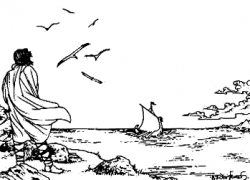
| Falathrim by Liz Danforth | Falathrim by Liz Danforth |
| General Information | General Information |
| Other names | Elves of the Falas |
| Origins | Teleri persuaded by Ossë to remain by the Sea in Middle-earth |
| Locations | The Havens of the Falas: Brithombar and Eglarest (occupied the western shorelands of Beleriand, around the mouths of the Rivers Brithon and Nenning) |
| Languages | Falathrin |
| Members | Círdan, Voronwë |
| Physical Description | Physical Description |
| Lifespan | Immortal |
The Falathrim were the shoreland Elves of the western shores of the Middle-earth who took Círdan as their lord from the beginning. They dwelt mainly in the ancient havens of Eglarest and Brithombar of the Falas, and their last home on Middle-earth before finally leaving for the Undying Lands was the Grey Havens.
Contents[hide] |
[edit] History
The Teleri were the most numerous Elven clan and for this reason they were led by two brothers, Elwë and Olwë in the Great Journey to Aman. They were also the most slow and reluctant and many turned back or stayed behind. When Elwë became lost in Beleriand, many of his people refused to carry on until he had been found; those were named Eglath, the forsaken.
It was Olwë who led the rest to the shores of Beleriand. As they lingered at the Bay of Balar they were befriended and taught by Ulmo's vassal, the Maia Ossë. When Ulmo returned with the floating island to take the bulk of the Teleri to the West, Ossë convinced some of them to forsake Valinor and the other Elves and stay behind with him.[1]
These became the Falathrim, and their leader was Nowë[2], kin of both Elwë and Olwë, who stayed behind despite his great eagerness to see the light of Valinor.[3] He was later known as Círdan. The Falathrim settled on Beleriand's western shores, building themselves Havens at Brithombar and Eglarest and became the first builders and sailors of ships in Middle-earth's history.
When Elwë returned, he established the Kingdom of Doriath, claiming overlordship of all Beleriand as King Elu Thingol. The Falathrim, along with the Eglath, were considered Sindar, and found many pearls that they sent to him as gifts.[4]
After the Return of the Noldor, the Elves of the Falas became fast in friendship with the Deep Elves. Círdan attended the Mereth Aderthad with many of his people, where he swore oaths of friendship.[5] With Finrod's aid, the Havens of the Falas were strengthened and rebuilt. The Elves of the Havens enjoyed peaceful relations with all the Elves of Beleriand, and were particularly closely allied with the people of Nargothrond. As one of the most remote peoples from Morgoth's forces in Angband, the other Elvish lords would often send their children to the Elves of the Havens for safekeeping.
They fought beside the Noldor, too: in the Dagor Bragollach ("Battle of Sudden Flame"), their mariners rescued High King Fingon from overwhelming hordes in Hithlum, and they went to the aid of Fingon again at the Nirnaeth Arnoediad ("Battle of Unnumbered Tears"). After that disaster, many of the survivors fled back to the Havens of the Falas, but they were not safe there for long. A year after the great defeat, Morgoth sent his creatures to besiege them, and both the Havens were overthrown. Most of the Elves of the Falas perished in the fall of the Havens, or were captured, but Círdan escaped. With his surviving followers and the young Ereinion Gil-galad, who was at that time lodging with the people of the Havens, he sailed southwards, and settled for a time on the Isle of Balar maintaining a haven.
As Morgoth's power overwhelmed the Eldar (perhaps soon after the Nirnaeth), some "seafaring Sindar from the west havens" fled with 3 small ships to the east. They ended up at the confluence of Morthond and Ringló. There they established Edhellond and were eventually joined by their Telerin kin, Silvan Elves from the north.[6][7]
During the War of Wrath, Círdan and Gil-galad sailed east to Lindon where Cirdan founded the Grey Havens on the newly formed Gulf of Lhûn, and the remnant of the Elves of the Havens must surely have accompanied him.
[edit] Etymology
Falathrim is a Sindarin name containing the word Falas. It means "Coast people".[8]
In one text, the names Falmari (Quenya) and Falathrim (Sindarin) both refer to the people of Círdan in Beleriand[9] however elsewhere and in the published Silmarillion, the Quenya name refers to those in Valinor,[10][11] and the Sindarin name to those of the Falas.[11]
[edit] Other names
The people of Círdan retained their name as Teleri and were known in Sindarin as Telir or Telerrim.[9]
Another name for the Falathrim was the Egladhrim, or the Eglain, a Sindarin name meaning "The Forsaken". While originally used as a name for the Sindar by themselves, it came to refer only to the Elves of the Falas, as distinguished from the "inland Elves" of Beleriand.[12]
References
- ↑ J.R.R. Tolkien, Christopher Tolkien (ed.), The Silmarillion, "Quenta Silmarillion: Of Eldamar and the Princes of the Eldalië"
- ↑ J.R.R. Tolkien, Christopher Tolkien (ed.), The Peoples of Middle-earth, "XIII. Last Writings", "Círdan", note 30
- ↑ J.R.R. Tolkien, Christopher Tolkien (ed.), The Peoples of Middle-earth, "XIII. Last Writings", "Círdan"
- ↑ J.R.R. Tolkien, Christopher Tolkien (ed.), The Silmarillion, "Quenta Silmarillion: Of the Sindar"
- ↑ J.R.R. Tolkien, Christopher Tolkien (ed.), The Silmarillion, "Quenta Silmarillion: Of Beleriand and its Realms"
- ↑ J.R.R. Tolkien, Christopher Tolkien (ed.), The Peoples of Middle-earth, "X. Of Dwarves and Men", "Notes", #67
- ↑ J.R.R. Tolkien, Christopher Tolkien (ed.), The Peoples of Middle-earth, "X. Of Dwarves and Men", "The Atani and their Languages"
- ↑ Robert Foster, The Complete Guide to Middle-earth, entry "Falathrim"
- ↑ 9.0 9.1 J.R.R. Tolkien, Christopher Tolkien (ed.), The Peoples of Middle-earth, "XIII. Last Writings"
- ↑ J.R.R. Tolkien, Christopher Tolkien (ed.), Morgoth's Ring, "Part Three. The Later *Quenta Silmarillion*: (I) The First Phase: 3. Of the Coming of the Elves"
- ↑ 11.0 11.1 J.R.R. Tolkien, Christopher Tolkien (ed.), The Silmarillion, "Index of Names"
- ↑ J.R.R. Tolkien, Christopher Tolkien (ed.), The War of the Jewels, "Part Four. Quendi and Eldar", pp. 365, 379-80