Elenwë
| Elenwë | Elenwë |
|---|---|
| Vanya | Vanya |
[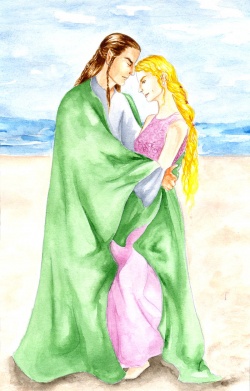 ](http://tolkiengateway.net/wiki/File:Marya_Filatova_-_Turukano_and_Elenwe.jpg) | [](http://tolkiengateway.net/wiki/File:Marya_Filatova_-_Turukano_and_Elenwe.jpg) |
| "Turukano and Elenwe" by Marya Filatova | "Turukano and Elenwe" by Marya Filatova |
| Biographical Information | Biographical Information |
| Pronunciation | Q, [eˈlenwe] |
| Location | Tirion |
| Language | Vanyarin |
| Death | |
| Family | Family |
| Spouse | Turgon |
| Children | Idril |
| Physical Description | Physical Description |
| Gender | Female |
| Hair color | Golden |
| Gallery | Images of Elenwë |
Elenwë was the wife of Turgon and the mother of Idril Celebrindal. She was one of the Vanyar, and her golden hair passed to her daughter.[2]
[edit] History
She followed her family to the departure of the Noldor from Aman. After Fëanor and his sons departed using the only ships, Fingolfin and Turgon took their people across the dangerous Helcaraxë, during which Elenwë was lost in the crossing, right before the Noldor returned to Middle-earth.[3][4] She and her daughter Idril fell into the bitter waters, and Turgon risked his life to save them. But he only could save Idril, and Elenwë was covered in fallen ice. Therefore, Turgon was thereafter always enemisted with the House of Fëanor.[5]
Elenwë is the only known full Vanya who accompanied the Flight of the Noldor and came under the Doom of Mandos. As she died before reaching Middle-earth, no Vanya is specifically known to have returned to Middle-earth (excepting the Host of the Valar of the War of Wrath, which however went home to Valinor).
[edit] Etymology
[ ](http://tolkiengateway.net/wiki/File:Quenya_-_Elenw%C3%AB.mp3 "File:Quenya - Elenwë.mp3") | *Quenya - Elenwë.mp3* |
|---|---|
| By Gilgamesh. (Help; more articles) | By Gilgamesh. (Help; more articles) |
The name contains elen meaning "star". The ending -wë means "person" and is peculiar since it is seen mostly in masculine names, being the male equivalent of -iel.[6]
[edit] Genealogy
|
b. Y.T. | ||||||||||||||||||||||||||||||
|---|---|---|---|---|---|---|---|---|---|---|---|---|---|---|---|---|---|---|---|---|---|---|---|---|---|---|---|---|---|---|
|
b. Y.T. |
b. Y.T. |
b. Y.T. | ||||||||||||||||||||||||||||
ELENWË | ||||||||||||||||||||||||||||||
|
b. Y.T. | ||||||||||||||||||||||||||||||
[edit] Other versions of the legendarium
Originally the name of Turgon's wife was Alairë - later corrected by Tolkien in 1970 to Anairë - who would not leave Valinor. Anairë became Fingolfin's spouse whilst Elenwë became Turgon's in genealogies.[7]
[edit] See also
References
- ↑ J.R.R. Tolkien, Christopher Tolkien (ed.), The War of the Jewels, "The Grey Annals": §52
- ↑ J.R.R. Tolkien, Christopher Tolkien (ed.), The Silmarillion, "Quenta Silmarillion: Of the Noldor in Beleriand"
- ↑ J.R.R. Tolkien, Christopher Tolkien (ed.), The Silmarillion, "Quenta Silmarillion: Of the Flight of the Noldor"
- ↑ J.R.R. Tolkien, Christopher Tolkien (ed.), The Silmarillion, "Quenta Silmarillion: Of Maeglin"
- ↑ J.R.R. Tolkien, Christopher Tolkien (ed.), The Peoples of Middle-earth, "XI. The Shibboleth of Fëanor", "The names of Finwë's descendants", pp. 343-344
- ↑ J.R.R. Tolkien, "Words, Phrases and Passages in Various Tongues in The Lord of the Rings: Eldarin Roots and Stems", in *Parma Eldalamberon* XVII (edited by Christopher Gilson), p. 23
- ↑ J.R.R. Tolkien, Christopher Tolkien (ed.), The War of the Jewels, "Part Three. The Wanderings of Húrin and Other Writings not forming part of the Quenta Silmarillion: III. Maeglin", p. 323