Rían
| Rían | Rían |
|---|---|
| Adan | Adan |
[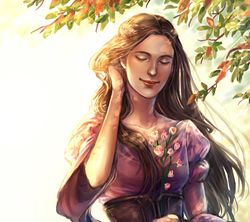 ](http://tolkiengateway.net/wiki/File:ForeverMedhok_-_Rian.jpg) | [](http://tolkiengateway.net/wiki/File:ForeverMedhok_-_Rian.jpg) |
| "Rian" by ForeverMedhok | "Rian" by ForeverMedhok |
| Biographical Information | Biographical Information |
| Location | Ladros |
| Birth | F.A. 450 |
| Death | |
| Family | Family |
| House | House of Bëor |
| Parentage | Belegund |
| Spouse | Huor |
| Children | Tuor |
| Physical Description | Physical Description |
| Gender | Female |
| Gallery | Images of Rían |
"Ar·phent Rían Tuor·na: man agorech?"― "Túrin Wrapper"
Rían was the daughter of Belegund of the House of Bëor,[1] the wife of Huor of the House of Hador, and the mother of Tuor.[2] Rían was said to be gentle of heart, a lover of trees and wild flowers, and was known as a singer and maker of songs.[3]
Contents[hide] |
[edit] History
Rían was born in F.A. 450.[4] She was only a young girl when the Dagor Bragollach erupted and was lost by Elves and Men in 455. In the wake of the defeat, her father Belegund became a companion of Barahir, who contested Morgoth's dominion over Dorthonion. But by 456, as Morgoth tightened his grip upon the land, Rían was led to safety with the other women and children by Emeldir, the wife of Barahir.[5] The refugees eventually reached Dor-lómin by way of Brethil.[6]
In F.A. 472, Rían wedded Huor of the House of Marach,[7] whose brother Húrin was married to Rían's cousin Morwen.[1] They had been married for only two months when Huor joined Húrin and left to fight in the Nirnaeth Arnoediad.[8]
[ ](http://tolkiengateway.net/wiki/File:Alan_Lee_-_R%C3%ADan_searches_the_Hill_of_Slain.png)
[ ](http://tolkiengateway.net/wiki/File:Alan_Lee_-_R%C3%ADan_searches_the_Hill_of_Slain.png "Enlarge")
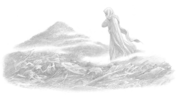
Rían searches the Hill of Slain by Alan Lee
In the Nirnaeth Arnoediad Huor was slain in the rearguard of King Turgon. His body, along with that of many Elves and Men, went into a great hill in the midst of Anfauglith which thereafter was called the Haudh-en-Nirnaeth.[9]
Rían, having heard no word of her husband's fate, went into the wild seeking tidings. She gave birth to a son, Tuor, and committed him to the care of Annael of the Elves of Mithrim. Rían made her way to Haudh-en-Nirnaeth and died of grief upon the mound.[8] She was only 22 years old when she died.
[edit] Etymology
Rían is Sindarin for "Crown-gift", from rî ("crown, garland") + ann ("gift").[10]
[edit] Genealogy
|
b. 386 |
b. 397 |
b. 406 | |||||||||||||||||||||||||||||
|
b. 417 | |||||||||||||||||||||||||||||||
RÍAN |
d. 506 |
d. 506 |
d. 506 |
d. 506 |
d. 506 |
d. 506 |
d. 506 |
d. 506 |
d. 506 |
d. 506 |
d. 506 |
d. 506 |
d. 506 |
d. 506 |
d. 506 |
d. 506 |
d. 506 |
d. 506 | |||||||||||||
|
b. 472 |
b. Y.T. | ||||||||||||||||||||||||||||||
|
b. 503 | |||||||||||||||||||||||||||||||
[edit] Other versions of the legendarium
In an early version of the Grey Annals the wife of Belegund and Rían were in Hithlum when the Dagor Bragollach occurred and thus they did not have to escape from Dorthonion. This was superseded by the story of Emeldir and her escape with the women and children from the highlands.[11]
In the Grey Annals, the year of Rían's marriage to Huor was F.A. 471 in one paragraph,[12] yet in the year 472 it is said that they wedded in the first days of spring and that Huor was summoned to battle two months later.[7] In The Silmarillion the latter version was used.
References
- ↑ 1.0 1.1 J.R.R. Tolkien, Christopher Tolkien (ed.), The War of the Jewels, "Part Two. The Later Quenta Silmarillion: Of the Coming of Men into the West (Chapter 14)", (i) The House of Bëor, p. 231
- ↑ J.R.R. Tolkien, Christopher Tolkien (ed.), The War of the Jewels, "Part Two. The Later Quenta Silmarillion: Of the Coming of Men into the West (Chapter 14)", (ii) The House of Hador, p. 234
- ↑ J.R.R. Tolkien, Christopher Tolkien (ed.), The Children of Húrin, "The Childhood of Túrin", p. 34
- ↑ J.R.R. Tolkien, Christopher Tolkien (ed.), The War of the Jewels, "The Grey Annals": §144
- ↑ J.R.R. Tolkien, Christopher Tolkien (ed.), The War of the Jewels, "The Grey Annals": §159
- ↑ J.R.R. Tolkien, Christopher Tolkien (ed.), The Silmarillion, "Quenta Silmarillion: Of the Ruin of Beleriand and the Fall of Fingolfin"
- ↑ 7.0 7.1 J.R.R. Tolkien, Christopher Tolkien (ed.), The War of the Jewels, "The Grey Annals": §218
- ↑ 8.0 8.1 J.R.R. Tolkien, Christopher Tolkien (ed.), The Silmarillion, "Quenta Silmarillion: Of Túrin Turambar"
- ↑ J.R.R. Tolkien, Christopher Tolkien (ed.), The Silmarillion, "Quenta Silmarillion: Of the Fifth Battle: Nirnaeth Arnoediad"
- ↑ J.R.R. Tolkien, Christopher Tolkien (ed.), The Lost Road and Other Writings, Part Three: "The Etymologies", entry "RIG"
- ↑ J.R.R. Tolkien, Christopher Tolkien (ed.), The War of the Jewels, "The Grey Annals": Note on §159
- ↑ J.R.R. Tolkien, Christopher Tolkien (ed.), The War of the Jewels, "The Grey Annals": §216