False Turning email
Q&A False Turning
Players should announce their intention to turn. Opponents should clear to the side walls.
The scenario described here was a network match with no officials. The players are experienced at the league level.
Donna anticipates that Niki’s lob will come out of the back corner wide and announces turning. The ball stays closer to the side wall than expected, and Donna decides not to turn, but plays the ball on their forehand.
Bruce clears to the side wall when Donna announces “turning”. Bruce is stuck on the side wall.
Donna’s shot is a winner.
The false turning puts Yellow at a disadvantage.
Situation in diagrams
Niki hits a cross-court lob headed to the deep right corner.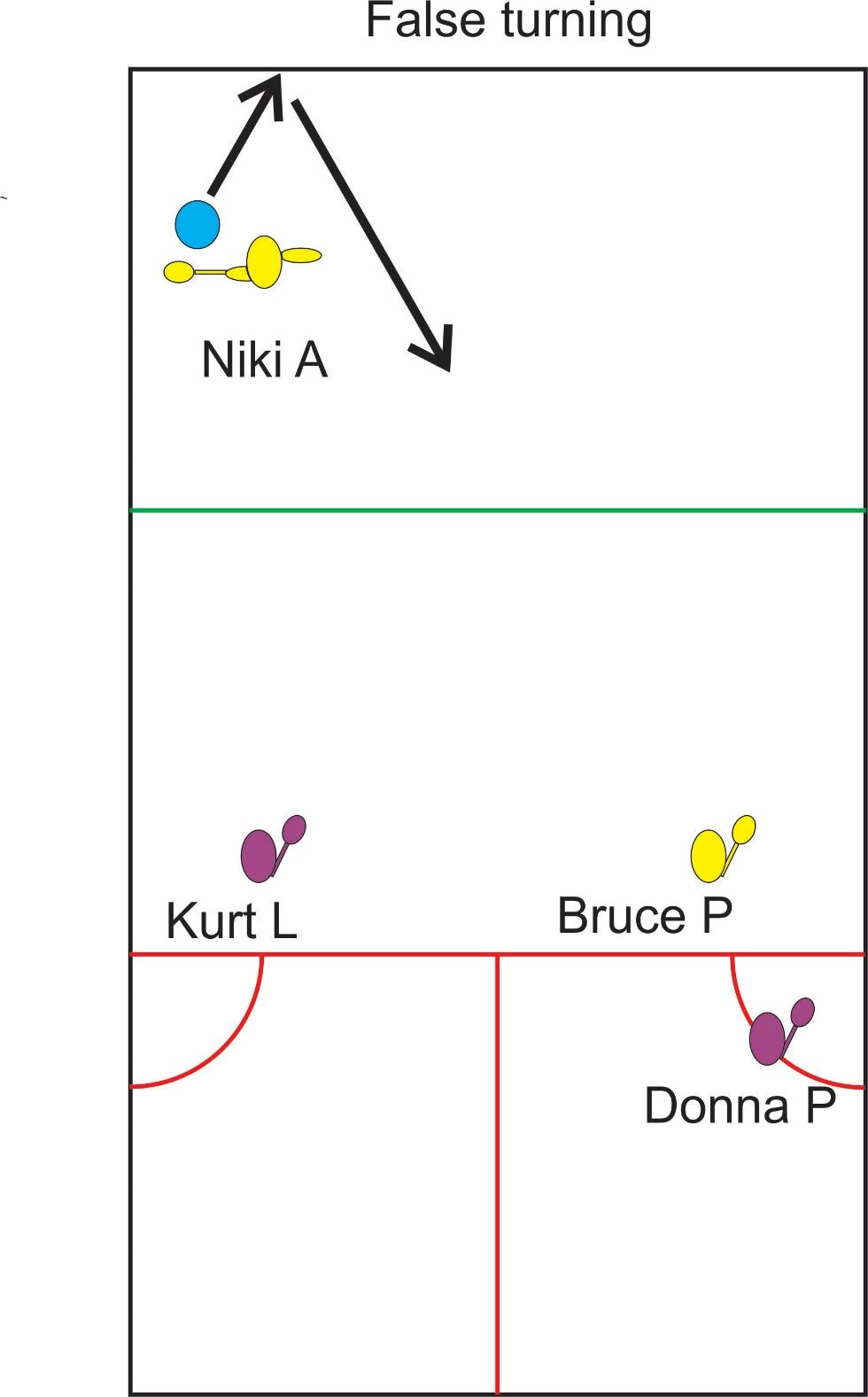
Bruce moves to the middle to clear for Donna.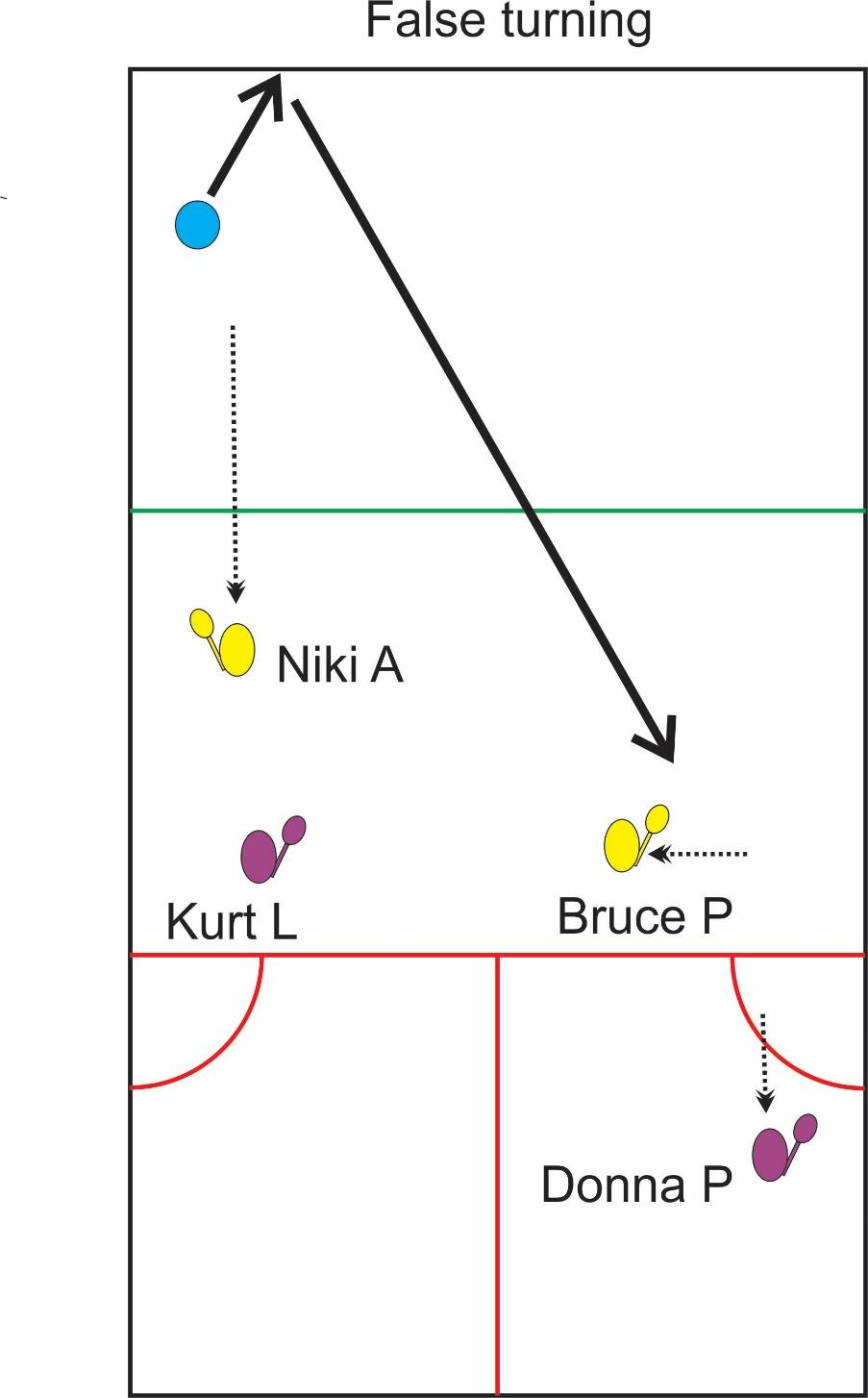
Donna begins to drop back to retrieve the lob.
Niki moves back after hitting the lob.
Donna announces “turning” and continues to a deeper position.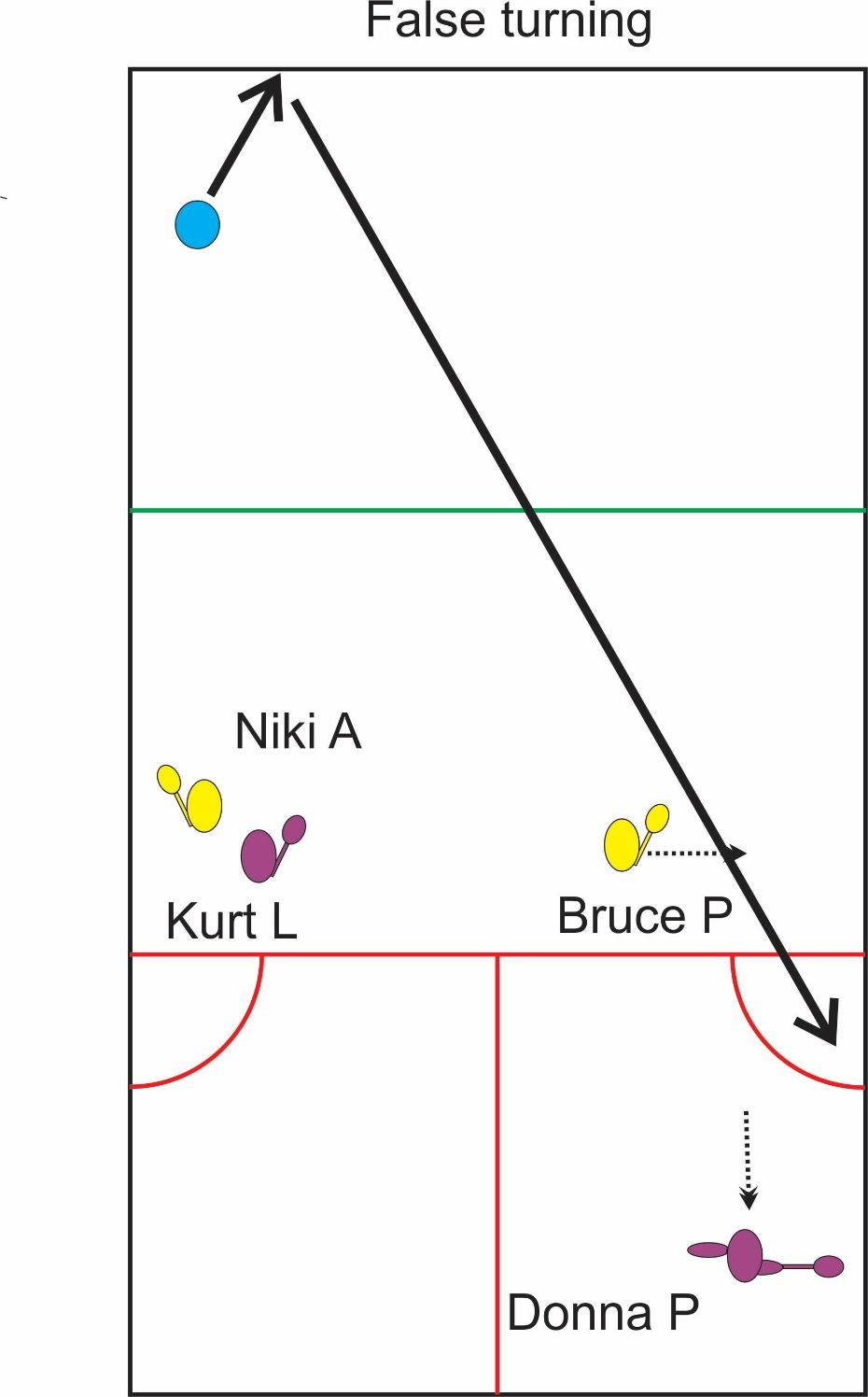
Bruce crosses over to the side wall.
Niki would have moved to a deeper defensive position.
Donna realizes the ball will stay closer to the right wall than anticipated. 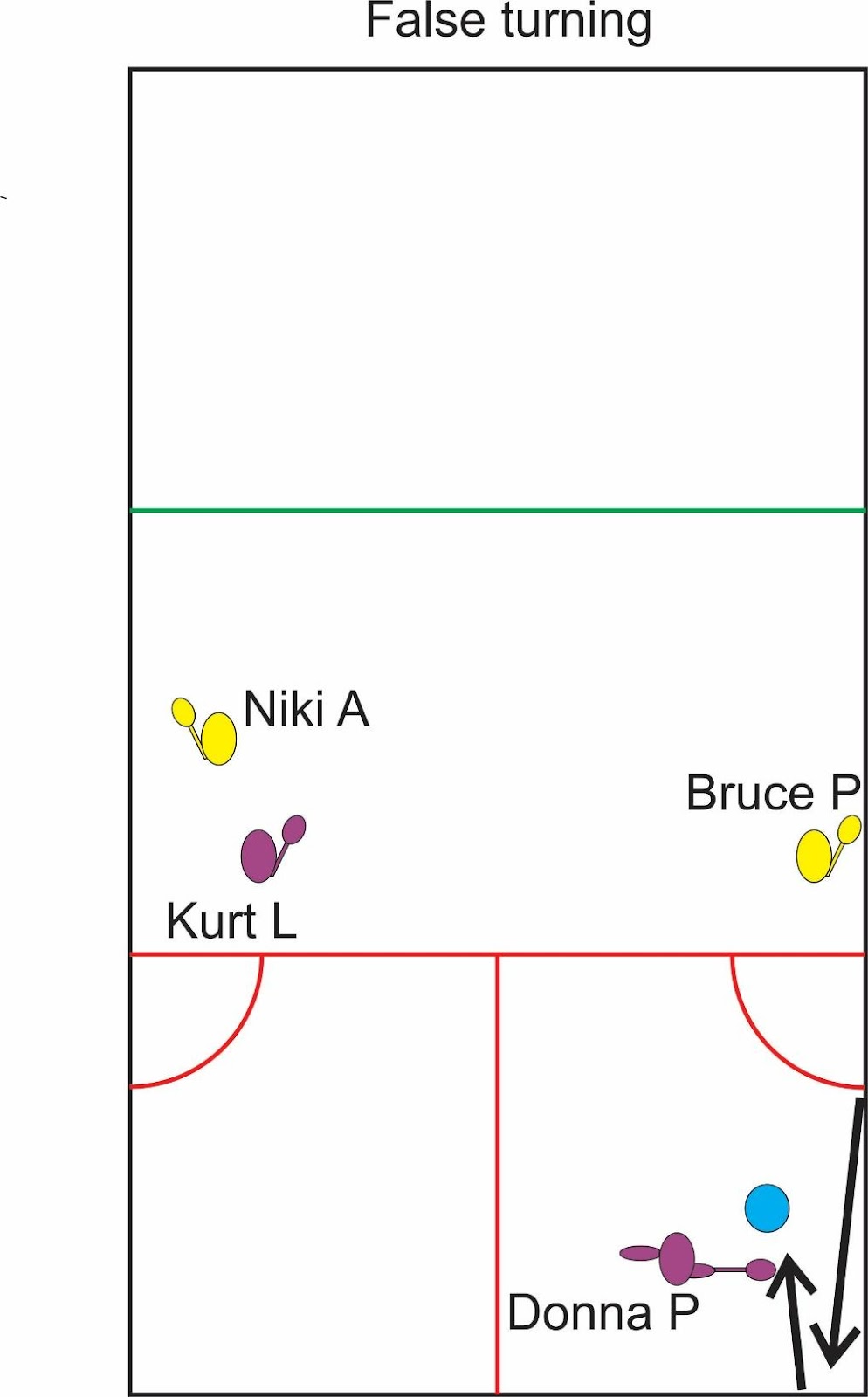
Donna does not turn, but plays the ball on the forehand.
Bruce is “stuck” on the side wall.
Donna plays a winner.
Both Donna and Bruce thought the outcome was not fair.
The foursome decided to play a let.
Some “what ifs”.
What if:
Donna did not play the ball and requested a let. LB’s opinion, no let. Bruce has cleared.
Donna’s shot hit Bruce. LB’s opinion, no let. Bruce properly cleared for the turn.
This was a refereed match. Donna is obliged to play the ball or lose the point. There is no interference. She did play the ball for a winner. Bruce was somewhat disadvantaged by clearing to the wall. LB’s opinion is point to Donna.
References and comments.
Turning is not mentioned in Rules 1-15.
Turning is described in Guideline 7.
It has been suggested that the rule revision committee should seek ways to improve the rules and reduce reliance on guidelines. Guideline 7, in particular, should be incorporated into the rules.
The scenario of announcing a turn but then hitting the ball without turning is not described in the rules bundle. This scenario is common enough to deserve mention in the rules bundle.
Referees and players are left with the general advice to decide on a fair outcome.
Turning was recognized as more dangerous than other shots which lead to guideline 7. Players are expected to announce turning as early as possible. No other shot expects or requires the striker to announce their intentions. The opponents are expected to clear to the side walls.
A player intentionally using “turning” to gain an unfair advantage should be at least warned if not penalized.
References
Q&A References for “turning”.
Turning is not mentioned in rules 1-15.
“Turning” is found in the definitions and in Guidelines 6 and 7.
ACE simply quotes Guideline 7.
Research found no comment on the situation of a player calling “turning” and not turning. Followed by either withholding the shot or hitting the shot.
Definitions.
COMING AROUND (See also “Turning” and “Around”). The movement of a player to turn, or follow the ball around, in order to strike the ball. The warning by a player that he is about to turn on the ball.
SQUIRT When the ball squirts out of the back corner causing the player to turn unexpectedly.
TURNING The action of the striker when the ball is followed around and the striker physically turns, to play the ball to the front wall or to the side walls in the front third of the court. This usually occurs in the back corners of the court
TURNS (See Turning, Around, and Coming around).
AROUND (See “Coming around” and “Turning”).
LATE CALL Failure to make an early call by a player turning, giving the opponents little time to clear
Guidelines
G6 Interference on a Further Attempt
Second paragraph
When a player shapes to play the ball on one side and then brings the racquet across the body to take the ball on the other side, it is neither turning nor making a further attempt and, if interference occurs, Rule 5 applies. This position frequently occurs after the ball has hit the side wall and the front wall simultaneously and then rebounds into the middle of the court.
G7 Interference on turning
A player who turns on the ball (or comes around) _must_ make every effort to play the ball. The changes in this Rule are designed to eliminate the abuse of the safety Let provision, often invoked by a player to recover from a defensive position, while continuing to provide safety for all players on court. In doing so the following provisions apply:
- The turning player _should_ warn his opponents as early as possible that he is turning by declaring his intent to turn (turning, coming around or some other clear verbal warning). Failure to do so will result in a warning initially; however failure subsequently to announce a turn or to announce the turn late _could_ result in a Point to the opponents.
- If the turning player fails to declare his intention to turn and then hits either opponent with the ball a Point _will_ be awarded to the opponents.
- If the turning player fails to declare his intention to turn and then requests a Let due to his opponents’ positions on the court, the Referee _should_ warn the turning player that future failure to declare a turn could, at the Referee’s discretion, result in No Let being awarded.
- However if the turning player fails to call turning or calls late but plays the ball safely, then the Referee _should_ allow play to continue and after the point has concluded, warn the turning player that future failure to declare a turn _could, _at the Referees discretion, result in the awarding of a Point to the opponents due to unsafe or dangerous play.
- The turning player’s opponents _must_ make every effort to clear to give the turning player the full front wall and the side walls in the front third of the court, as well as provide freedom to the striker to play the ball.
- Where possible, the turning player _should_ play the ball to the front wall or to the sidewalls in the front third of the court. If the turning player does not play the ball he _will not_ be granted a Let if he is considered to be unreasonably trying to get out of an unfavourable position, especially when the opponents have cleared properly.
- If the ball hits an opponent who has cleared to allow the turning player to play the ball safely to the front third of the court, the turning player _will_ lose the Point. Also to ensure the safety of the players on the court in enforcing the Turning rule, if the turning player plays a shot which is considered reckless or dangerous (not safe) the striker will be penalized and a Point _will_ be awarded to the opponents.
The exceptions are as follows:
- Where the striker, while planning to play his normal shot, is forced to turn to play the ball due to the ball “squirting” off the back or side wall, forcing the striker to turn unexpectedly; in this case a Let _will_ be allowed, provided the striker could have played the ball.
- When the opponents do not make every effort to clear, after turning has been declared, then the striker need not play the ball and a Let _will_ be allowed and the Referee should warn the opponents that future failure to clear _will_ result in a Point to the striker.
Footnote to Referees:
The overriding principle for all Referees is that the game should be played safely and fairly, and Referee’s calls should be made to promote safety while preserving the integrity of the Rules, and the flow of the game. The Referee should include, when making his judgement, whether or not the turning player could have reached the ball and played it to the front wall and would it have resulted in a safe return.
Ultimately it is the responsibility of the player turning to play the ball in a safe manner. Failure to do so, _may_ at the discretion of the Referee, result in a warning, or, if the Referee deems the conduct offensive, a Point.
An initial warning applies to both players of the team warned.
A Complete Explanation (ACE) and Interpretation of Squash Doules (sic) Rules update 2024.
The section titled “Turning” is an exact quote of Guideline 7.