Rule 6(a)(2) application
Note: See Rules formatting changes
[Last edited Tuesday January 21, 2025]
A point shall be awarded when an opponent violates rule 5 and fails to make the expected effort to clear. Take note of the wording, “in violating Rule 5” which includes fair view, access, stroke space, front wall shots, boasts, and visual and auditory distractions. Here the focus is only on direct to front and side wall shots.
Applying Rule 6 a ii will lead to conclusions that many referees and players will disagree with.
To apply 6 a ii, the player violating Rule 5 did not make the expected effort to avoid the violation. Other parts of Rule 6 deal with situations when the offending player has made the expected effort to clear but did interfere.
Also, the striking player was deprived of an opportunity to attempt a shot. Take note, it states “a shot”.
Refer to Fig 201a Front wall shot #1. Purple is shown in 6 different spots when Yellow requests a let.
Scenarios A, B, and F show Purple interfering with a front wall shot. Because Purple’s effort to clear was less than expected, a point shall be awarded in scenarios A, B, and F.
.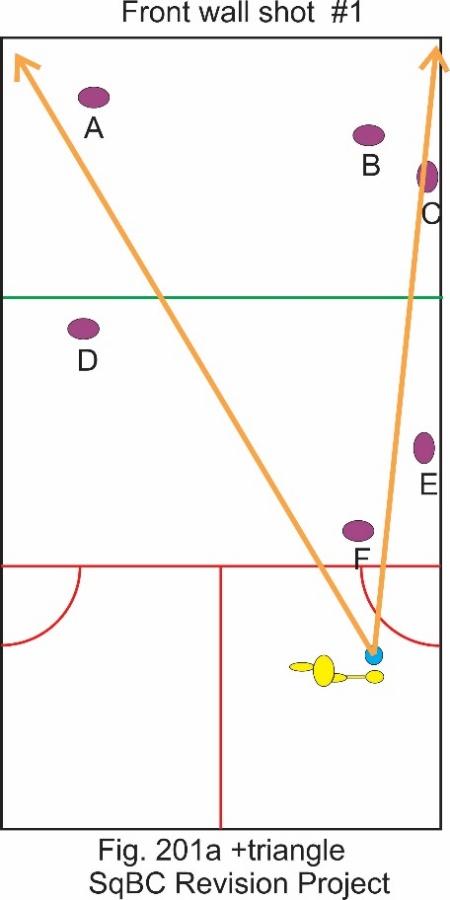
Scenarios C, D, and E show an opponent interfering with a boast to the front 2/3rds of a side wall. All three scenarios are viable boasts. Be reminded that if Purple does not make the expected effort to clear, a point shall be awarded in each scenario.
According to Rule 6 a ii, it does not matter if Purple was the previous striker or not. It does not matter that Yellow had most of the front wall open for a shot in all but scenario F.
There is no need to invoke the front-third concept.
The subjective part of these scenarios is judging Purple’s effort to clear. When a referee judges Purple could have made a better effort to clear, it should be a point to Yellow.
An issue that needs to be addressed is judging when a player has made the effort within the scope of their normal ability, and when they have not. In many cases, that judgment of effort will determine if a let or a point should be awarded. The process of making that judgment should be objective but acknowledging that recalling what unfolded will be variable among observers.