Esquire, As a Verb;
Verb
esquire (third-person singular simple present esquires, present participle esquiring, simple past and past participle esquired)
- (transitive, obsolete) To attend, wait on, escort.
Etymology 2
Old French esquiere, esquierre, esquarre (“a square”) (whence modern French équerre), perhaps via a form like based esquire from bas d'esquire ("bottom of a square"), whence attested forms base (e)squire, e(s)quire bast.
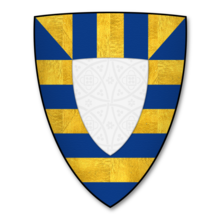
The arms of Mortimer, barry of six or and azure on a chief of the first two pallets between two base esquires of the second, over all an inescutcheon argent.
Noun
esquire (plural esquires)
- (heraldry, rare) The lower of the halves into which a square is divided diagonally, a single gyron, but potentially larger (extending across the shield) or smaller (for example, on Mortimer's arms). quotations ▼
References
- “esquire”, in Webster’s Revised Unabridged Dictionary, Springfield, Mass.: G. & C. Merriam, 1913, →OCLC.
- William Dwight Whitney and Benjamin E[li] Smith, editors (1914), “esquire”, in The Century Dictionary: An Encyclopedic Lexicon of the English Language, volume II (D–Hoon), revised edition, New York, N.Y.: The Century Co., →OCLC.
Further reading
 esquire on Wikipedia.
Anagrams
downloaded: January 24, 2024, 8:33 PM