SAINT
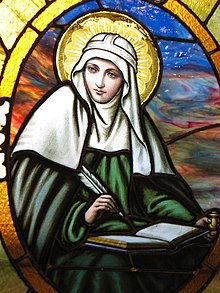
St Bridget of Sweden pictured with a halo. In Christian iconography, saints may also be depicted with wreaths, palm branches, and white lilies.
In religious belief, a saint is a person who is recognized as having an exceptional degree of holiness, likeness, or closeness to God.
However, the use of the term saint depends on the context and denomination.
In Catholic, Eastern Orthodox, Anglican, Oriental Orthodox, and Lutheran doctrine, all of their faithful deceased in Heaven are considered to be saints, but some are considered worthy of greater honor or emulation.[1]
Official ecclesiastical recognition, and consequently a public cult of veneration, is conferred on some denominational saints through the process of canonization in the Catholic Church or glorification in the Eastern Orthodox Church after their approval.[2]
While the English word saint originated in Christianity, historians of religion tend to use the appellation "in a more general way to refer to the state of special holiness that many religions attribute to certain people", referring to
the Jewish tzadik,
the Islamic walī,
the Hindu rishi or
the Shintoist kami,
the Taoist shengren, and
the Buddhist arhat or bodhisattva
also as saints.[3][4]
Depending on the religion, saints are recognized either by official ecclesiastical declaration, as in the Catholic faith, or by popular acclamation (see folk saint).[5]
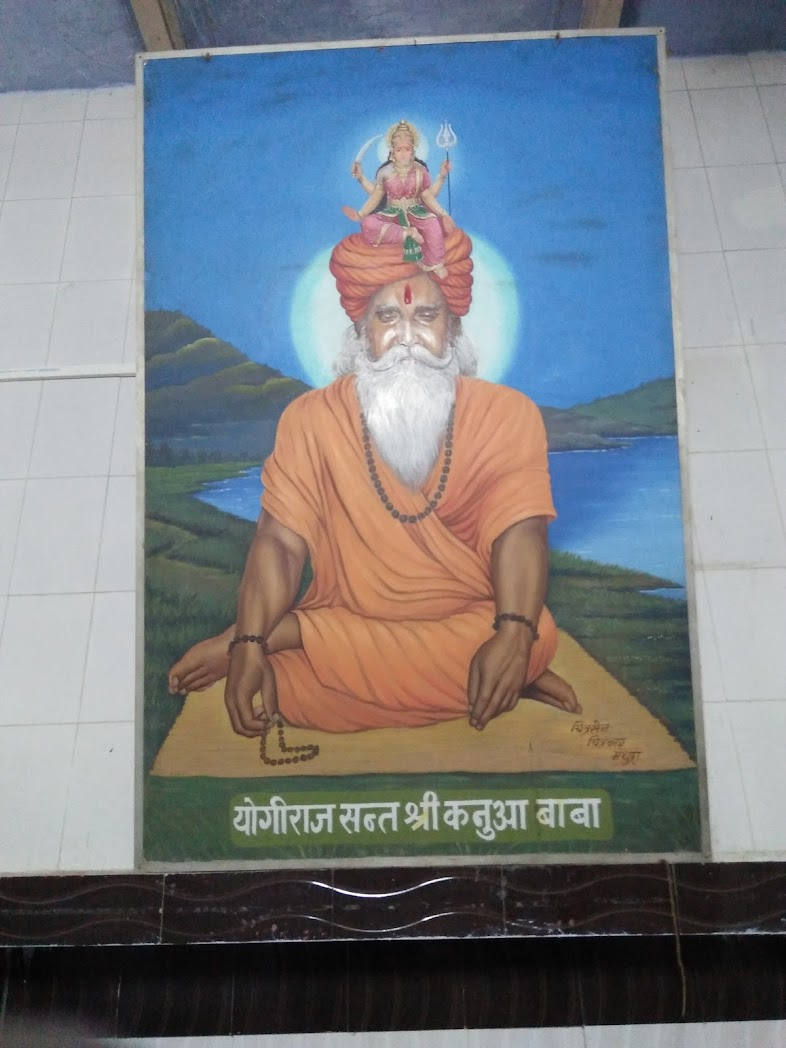
Portrait of the saintly Kanua, a Hindu baba of Mathura, India, also pictured with a light encircling his head.
General characteristics
The English word saint comes from the Latin sanctus, with the Greek equivalent being ἅγιος (hagios) 'holy'.[6]
The word ἅγιος appears 229 times in the Greek New Testament, and its English translation 60 times in the corresponding text of the King James Version of the Bible.[7]
The word sanctus was originally a technical one in ancient Roman religion, but due to its globalized use in Christianity the modern word saint is now also used as a translation of comparable terms for persons "worthy of veneration for their holiness or sanctity" in other religions.
Many religions also use similar concepts (but different terminology) to venerate persons worthy of some honor.[3]
Author John A. Coleman of the Graduate Theological Union, Berkeley, California, wrote that saints across various cultures and religions have the following family resemblances:[8]
- exemplary model
- extraordinary teacher
- wonder worker or source of benevolent power
- intercessor
- a life often refusing material attachments or comforts
- possession of a special and revelatory relation to the holy.
The anthropologist Lawrence Babb in an article about Indian guru Sathya Sai Baba asks the question "Who is a saint?", and responds by saying that in the symbolic infrastructure of some religions, there is the image of a certain extraordinary spiritual king's "miraculous powers", to whom frequently a certain moral presence is attributed.
These saintly figures, he asserts, are "the focal points of spiritual force-fields".
They exert "powerful attractive influence on followers but touch the inner lives of others in transforming ways as well".[9]