Occurrence of elemental selenium
Occurrence
from: Selenium - Wikipedia
See also: Category:Selenide minerals
[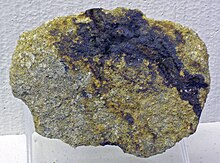 ]
Native selenium in sandstone, from a uranium mine near Grants, New Mexico
Native (i.e., elemental) selenium is a rare mineral, which does not usually form good crystals, but, when it does, they are steep rhombohedra or tiny acicular (hair-like) crystals.[49]
Isolation of selenium is often complicated by the presence of other compounds and elements.
Selenium occurs naturally in a number of inorganic forms, including selenide, selenate, and selenite, but these minerals are rare.
The common mineral selenite is not a selenium mineral, and contains no selenite ion, but is rather a type of gypsum (calcium sulfate hydrate) named like selenium for the moon well before the discovery of selenium.
Selenium is most commonly found as an impurity, replacing a small part of the sulfur in sulfide ores of many metals.[50][51]
In living systems, selenium is found in the amino acids selenomethionine, selenocysteine, and methylselenocysteine. In these compounds, selenium plays a role analogous to that of sulfur.
Another naturally occurring organoselenium compound is dimethyl selenide.[52][53]
Certain soils are selenium-rich, and selenium can be bioconcentrated by some plants. In soils, selenium most often occurs in soluble forms such as selenate (analogous to sulfate), which are leached into rivers very easily by runoff.[50][51] Ocean water contains significant amounts of selenium.[54][55]
Typical background concentrations of selenium do not exceed 1 ng/m3 in the atmosphere; 1 mg/kg in soil and vegetation and 0.5 μg/L in freshwater and seawater.[56]
Anthropogenic sources of selenium include coal burning, and the mining and smelting of sulfide ores.[57]
downloaded: December 28, 2023, 2:48 PM