Orientation, Orient, Entimology 1
Etymology 1
[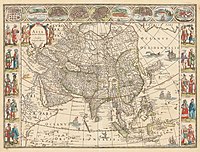 ]
A 1635 map of the orient (sense 1) or Asia by Willem Blaeu
[ ]
The sunrise seen in the orient (sense 2) or east direction from Aci Castello, Sicily, Italy
The noun is derived
from Middle English orient, oriente, oryent, oryente, oryentte (“the east direction; eastern horizon or sky; eastern regions of the world, Asia, Orient; eastern edge of the world”),[1]
borrowed from Anglo-Norman orient, oriente, and
Old French orient (“east direction; Asia, Orient”) (modern French orient), or*
directly from its etymon Latin oriēns (“the east; daybreak, dawn; sunrise; (participle) rising; appearing; originating”),
present active participle of orior (“to get up, rise; to appear, become visible; to be born, come to exist, originate”),
from Proto-Indo-European *h₃er-* (“to move, stir; to rise, spring”).[2]
The adjective is derived from Middle English orient (“eastern; from Asia or the Orient; brilliant, shining (characteristic of jewels from the Orient)”),
from Middle English orient (noun); see above.[3]