Europa
Europa (consort of Zeus) - Wikipedia
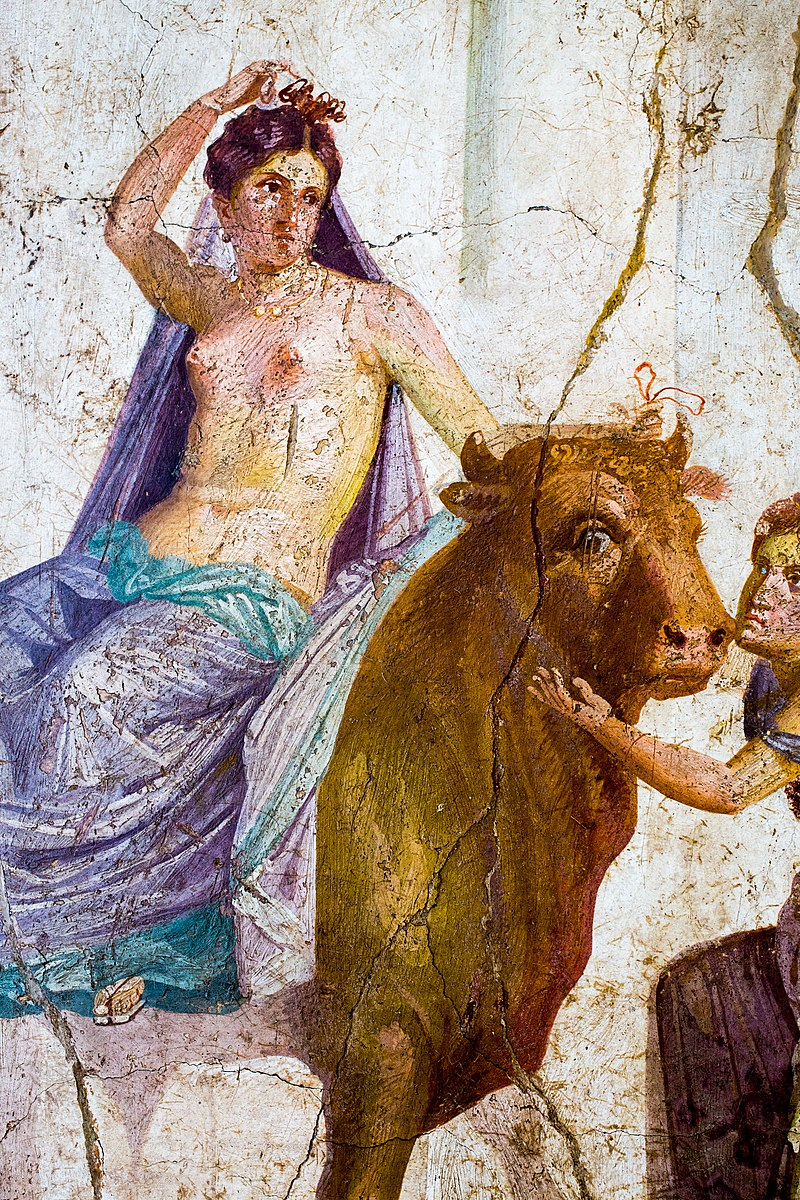
wall painting (fresco) - description: Europa already sitting on the back of the bull (Zeus), three of her friends try to stop her; in a rocky landscape -
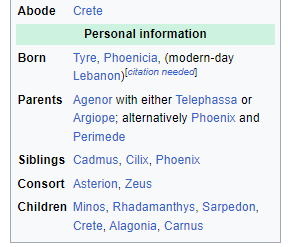
In Greek mythology, Europa (/jʊəˈroʊpə, jə-/; Ancient Greek: Εὐρώπη, Eurṓpē, Attic Greek pronunciation: [eu̯.rɔ̌ː.pɛː]) was a Phoenician princess from Tyre Lebanon and the mother of King Minos of Crete.
The continent of Europe may be named after her.
The story of her abduction by Zeus in the form of a bull was a Cretan story; as classicist Károly Kerényi points out, "most of the love-stories concerning Zeus originated from more ancient tales describing his marriages with goddesses.
This can especially be said of the story of Europa."[1]
Europa's earliest literary reference is in the Iliad, which is commonly dated to the 8th century BC.[2]
Another early reference to her is in a fragment of the Hesiodic Catalogue of Women, discovered at Oxyrhynchus.[3]
The earliest vase-painting securely identifiable as Europa dates from the mid-7th century BC.[4]
Etymology

Statue of Europa representing Europe at Palazzo Ferreria
Greek Εὐρώπη (Eurṓpē) contains the elements εὐρύς (eurus), "wide, broad"[5] and ὤψ/ὠπ-/ὀπτ- (ōps/ōp-/opt-) "eye, face, countenance".[6]
Broad has been an epithet of Earth herself in the reconstructed Proto-Indo-European religion.[7]
It is common in ancient Greek mythology and geography to identify lands or rivers with female figures.
Thus, Europa is first used in a geographic context in the Homeric Hymn to Delian Apollo, in reference to the western shore of the Aegean Sea.[8]
As a name for a part of the known world, it is first used in the 6th century BC by Anaximander and Hecataeus.[9]
The weakness of an etymology with εὐρύς (eurus), is 1. that the -u stem of εὐρύς disappears in Εὐρώπη Europa and 2. the expected form εὐρυώπη euryopa that retains the -u stem in fact exists.
An alternative suggestion due to Ernest Klein and Giovanni Semerano (1966) attempted to connect
a Semitic term for "west",
Akkadian erebu meaning "to go down, set" (in reference to the sun), Phoenician 'ereb "evening; west", which would parallel occident (the resemblance to Erebus,
from PIE h1regʷos*, "darkness", is accidental, however).
Barry (1999) adduces the word Ereb on an Assyrian stele with the meaning of "night", "[the country of] sunset",
in opposition to Asu "[the country of] sunrise", i.e. Asia (Anatolia coming equally from Ἀνατολή, "(sun)rise", "east").[10]
The Dictionary of Classical Mythology explains that Zeus was enamoured of Europa and decided to seduce or rape her, the two being near-equivalent in Greek myth.[19]
He transformed himself into a tame white bull and mixed in with her father's herds.
While Europa and her helpers were gathering flowers, she saw the bull, caressed his flanks, and eventually got onto his back.
Zeus took that opportunity and ran to the sea and swam, with her on his back, to the island of Crete.
He then revealed his true identity, and Europa became the first queen of Crete.
Zeus gave her
a necklace made by Hephaestus[3] and three additional gifts:
the bronze automaton guard Talos,
the hound Laelaps who never failed to catch his quarry, and
a javelin that never missed.
Zeus later re-created the shape of the white bull in the stars, which is now known as the constellation Taurus.
It should not be confused with the Cretan Bull that fathered the Minotaur and was captured by Heracles.
Roman mythology adopted the tale of the Raptus, also known as "The Abduction of Europa" and "The Seduction of Europa", substituting the god Jupiter for Zeus.
The myth of Europa and Zeus may have its origin in a sacred union between the Phoenician deities in bovine form.
Having given birth to three sons by Zeus, Europa married a king Asterios, this being also the name of the Minotaur and an epithet of Zeus, likely derived from the name `Aštar.[20]
According to Herodotus' rationalizing approach, Europa was kidnapped by Greeks (probably Cretans), who were seeking to avenge the kidnapping of Io, a princess from Argos.
His variant story may have been an attempt to rationalize the earlier myth; or the present myth may be a garbled version of facts—the abduction of a Phoenician aristocrat—later enunciated without gloss by Herodotus.