DAM
A dam is a barrier that stops or restricts the flow of surface water or underground streams. Reservoirs created by dams not only suppress floods but also provide water for activities such as irrigation, human consumption, industrial use, aquaculture, and navigability. Hydropower is often used in conjunction with dams to generate electricity.
A dam can also be used to collect or store water which can be evenly distributed between locations. Dams generally serve the primary purpose of retaining water, while other structures such as floodgates or levees (also known as dikes) are used to manage or prevent water flow into specific land regions.
The word dam can be traced back to Middle English,[1] and before that, from Middle Dutch, as seen in the names of many old cities,[2] such as Amsterdam and Rotterdam.
Ancient dams were built in Mesopotamia and the Middle East for water control.
The earliest known dam is the Jawa Dam in Jordan, dating to 3,000 BC. Egyptians also built dams, such as Sadd-el-Kafara Dam for flood control. In modern-day India, Dholavira had an intricate water-management system with 16 reservoirs and dams. The Great Dam of Marib in Yemen, built between 1750 and 1700 BC, was an engineering wonder, and Eflatun Pinar, a Hittite dam and spring temple in Turkey, dates to the 15th and 13th centuries BC. The Kallanai Dam in South India, built in the 2nd century AD, is one of the oldest water regulating structures still in use.
Roman engineers built dams with advanced techniques and materials, such as hydraulic mortar and Roman concrete, which allowed for larger structures.
They introduced reservoir dams, arch-gravity dams, arch dams, buttress dams, and multiple arch buttress dams. In Iran, bridge dams were used for hydropower and water-raising mechanisms.
During the Middle Ages, dams were built in the Netherlands to regulate water levels and prevent sea intrusion.
In the 19th century, large-scale arch dams were constructed around the British Empire, marking advances in dam engineering techniques.
The era of large dams began with the construction of the Aswan Low Dam in Egypt in 1902.
The Hoover Dam, a massive concrete arch-gravity dam, was built between 1931 and 1936 on the Colorado River.
By 1997, there were an estimated 800,000 dams worldwide, with some 40,000 of them over 15 meters high.
Power generation plant
Main article: Hydroelectricity

Hydroelectric dam in cross section[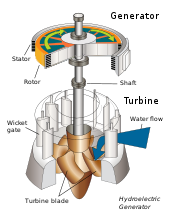 ]
Hydraulic turbine and electric generator
As of 2005, hydroelectric power, mostly from dams, supplies some 19% of the world's electricity, and over 63% of renewable energy.[72]
Much of this is generated by large dams, although China uses small-scale hydro generation on a wide scale and is responsible for about 50% of world use of this type of power.[72]
Most hydroelectric power comes from the potential energy of dammed water driving a water turbine and generator; to boost the power generation capabilities of a dam, the water may be run through a large pipe called a penstock before the turbine.
A variant on this simple model uses pumped-storage hydroelectricity to produce electricity to match periods of high and low demand, by moving water between reservoirs at different elevations.
At times of low electrical demand, excess generation capacity is used to pump water into the higher reservoir. When there is higher demand, water is released back into the lower reservoir through a turbine. (For example, see Dinorwig Power Station.)