EAGLE
Etymology
The modern English term for the bird is derived from Latin: aquila by way of French: aigle.
The origin of aquila is unknown, but it is believed to possibly derive from aquilus (meaning dark-colored, swarthy, or blackish) as a reference to the plumage of eagles.
Old English used the term earn, related to Scandinavia's ørn/örn.
It is similar to other Indo-European terms for "bird" or "eagle", including Greek: ὄρνις (ornís), Russian: орёл (orël), and Welsh: eryr.
In the southern part of Finland, near the Gulf of Finland, is the town of Kotka, which literally means "eagle", while the town of L'Aquila in the central part of Italy literally means "the eagle".

The sculpture of eagle at the top of the fountain at Plac Orła Białego in Szczecin, Poland
In Britain before 1678, eagle referred specifically to the golden eagle, with the other native species, the white-tailed eagle, being known as erne.
The modern name "golden eagle" for aquila chrysaetos was introduced by the naturalist John Ray.[26]
The village of Eagle in Lincolnshire, England, has nothing to do with the bird; its name is derived from the Old English words for "oak" and "wood" (compare Oakley).[27]
Religion and spirituality
In ancient Sumerian mythology, the mythical king Etana was said to have been carried into heaven by an eagle.[28]
Classical writers such as Lucan and Pliny the Elder claimed that the eagle was able to look directly at the sun, and that they forced their fledglings to do the same.
Those that blinked would be cast from the nest.
This belief persisted until the Medieval era.[29]
The eagle is the patron animal of the ancient Greek god Zeus.
In particular, Zeus was said to have taken the form of an eagle in order to abduct Ganymede, and there are numerous artistic depictions of the eagle Zeus bearing Ganymede aloft, from Classical times up to the present.
Eagles appear metaphorically in many translations of the Old Testament.
God is spoken of as carrying Israel on "eagles' wings" in Exodus 19:4, Isaiah 40:31 compares those who wait on the Lord to flying eagles, and Psalm 103 mentions renewing one's youth "as the eagle".
In explaining this rejuvenation, Augustine of Hippo says in his commentary on the Psalms that eagles' beaks overgrow as they age and that they break them against rocks to restore them.[31]
The translation, however, is uncertain: the word in the Hebrew, נשר, can also be translated vulture,[32] and is listed alongside specific kinds of vulture in Leviticus' discussion of unclean animals.
The eagle is also often used in Christian iconography to represent the Gospel of John,[33] and eagle-shaped lecterns are common in Anglican and some Roman Catholic churches.[34] The eagle was believed to be able to look directly into the sun in the same way that the Gospel of John looks directly at Jesus' divinity, and the great distances the eagle flies represent the spread of the gospel to the ends of the earth.
The United States eagle feather law stipulates that only individuals of certifiable Native American ancestry enrolled in a federally recognized tribe are legally authorized to obtain eagle feathers for religious or spiritual reasons.[35]
In Canada, the poaching of eagle feathers for the booming U.S. market has sometimes resulted in the arrests of First Nations person for the crime.[36]
The Moche people of ancient Peru worshiped the eagle and often depicted eagles in their art.[37]
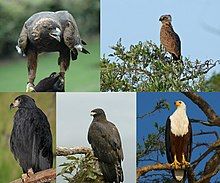
From left to right:
golden eagle (Aquila chrysaetos),
brown snake eagle (Circaetus cinereus),
solitary eagle (Buteogallus solitarius),
Black eagle (Ictinaetus malaiensis) and
African fish eagle (Haliaeetus vocifer).
Among the eagles are some of the largest birds of prey: only the condors and some of the Old World vultures are markedly larger.
It is regularly debated which should be considered the largest species of eagle.
They could be measured variously in total length, body mass, or wingspan.
Different lifestyle needs among various eagles result in variable measurements from species to species.
For example, many forest-dwelling eagles, including the very large harpy eagle, have relatively short wingspans, a feature necessary for being able to maneuver in quick, short bursts through densely forested habitats.[9]
Eagles in the genus Aquila, found almost exclusively in open country, are noted for their ability to soar, and have relatively long wings for their size.[9]