Audie Murphy
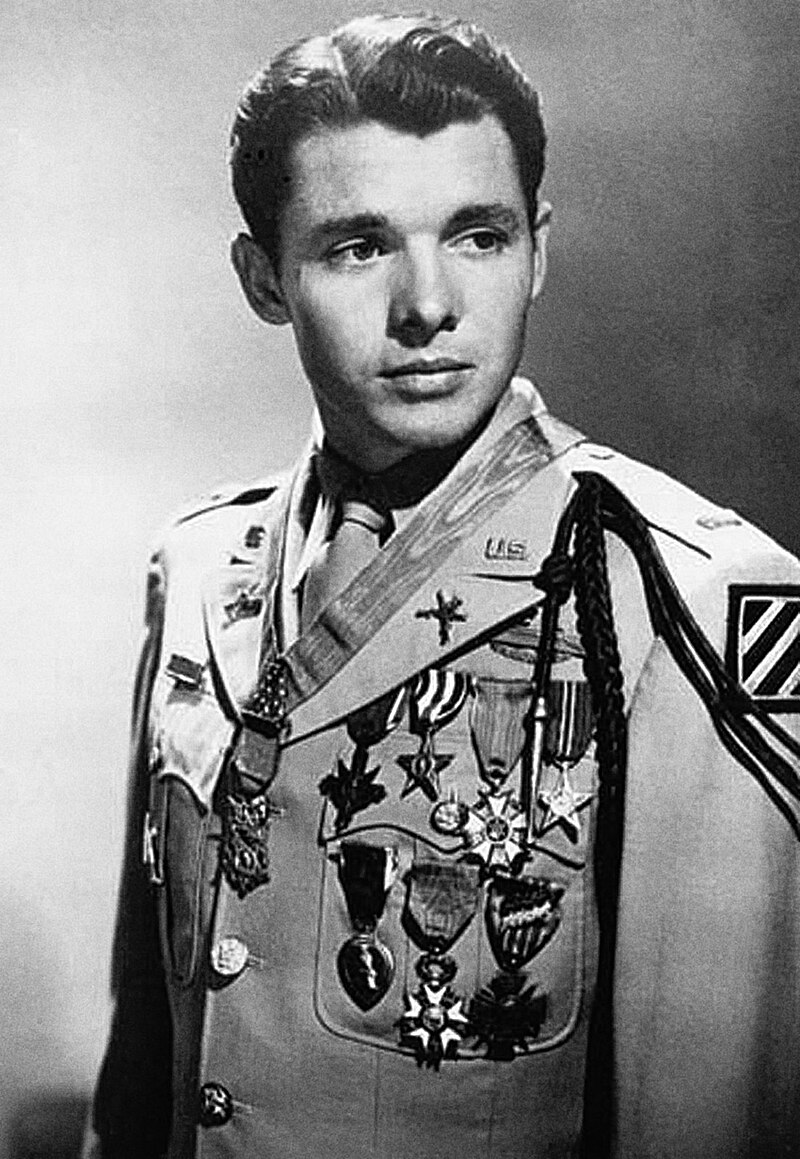
Audie Leon Murphy (20 June 1925 – 28 May 1971) was an American soldier, actor, and songwriter. He was one of the most decorated American combat soldiers of World War II.[3]
He received every military combat award for valor available from the United States Army, as well as French and Belgian awards for heroism.
Murphy received the Medal of Honor for valor that he demonstrated at the age of 19 for single-handedly holding off a company of German soldiers for an hour at the Colmar Pocket in France in January 1945, before leading a successful counterattack while wounded and out of ammunition.
Murphy was born into a large family of sharecroppers in Hunt County, Texas.
After his father abandoned them, his mother died when he was a teenager.
Murphy left school in fifth grade to pick cotton and find other work to help support his family; his skill with a hunting rifle helped feed his family.
After the attack on Pearl Harbor in 1941, Murphy's older sister helped him to falsify documentation about his birthdate in order to meet the minimum age requirement for enlisting in the military.
Turned down initially for being underweight by the Army, Navy and the Marine Corps, he eventually was able to enlist in the Army.
He first saw action in the 1943 Allied invasion of Sicily; then in 1944 he participated in the Battle of Anzio, the liberation of Rome, and the invasion of southern France.
Murphy fought at Montélimar and led his men on a successful assault at L'Omet quarry near Cleurie in northeastern France in October.
Despite suffering from multiple illnesses and wounds throughout his service, Murphy become one of the most praised and decorated soldiers of World War II.[4]
He is credited with killing 241 enemy soldiers.[5][6]
After the war, Murphy embarked on a 21-year acting career.
He played himself in the 1955 autobiographical film To Hell and Back, based on his 1949 memoirs of the same name, but most of his roles were in Westerns.
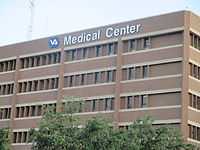
Audie L. Murphy Memorial VA Hospital in San Antonio, Texas
Since his military service, Murphy had been plagued with insomnia and bouts of depression, and he slept with a loaded pistol under his pillow.[99][100] A post-service medical examination on 17 June 1947 revealed symptoms of headaches, vomiting, and nightmares about the war. His medical records indicated that he took sleeping pills to help prevent nightmares.[101]
During the mid-1960s, he recognized his dependence on the sedative Placidyl, and locked himself alone in a hotel room for a week to successfully break the addiction.[19]
Post-traumatic stress levels exacerbated his innate moodiness,[14] and surfaced in episodes that friends and professional colleagues found alarming.[102]
To draw attention to the problems of returning Korean War and Vietnam War veterans, Murphy spoke out candidly about his own problems with post-traumatic stress disorder.[107]
It was known during Murphy's lifetime as "battle fatigue" and "shell shock", terminology that dated back to World War I.
He called on the government to give increased consideration and study to the emotional impact of combat experiences, and to extend health care benefits to war veterans.[108][109]
As a result of legislation introduced by U.S. Congressman Olin Teague five months after Murphy's death in 1971, the Audie L. Murphy Memorial VA Hospital[110] in San Antonio, now a part of the South Texas Veterans Health Care System, was dedicated in 1973.[111][112]