Nocturnal
Origins
[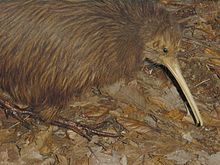 ]
The kiwi is a family of nocturnal birds endemic to New Zealand.
While it is difficult to say which came first, nocturnality or diurnality, a hypothesis in evolutionary biology, the nocturnal bottleneck theory, postulates that in the Mesozoic, many ancestors of modern-day mammals evolved nocturnal characteristics in order to avoid contact with the numerous diurnal predators.[3]
A recent study attempts to answer the question as to why so many modern day mammals retain these nocturnal characteristics even though they are not active at night.
The leading answer is that the high visual acuity that comes with diurnal characteristics is not needed anymore due to the evolution of compensatory sensory systems, such as a heightened sense of smell and more astute auditory systems.[4]
In a recent study, recently extinct elephant birds and modern day nocturnal kiwi bird skulls were examined to recreate their likely brain and skull formation.
They indicated that olfactory bulbs were much larger in comparison to their optic lobes, indicating they both have a common ancestor who evolved to function as a nocturnal species, decreasing their eyesight in favor of a better sense of smell.[4]
The anomaly to this theory were anthropoids, who appeared to have the most divergence from nocturnality than all organisms examined.
While most mammals did not exhibit the morphological characteristics expected of a nocturnal creature, reptiles and birds fit in perfectly.
A larger cornea and pupil correlated well with whether these two classes of organisms were nocturnal or not.[2]