Sharia
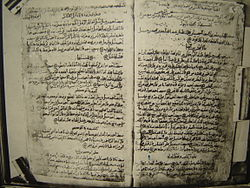
A manuscript of Ibn Hanbal's legal writings,
produced in October 879
Sharia (/ʃəˈriːə/; Arabic: شَريعَة, romanized: sharīʿa [ʃaˈriːʕa]) is a body of religious law that forms a part of the Islamic tradition.[1][2][3] It is derived from the religious precepts of Islam and is based on the sacred scriptures of Islam, particularly the Quran and the Hadith.[1] In Arabic, the term sharīʿah refers to God's immutable divine law and is contrasted with fiqh, which refers to its human scholarly interpretations.[4][5][6] Over time, legal schools have emerged, reflecting the preferences of particular societies and governments, as well as islamic scholars or imams through their work on the theoretical (usul) and practical application (füru'/Fatwa) of laws and regulations. However, sharia has never been the sole valid legal system in Islam, and has always been used alongside urf (customary law) from the beginning.[7][8]
Traditional theory of Islamic jurisprudence recognizes four sources of Sharia: the Quran, sunnah (authentic hadith), qiyas (analogical reasoning),[note ^1] and ijma (juridical consensus).[11] Five Sunni Madhhab (legal school of Sunni Islam), Hanafi, Maliki, Shafiʽi, Hanbali and Zahiri, developed Sunni methodologies for deriving Sharia rulings from scriptural sources using a process known as ijtihad.[4][5] Traditional jurisprudence (fiqh) distinguishes two principal branches of law, ʿibādāt (rituals) and muʿāmalāt (social relations), which together comprise a wide range of topics.[4][6] Its rulings are concerned with ethical standards as much as with legal norms,[12][13] assigning actions to one of five categories: mandatory, recommended, neutral, abhorred, and prohibited.[4][5][6] Fiqh was elaborated over the centuries by legal opinions (fatwas) issued by qualified jurists (muftis) and historically applied in Sharia courts by ruler-appointed judges,[4][6] complemented by various economic, criminal and administrative laws issued by Muslim rulers.[14]
In the 21st century, the role of Sharia has become an increasingly contested topic around the world.[5] The manner of its application in modern times has been a subject of dispute between Muslim fundamentalists and modernists.[2][15] There are progressives who argue that Sharia is compatible with democracy, human rights, minority rights, freedom of thought, women's rights and banking.[16][17][18] According to human rights groups, some of the classical sharia practices involve serious violations against basic human rights, gender equality and freedom of expression, and the practices of countries governed by sharia are criticized. Against this, "The concept of human rights" can be categorically excluded by the governments of countries such as Iran and Saudi Arabia on the grounds that it belongs to secular and western values,[19] and Cairo conference on the subject by the Organisation of Islamic Cooperation declares that human rights can only be respected if they are compatible with Islam.[20] The European Court of Human Rights in Strasbourg (ECtHR) ruled in several cases that Sharia is "incompatible with the fundamental principles of democracy".[21][22] In Muslim countries in the modern era traditional laws have been widely used with European models.[5][23] Judicial procedures and legal education have likewise been brought in line with European practice.[5] While the constitutions of most Muslim-majority states contain references to Sharia its rules are largely retained only in family law.[5] The Islamic revival of the late 20th century brought calls by Islamic movements for full implementation of Sharia, including hudud corporal punishments, such as stoning.[5][24]