FLOW
The psychology sense “state of focus” was coined by Mihaly Csikszentmihalyi in 1975.
Etymology
Flow is so named because, during Csíkszentmihályi's 1975 interviews, several people described their "flow" experiences using the metaphor of a water current carrying them along: "'It was like floating,' 'I was carried on by the flow.'
FLOW AND TECHNOLOGY:
The impact of technological advancements on flow experiences represents another noteworthy research direction.
As digital technology increasingly permeates our lives, exploring how immersive technologies such as virtual reality or augmented reality facilitate or hinder flow states could be an enlightening line of study.
The potential of such research has been discussed by Csikszentmihalyi and Csikszentmihalyi (2014), emphasizing the need to understand how digital distractions may disrupt flow and how these effects could be mitigated.
Another critical avenue for future research is the role of flow in online learning.
The rise of digital education platforms, as discussed by Csíkszentmihályi and Nakamura (2018), necessitates investigations into how flow can be fostered in these contexts and how it might influence learning outcomes.[108]

This specific FMRI scan determined which areas of the brain are activated during working memory tasks, but this type of imaging could also determine the areas of brain activated during flow experiences
The neuroscientific underpinnings of flow are a developing field with significant potential.
With advancements in neuroimaging technologies, as highlighted by Linden (2021), the opportunity to correlate psychological experiences of flow with their physiological counterparts becomes increasingly feasible ^[109]
Characteristics
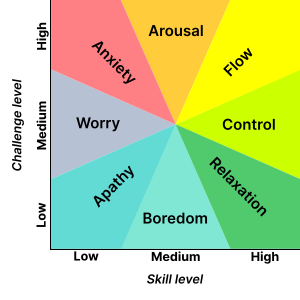
Mental state in terms of challenge level and skill level, according to Csikszentmihalyi's flow model.[20]
(Click on a fragment of the image to go to the appropriate article)
The flow state can be entered while performing any activity, although it is more likely to occur when the task or activity is wholeheartedly engaged for intrinsic purposes.[17][21] Passive activities such as taking a bath or even watching TV, usually do not elicit a flow experience because active engagement is prerequisite to entering the flow state.[22][23] While the activities that induce flow vary and may perhaps be multifaceted, Csikszentmihályi asserts that the experience of flow is similar whatever the activity.[24]
Flow theory postulates that three conditions must be met to achieve flow:
- The activity must have clear goals and progress. This establishes structure and direction.[25]
- The task must provide clear and immediate feedback. This helps to negotiate any changing demands and allows adjusting performance to maintain the flow state.[25]
- Good balance is required between the perceived challenges of the task and one's perceived skills. Confidence in the ability to complete the task is required.[25]
It has been argued that the antecedent factors of flow are interrelated, and as such, a perceived balance between challenges and skills requires that the goals are clear, and feedback is effective. Thus, the coordination of perceived demands and task skills can be identified as the central precondition of flow experience.[26]
In 1987, Massimini, Csíkszentmihályi and Carli published the eight-channel model of flow .[27] Antonella Delle Fave, who worked with Fausto Massimini at the University of Milan, calls this graph the Experience Fluctuation Model.[28] The model depicts the channels of experience that result from different levels of perceived challenges and perceived skills. The graph illustrates another aspect of flow: it is more likely to occur when the activity is a higher-than-average challenge (above the center point) and the individual has above-average skills (to the right of the center point).[17] The center of the graph where the sectors meet represents the average level of challenge and skill across all individual daily activities. The further from the center an experience is, the greater the intensity of that state of being, whether it is flow or anxiety or boredom or relaxation.[21]
Several problems of the model have been discussed in literature.[26][29] One is that it does not ensure the perceived balance between challenges and skills which is said to be the central precondition of flow experience. Individuals with a low average level of skills and a high average level of challenges, (or the converse) do not necessarily experience a match between skills and challenges when both are above their individual average.[30] Another study found that low challenge situations which were surpassed by skill were associated with enjoyment, relaxation, and happiness, which, they claim, is contrary to flow theory.[31]
Schaffer (2013) proposed seven flow conditions:
- Knowing what to do
- Knowing how to do it
- Knowing how well one is doing
- Knowing where to go (if navigation is involved)
- High perceived challenges
- High perceived skills
- Freedom from distractions
Schaffer published a flow condition questionnaire (FCQ), to measure each of these seven flow conditions for any given task or activity.[32]