Nut, Egyptian
Nut /ˈnʊt/[2] (Ancient Egyptian: Nwt, Coptic: Ⲛⲉ),
also known by various other transcriptions,
is the goddess of the sky, stars, cosmos, mothers, astronomy, and the universe in the ancient Egyptian religion.[3]
She was seen as a star-covered nude woman arching over the Earth,[4] or as a cow.
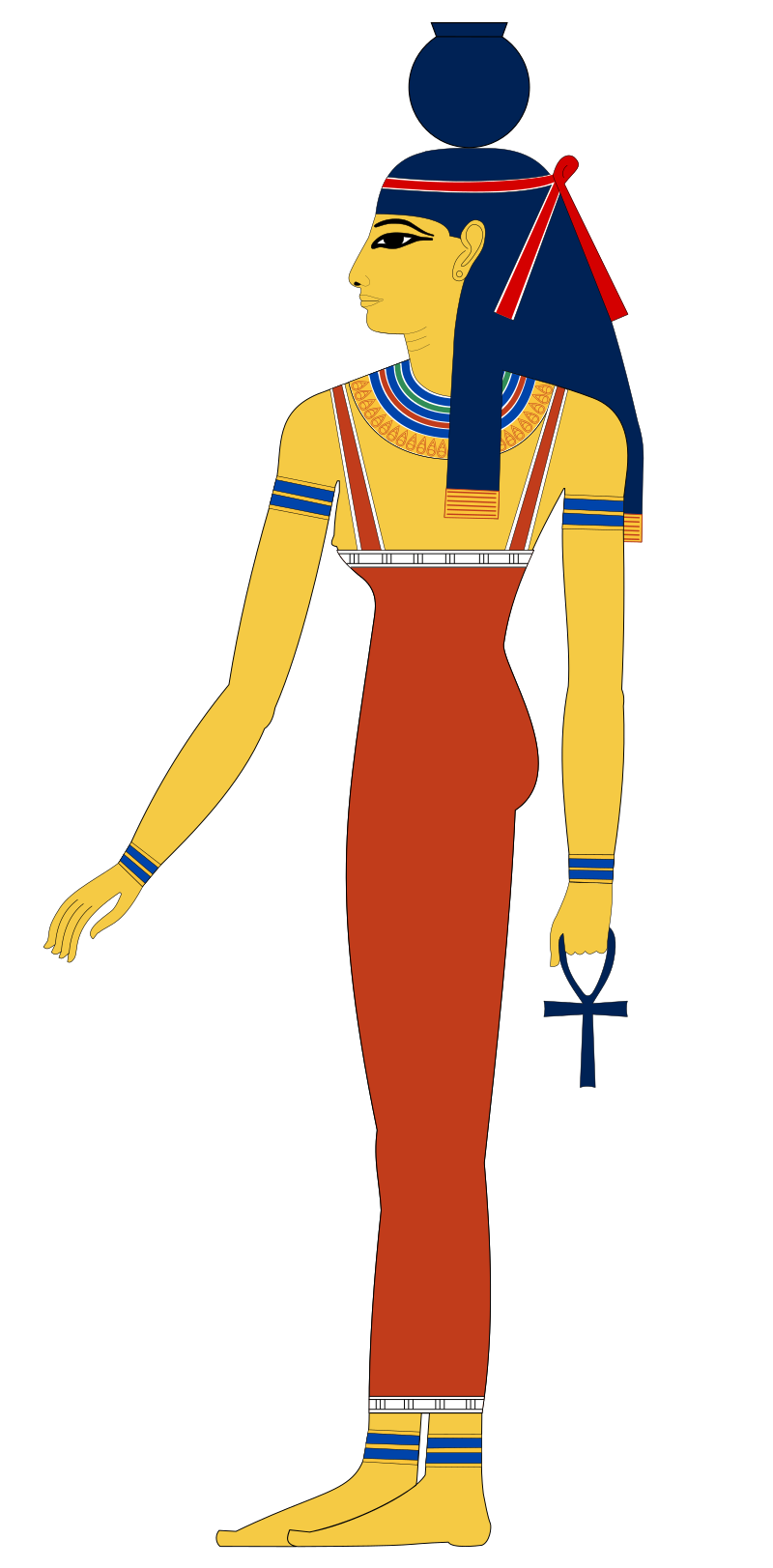
She was depicted wearing the water-pot sign (nw) that identifies her.
The pronunciation of ancient Egyptian is uncertain because vowels were long omitted from its writing, although her name often includes the unpronounced determinative hieroglyph for "sky". Her name Nwt, itself also meaning "Sky",[5] is usually transcribed as "Nut" but also sometimes appears in older sources as Nunut, Nent, and Nuit.[6]
She also appears in the hieroglyphic record by a number of epithets, not all of which are understood.
Nut is a daughter of Shu and Tefnut.
Her brother and husband is Geb. She had four children – Osiris, Set, Isis, and Nephthys – to which is added Horus in a Graeco-Egyptian version of the myth of Nut and Geb.[7] She is considered one of the oldest deities among the Egyptian pantheon,[8] with her origin being found on the creation story of Heliopolis. She was originally the goddess of the nighttime sky, but eventually became referred to as simply the sky goddess. Her headdress was the hieroglyph of part of her name, a pot, which may also symbolize the uterus. Mostly depicted in nude human form, Nut was also sometimes depicted in the form of a cow whose great body formed the sky and heavens, a sycamore tree, or as a giant sow, suckling many piglets (representing the stars).