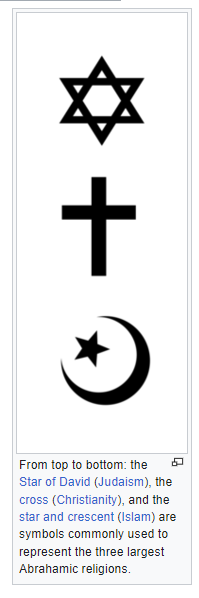
Abrahamic religions
Abrahamic religions - Wikipedia
Etymology
The Catholic scholar of Islam Louis Massignon stated that the phrase "Abrahamic religion" means that all these religions come from one spiritual source.[10]
The modern term comes from the plural form of a Quranic reference to dīn Ibrāhīm, 'religion of Ibrahim', Arabic form of Abraham's name.[11]
God's promise at Genesis 15:4–8 regarding Abraham's heirs became paradigmatic for Jews, who speak of him as "our father Abraham" (Avraham Avinu). With the emergence of Christianity, Paul the Apostle, in Romans 4:11–12, likewise referred to him as "father of all" those who have faith, circumcised or uncircumcised. Islam likewise conceived itself as the religion of Abraham.[12] All the major Abrahamic religions claim a direct lineage to Abraham:
- Abraham is recorded in the Torah as the ancestor of the Israelites through his son Isaac, born to Sarah through a promise made in Genesis.[13][14]
- Christians affirm the ancestral origin of the Jews in Abraham.[12] Christianity also claims that Jesus was descended from Abraham.[15]
- Muhammad, as an Arab, is believed by Muslims to be descended from Abraham's son Ishmael, through Hagar. Jewish tradition also equates the descendants of Ishmael, Ishmaelites, with Arabs, while the descendants of Isaac by Jacob, who was also later known as Israel, are the Israelites.[16]
- The Bahá'í Faith states in its scripture that Bahá'ullah descended from Abraham through his wife Keturah's sons.[6][17][18]
Debates regarding the term
The appropriateness of grouping Judaism, Christianity, and Islam by the terms "Abrahamic religions" or "Abrahamic traditions" has, at times, been challenged.[19]
The common Christian beliefs of Incarnation, Trinity, and the resurrection of Jesus, for example, are not accepted by Judaism or Islam (see for example Islamic view of Jesus' death).
There are key beliefs in both Islam and Judaism that are not shared by most of Christianity (such as abstinence from pork), and key beliefs of Islam, Christianity, and the Baháʼí Faith not shared by Judaism (such as the prophetic and Messianic position of Jesus, respectively).[20]
Adam Dodds argues that the term "Abrahamic faiths", while helpful, can be misleading, as it conveys an unspecified historical and theological commonality that is problematic on closer examination. While there is a commonality among the religions, in large measure their shared ancestry is peripheral to their respective foundational beliefs and thus conceals crucial differences.[21] Alan L. Berger, professor of Judaic Studies at Florida Atlantic University, wrote that although "Judaism birthed both Christianity and Islam," the three faiths "understand the role of Abraham" in different ways.[22][failed ^verification] Aaron W. Hughes, meanwhile, describes the term as "imprecise" and "largely a theological neologism".[23]
An alternative designation for the "Abrahamic religions", "desert monotheism", may also have unsatisfactory connotations.[24]