ENGLISH LANGUAGE
Category:English language - Wiktionary, the free dictionary
It is spoken in American Samoa, Anguilla, Antigua and Barbuda, Ascension Island, Australia, Barbados, Belize, Bermuda, Botswana, Cameroon, Canada, the Caribbean Netherlands, Christmas Island, Dominica, Fiji, Ghana, Gibraltar, Grenada, Guam, Guernsey, Guyana, Hawaii, Hong Kong, India, Ireland, Jamaica, Jersey, Kenya, Kiribati, Lesotho, Liberia, Malawi, Malaysia, Malta, Mauritius, Micronesia, Montserrat, Nauru, New Zealand, Nigeria, Niue, Norfolk Island, Oman, Pakistan, Palau, Papua New Guinea, Puerto Rico, Rwanda, Saint Helena, Saint Kitts and Nevis, Saint Lucia, Saint Vincent and the Grenadines, Samoa, Sierra Leone, Singapore, South Africa, South Sudan, Sudan, Swaziland, Tanzania, the Bahamas, the British Indian Ocean Territory, the British Virgin Islands, the Cayman Islands, the Cocos (Keeling) Islands, the Cook Islands, the Falkland Islands, the Gambia, the Isle of Man, the Marshall Islands, the Pitcairn Islands, the Seychelles, the Solomon Islands, the United Kingdom, the Philippines, the Turks and Caicos Islands, the United States, the United States Virgin Islands, Tokelau, Tonga, Trinidad and Tobago, Tuvalu, Uganda, Vanuatu, Zambia and Zimbabwe.
Etymology
See also: Etymology
See the history of English language on Wikipedia.
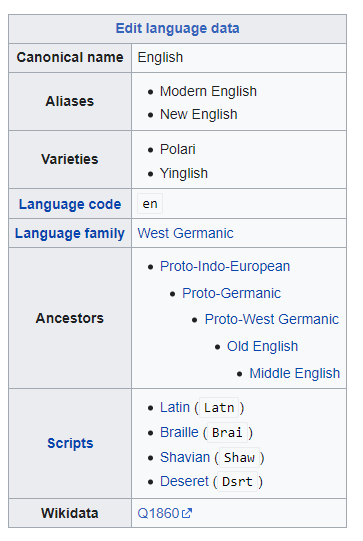
The ancestors of Modern English (1500 to present) are, in order:
Middle English (1150 to 1500),
Old English (450 to 1150),
Proto-Germanic, and
Webster’s early dictionaries used three terms where Wiktionary and modern convention is to use two.
Thus, where Webster uses “AS.” (Anglo-Saxon), we speak of “Old English”; where Webster uses “OE.” (Old English), we speak of “(the early period of) Middle English”; where Webster uses “ME.” (Middle English), we speak of “(the late period of) Middle English”.
English has also borrowed extensively from other languages.
Key waves of borrowings into English are from
Old Norse (non);
Anglo-Norman (xno);
French (fr);
Latin (la; see Latin influence in English); and
Ancient Greek (grc).
Note however that many French words were borrowed via Anglo-Norman (from Old French (fro)), with the main borrowing from French happening from the 14th century with Middle French (frm); many Latin words were borrowed via French, and others are classical compounds, which instead of being borrowed are modern coinages based on nativized combining forms (e.g., biology is not borrowed from Ancient Greek, but is coined from bio- + -logy); and many Ancient Greek words were borrowed via Latin (and often then via French), and others are classical compounds. In modern times, English has borrowed from a great many languages.