Levant Crisis
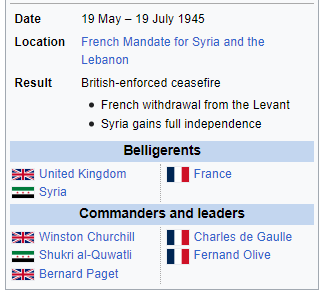
The Levant Crisis, also known as the Damascus Crisis, the Syrian Crisis, or the Levant Confrontation, was a military confrontation that took place between British and French forces in Syria in May 1945 soon after the end of World War II in Europe.
French troops had tried to quell nationalist protests in Syria at the continued occupation of the Levant by France.
With heavy Syrian casualties, British Prime Minister Winston Churchill opposed French action and sent British forces into Syria from Transjordan with orders to fire on the French if necessary.[1]
British armoured cars and troops then reached the Syrian capital of Damascus, following which the French were escorted and confined to their barracks.[2]
With political pressure added, the French ordered a ceasefire.[3]
The crisis almost brought Britain and France to the point of war.[4][5]
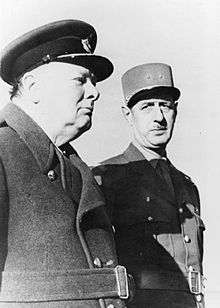
Winston Churchill and Charles De Gaulle in a meeting in 1944
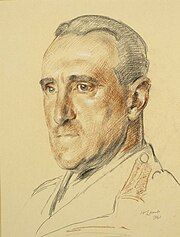
Sir Bernard Paget Commander of Middle East Command
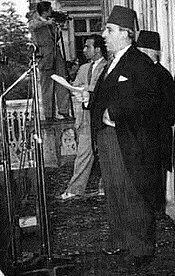
Syrian President Shukri al-Quwatli declaring Syria's independence from France, 17 April 1946
Crisis
The crisis proper began on 19 May when demonstrations in Damascus involved firing on the grounds of the French hospital; about a dozen people were injured but none were killed. The next day serious rioting broke out in Aleppo in which three French soldiers were killed and some injured. The French blamed the deaths on the inability of the Syrian gendarmerie to maintain order and looked to use this as an excuse to use French troops to restore order.[9] By 27 May fighting escalated between Syrian youths and the French army in Hama and Homs.[10] Tensions continued to escalated due to events in Hama. A dispute between the local French and Syrian gendarmes resulted in French reinforcements being sent to the city. This relief column was ambushed leading to the deaths of French soldiers and the Syrian capture of artillery and armoured vehicles. The French retaliated with force, leading to around 80 deaths in Hama.[9] The French Delegate General Plenipotentiary for the Levant, Paul Beynet, was in an increasingly combative mood as a result of the violence and believed that in order to restore order across the country the 'Damascus abscess must be lanced'.[11] On Beynets command , General Oliva-Roget ordered his troops to begin shelling Damascus on May 29.
Winston Churchill and Charles De Gaulle in a meeting in 1944
On 29 May, French troops stormed the Syrian parliament and tried to arrest the President Shukri al-Quwatli and the speaker Saadallah al-Jabiri but both managed to escape. The French burned, bombarded the building and then cut off Damascus's electricity. They also sealed off Syria's borders with Jordan, Iraq and Lebanon. The French began shelling with artillery and mortars while colonial Senegalese troops were sent in, who committed acts of looting and wanton destruction.[12]
Having managed to escape via a British armoured car, Quwatli sent an urgent request to Prime Minister Winston Churchill for British troops to intervene.[13] Churchill said he would do what he could, but his relationship with Charles de Gaulle was at a low ebb following his visit to Paris the previous year, in spite of his efforts to preserve French interests following the Yalta conference.[14] In January Churchill told a colleague that he believed that de Gaulle was "a great danger to peace and for Great Britain. After five years of experience, I am convinced that he is the worst enemy of France in her troubles ... he is one of the greatest dangers to European peace. ... I am sure that in the long run no understanding will be reached with General de Gaulle".[5]
General Bernard Paget, who was in charge of the British Ninth Army reminded the French they fell under his command.[15] De Gaulle had thought this ended with the war over in Europe but would actually terminate once the Pacific War had ended. Paget had a large force in the region at his disposal and threatened that he would be forced to intervene from the Transjordan if the violence did not stop. Churchill agreed but needed the backing of the United States and the Soviet Union in which to send British troops against the French.[10]
At the same time, the French Army of the Levant in the region had been severely weakened—nearly 70 percent of all officers and 40 percent of Syrian soldiers in the French army had deserted their posts and taken up arms with the Syrian rebels. In Hama two French aircraft were downed, while the commander of a French unit was ambushed and killed. In Hauran French troops were rounded up and disarmed — their weapons distributed to young men hoping to march towards Damascus to help the central government.[13] The French then called in for reinforcements and were now using their air force to drop bombs on suspected areas of resistance. At the same time the Syrian Prime Minister Faris al-Khoury was at the founding conference of the United Nations in San Francisco, presenting Syria's claim for independence and also ordered the fighting to stop. They were both backed by President Harry Truman, who declared "those French ought to be taken out and castrated".[16]