Hippocratic Oath
The Hippocratic Oath is an oath of ethics historically taken by physicians. It is one of the most widely known of Greek medical texts. In its original form, it requires a new physician to swear, by a number of healing gods, to uphold specific ethical standards. The oath is the earliest expression of medical ethics in the Western world, establishing several principles of medical ethics which remain of paramount significance today. These include the principles of medical confidentiality and non-maleficence. As the seminal articulation of certain principles that continue to guide and inform medical practice, the ancient text is of more than historic and symbolic value. It is enshrined in the legal statutes of various jurisdictions, such that violations of the oath may carry criminal or other liability beyond the oath's symbolic nature.
The original oath was written in Ionic Greek, between the fifth and third centuries BC.[1] Although it is traditionally attributed to the Greek doctor Hippocrates and it is usually included in the Hippocratic Corpus, some modern scholars do not regard it as having been written by Hippocrates himself.
Text of the oath
Earliest surviving copy
[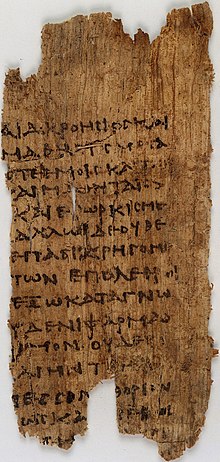 ]
A fragment of the oath on the 3rd-century Papyrus Oxyrhynchus 2547.
The oldest partial fragments of the oath date to circa AD 275. The oldest extant version dates to roughly the 10th–11th century, held in the Vatican Library.[2]
A commonly cited version, dated to 1595, appears in Koine Greek with a Latin translation.[3][4] In this translation, the author translates "πεσσὸν" to the Latin "fœtum."
Below is the Hippocratic Oath, in Greek, from the 1923 Loeb edition, followed by the English translation:
ὄμνυμι Ἀπόλλωνα ἰητρὸν καὶ Ἀσκληπιὸν καὶ Ὑγείαν καὶ Πανάκειαν καὶ θεοὺς πάντας τε καὶ πάσας, ἵστορας ποιεύμενος, ἐπιτελέα ποιήσειν κατὰ δύναμιν καὶ κρίσιν ἐμὴν ὅρκον τόνδε καὶ συγγραφὴν τήνδε:
ἡγήσεσθαι μὲν τὸν διδάξαντά με τὴν τέχνην ταύτην ἴσα γενέτῃσιν ἐμοῖς, καὶ βίου κοινώσεσθαι, καὶ χρεῶν χρηΐζοντι μετάδοσιν ποιήσεσθαι, καὶ γένος τὸ ἐξ αὐτοῦ ἀδελφοῖς ἴσον ἐπικρινεῖν ἄρρεσι, καὶ διδάξειν τὴν τέχνην ταύτην, ἢν χρηΐζωσι μανθάνειν, ἄνευ μισθοῦ καὶ συγγραφῆς, παραγγελίης τε καὶ ἀκροήσιος καὶ τῆς λοίπης ἁπάσης μαθήσιος μετάδοσιν ποιήσεσθαι υἱοῖς τε ἐμοῖς καὶ τοῖς τοῦ ἐμὲ διδάξαντος, καὶ μαθητῇσι συγγεγραμμένοις τε καὶ ὡρκισμένοις νόμῳ ἰητρικῷ, ἄλλῳ δὲ οὐδενί.
διαιτήμασί τε χρήσομαι ἐπ᾽ ὠφελείῃ καμνόντων κατὰ δύναμιν καὶ κρίσιν ἐμήν, ἐπὶ δηλήσει δὲ καὶ ἀδικίῃ εἴρξειν.
οὐ δώσω δὲ οὐδὲ φάρμακον οὐδενὶ αἰτηθεὶς θανάσιμον, οὐδὲ ὑφηγήσομαι συμβουλίην τοιήνδε: ὁμοίως δὲ οὐδὲ γυναικὶ πεσσὸν φθόριον δώσω.
ἁγνῶς δὲ καὶ ὁσίως διατηρήσω βίον τὸν ἐμὸν καὶ τέχνην τὴν ἐμήν.
οὐ τεμέω δὲ οὐδὲ μὴν λιθιῶντας, ἐκχωρήσω δὲ ἐργάτῃσιν ἀνδράσι πρήξιος τῆσδε.
ἐς οἰκίας δὲ ὁκόσας ἂν ἐσίω, ἐσελεύσομαι ἐπ᾽ ὠφελείῃ καμνόντων, ἐκτὸς ἐὼν πάσης ἀδικίης ἑκουσίης καὶ φθορίης, τῆς τε ἄλλης καὶ ἀφροδισίων ἔργων ἐπί τε γυναικείων σωμάτων καὶ ἀνδρῴων, ἐλευθέρων τε καὶ δούλων.
ἃ δ᾽ ἂν ἐνθεραπείῃ ἴδω ἢ ἀκούσω, ἢ καὶ ἄνευ θεραπείης κατὰ βίον ἀνθρώπων, ἃ μὴ χρή ποτε ἐκλαλεῖσθαι ἔξω, σιγήσομαι, ἄρρητα ἡγεύμενος εἶναι τὰ τοιαῦτα.
ὅρκον μὲν οὖν μοι τόνδε ἐπιτελέα ποιέοντι, καὶ μὴ συγχέοντι, εἴη ἐπαύρασθαι καὶ βίου καὶ τέχνης δοξαζομένῳ παρὰ πᾶσιν ἀνθρώποις ἐς τὸν αἰεὶ χρόνον: παραβαίνοντι δὲ καὶ ἐπιορκέοντι, τἀναντία τούτων.[5]
I swear by Apollo Healer, by Asclepius, by Hygieia, by Panacea, and by all the gods and goddesses, making them my witnesses, that I will carry out, according to my ability and judgment, this oath and this indenture.
To hold my teacher in this art equal to my own parents; to make him partner in my livelihood; when he is in need of money to share mine with him; to consider his family as my own brothers, and to teach them this art, if they want to learn it, without fee or indenture; to impart precept, oral instruction, and all other instruction to my own sons, the sons of my teacher, and to indentured pupils who have taken the Healer's oath, but to nobody else.
I will use those dietary regimens which will benefit my patients according to my greatest ability and judgment, and I will do no harm or injustice to them.[6] Neither will I administer a poison to anybody when asked to do so, nor will I suggest such a course. Similarly I will not give to a woman a pessary to cause abortion. But I will keep pure and holy both my life and my art. I will not use the knife, not even, verily, on sufferers from stone, but I will give place to such as are craftsmen therein.
Into whatsoever houses I enter, I will enter to help the sick, and I will abstain from all intentional wrong-doing and harm, especially from abusing the bodies of man or woman, bond or free. And whatsoever I shall see or hear in the course of my profession, as well as outside my profession in my intercourse with men, if it be what should not be published abroad, I will never divulge, holding such things to be holy secrets.
Now if I carry out this oath, and break it not, may I gain for ever reputation among all men for my life and for my art; but if I break it and forswear myself, may the opposite befall me.[5] – Translation by W.H.S. Jones.