Fourteenth Amendment, Public Debt
National debt of the United States - Wikipedia
The national debt of the United States is the total national debt owed by the federal government of the United States to Treasury security holders.
The national debt at any point in time is the face value of the then-outstanding Treasury securities that have been issued by the Treasury and other federal agencies.
The terms "national deficit" and "national surplus" usually refer to the federal government budget balance from year to year, not the cumulative amount of debt.
In a deficit year the national debt increases as the government needs to borrow funds to finance the deficit, while in a surplus year the debt decreases as more money is received than spent, enabling the government to reduce the debt by buying back some Treasury securities.
In general, government debt increases as a result of government spending and decreases from tax or other receipts, both of which fluctuate during the course of a fiscal year.[1]
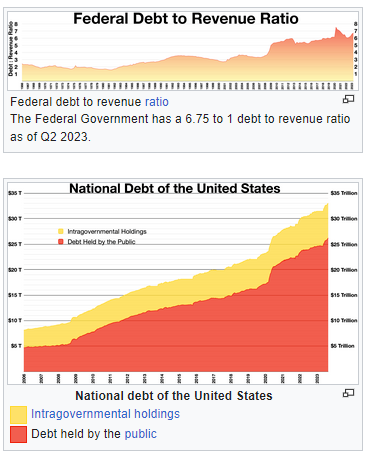
There are two components of gross national debt:[2]
- "Debt held by the public" – such as Treasury securities held by investors outside the federal government, including those held by individuals, corporations, the Federal Reserve, and foreign, state and local governments.
- "Debt held by government accounts" or "intragovernmental debt" – is non-marketable Treasury securities held in accounts of programs administered by the federal government, such as the Social Security Trust Fund. Debt held by government accounts represents the cumulative surpluses, including interest earnings, of various government programs that have been invested in Treasury securities.
Historically, the U.S. public debt as a share of gross domestic product (GDP) increases during wars and recessions and then subsequently declines.
The ratio of debt to GDP may decrease as a result of a government surplus or via growth of GDP and inflation.
For example, debt held by the public as a share of GDP had peaked just after World War II (113% of GDP in 1945), but has since reached new highs of up to 134.84% of GDP during the second quarter of 2020.[3]
In recent decades, aging demographics and rising healthcare costs have led to concern about the long-term sustainability of the federal government's fiscal policies.[4]
The aggregate, gross amount that Treasury can borrow is limited by the United States debt ceiling.[5]
Total US federal government debt breached $30 trillion mark for the first time in history in February 2022.[6] As of August 2023, total federal debt was $32.6 trillion; $25.8 trillion held by the public and $6.8 trillion in intragovernmental debt.[7] The annualized cost of servicing this debt was $726 billion in July 2023, which accounted for 14% of the total federal spending.[8] In December 2021, debt held by the public was estimated at 96.19% of GDP, and approximately 33% of this public debt was owned by foreigners (government and private).[9] The United States has the largest external debt in the world. The total number of U.S. Treasury securities held by foreign entities in December 2021 was $7.7 trillion, up from $7.1 trillion in December 2020.[10]
During the COVID-19 pandemic, the federal government spent trillions in virus aid and economic relief. The CBO estimated that the budget deficit for fiscal year 2020 would increase to $3.3 trillion or 16% GDP, more than triple that of 2019 and the largest as % GDP since 1945.[11]
In 2013, the U.S. national debt to GDP ratio surpassed 100% when both debt and GDP were approximately $16.7 ($19.4 trillion in 2021) trillion.[12] On April 28, 2022, the Congressional Budget Office released a report which stated that in order to stabilize the $30 trillion in national debt (i.e. stop the debt from growing relative to the United States economy), it would require that "income tax receipts or benefit payments change substantially from their currently projected path."[13]