Iris (mythology)
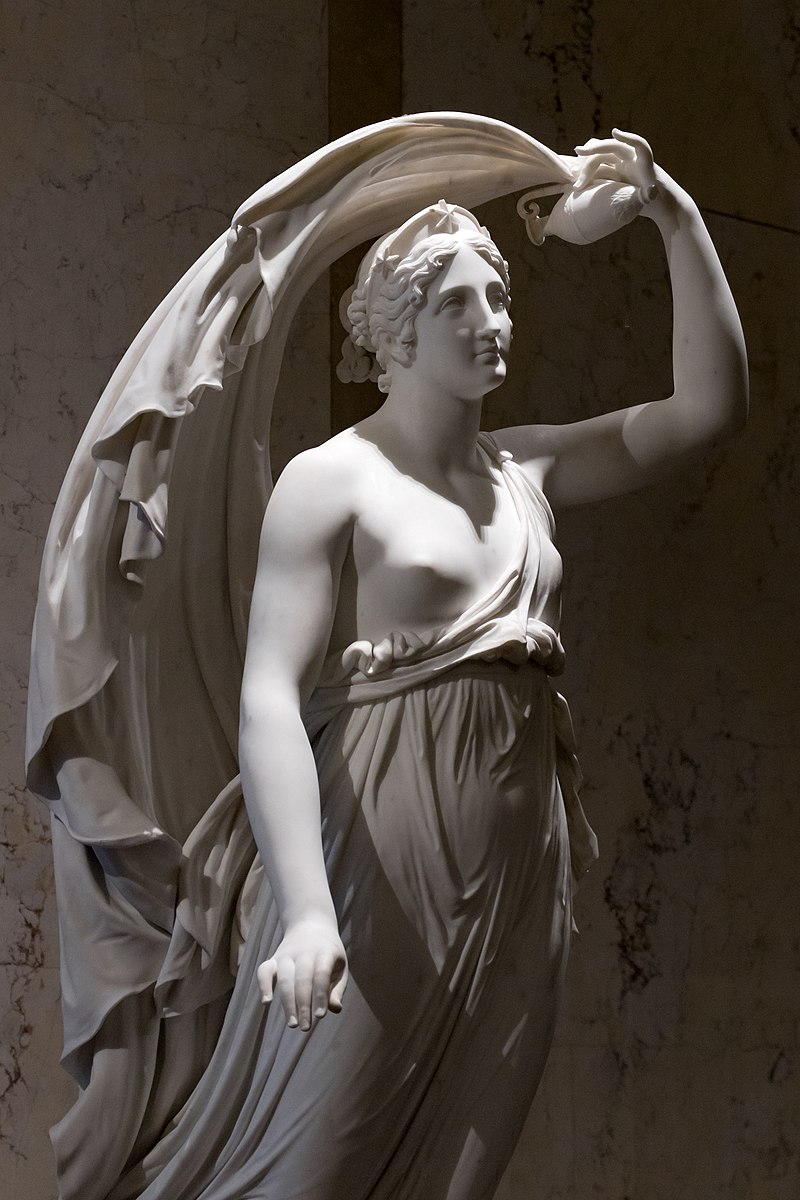
Gaetano Matteo Monti, Iris as goddess of the rainbow (1841, marble)
Etymology
The ancient Greek noun Ἶρις means both the rainbow[2] and the halo of the Moon.[6]
An inscription from Corinth provides evidence for an original form Ϝῖρις (wîris) with a digamma that was eventually dropped.[6]
The noun seems to be of pre-Greek origin.[7]
A Proto-Indo-European pre-form uh2i-r-i-* has been suggested, although Beekes finds it 'hard to motivate.'[6]
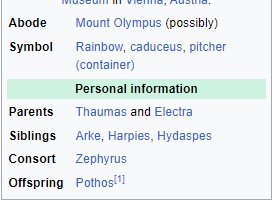
In ancient Greek religion and mythology, Iris (/ˈaɪrɪs/; EYE-riss; Greek: Ἶρις, translit. Îris, lit. "rainbow,"[2][3] Ancient Greek: [îːris]) is a daughter of the gods Thaumas and Electra,[4] the personification of the rainbow and messenger of the gods, a servant to the Olympians and especially Queen Hera.[5]
Iris appears in several stories carrying messages from and to the gods or running errands but has no unique mythology of her own.
Similarly, very little to none of a historical cult and worship of Iris is attested in surviving records, with only a few traces surviving from the island of Delos.
In ancient art, Iris is depicted as a winged young woman carrying a caduceus, the symbol of the messengers, and a pitcher of water for the gods.
Iris was traditionally seen as the consort of Zephyrus, the god of the west wind and one of the four Anemoi, by whom she is the mother of Pothos in some versions.[1]