Giants
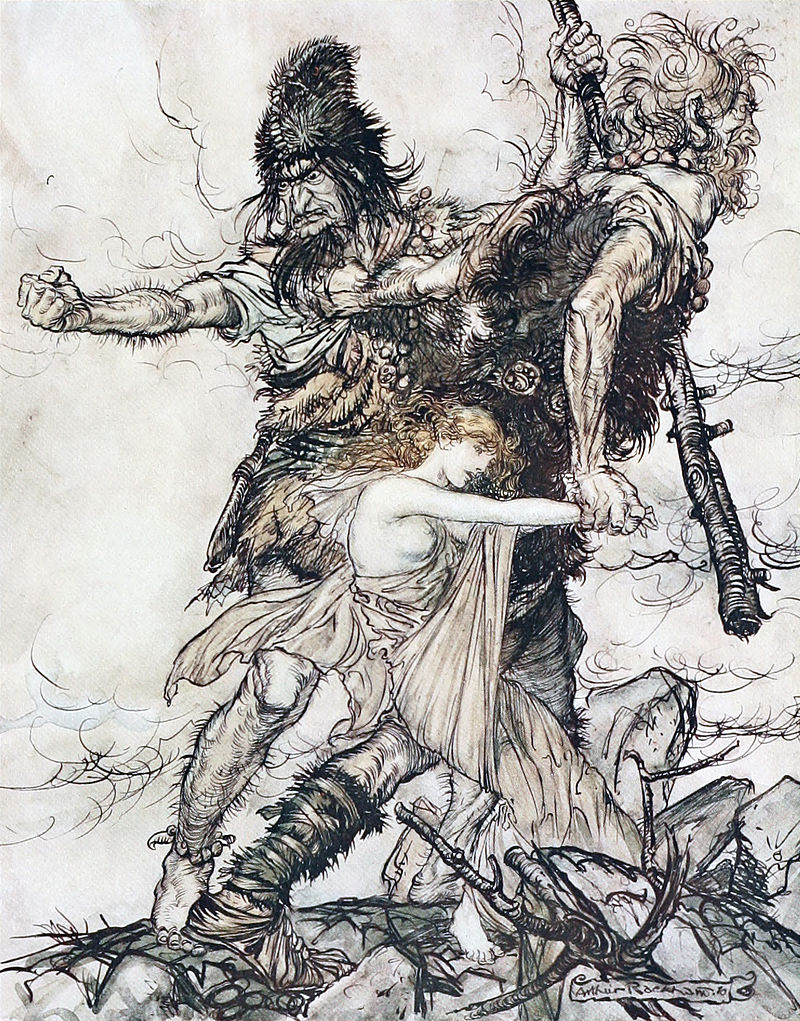
The giants Fafner and Fasolt seize Freyja in Arthur Rackham's illustration of Richard Wagner's Der Ring des Nibelungen.
In folklore, giants (from Ancient Greek: gigas, cognate giga-) are beings of humanoid appearance, but are at times prodigious in size and strength or bear an otherwise notable appearance.
The word giant is first attested in 1297 from Robert of Gloucester's chronicle.[1]
It is derived from the Gigantes (Greek: Γίγαντες[2]) of Greek mythology.
Fairy tales such as Jack the Giant Killer have formed the modern perception of giants as dimwitted and violent ogres; sometimes said to eat humans, while other giants tend to eat livestock.
In more recent portrayals, like those of Jonathan Swift and Roald Dahl, some giants are both intelligent and friendly.
Genesis tells of the Nephilim before and after Noah's Flood.
The word Nephilim is loosely translated as giants in some translations of the Hebrew Bible, but left untranslated in others.
According to Genesis 7:23, the Nephilim were destroyed in the Flood, but Nephilim are reported after the Flood, including:
The Book of Numbers[10] includes the discouraging report by the spies sent by Moses into Canaan: "We can't attack those people; they are stronger than we are. (...) All the people we saw there are of great size. We saw the Nephilim there (the descendants of Anak come from the Nephilim). We seemed like grasshoppers in our own eyes, and we looked the same to them."
However, the Book of Joshua, describing the actual conquest of Canaan in a later generation, makes no reference to such people living there.

David faces Goliath in this 1888 lithograph by Osmar Schindler
The Bible also tells of Gog and Magog, who later entered European folklore, and of the famous battle between David and the Philistine Goliath.
While Goliath is often portrayed as a giant in retellings of the Biblical narrative, he appears to be significantly smaller than other giants, biblical or otherwise.
The Masoretic Text version of the Book of Samuel gives his height as six cubits and one span (possibly 313–372 centimetres (10 ft 3 in – 12 ft 2 in)),[15] while the Septuagint, the 1st-century Jewish historian Flavius Josephus and the 2nd–1st-centuries BCE Dead Sea Scrolls give Goliath's height as four cubits and one span (possibly 216–258 centimetres (7 ft 1 in – 8 ft 6 in)).[16]
For comparison, the Anakites are described as making the Israelites seem like grasshoppers.[17]
See also Gibborim.
Josephus also described the Amorites as giants in his Antiquities of the Jews, circa 93 CE, indicating that some sort of fossils may have been on display at that time:[18] "For which reason they removed their camp to Hebron; and when they had taken it, they slew all the inhabitants. There were till then left the race of giants, who had bodies so large, and countenances so entirely different from other men, that they were surprising to the sight, and terrible to the hearing. The bones of these men are still shown to this very day, unlike to any credible relations of other men."[19]
The Book of Enoch describes giants as the offspring of Watchers and women in 7:2.[20]