JAHWIST
The Jahwist, or Yahwist, often abbreviated J, is one of the most widely recognized sources of the Pentateuch (Torah), together with the Deuteronomist, the Priestly source and the Elohist.
The existence of the Jahwist is somewhat controversial, with a number of scholars, especially in Europe, denying that it ever existed as a coherent independent document.[4]
Nevertheless, many scholars do assume its existence.[5]
The Jahwist is so named because of its characteristic use of the term Yahweh (German: Jahwe; Hebrew: יהוה) for God.[6]
Background
Modern scholars agree that separate sources underlie the Pentateuch, but there is much disagreement on how these sources were used by the authors to write the first five books of the Bible.[7]
The explanation called the documentary hypothesis dominated much of the 20th century, but the consensus surrounding this hypothesis has now broken down.
Its critics suggest that contemporary upholders tend to give a much larger role to the redactors, who are now seen as adding much material of their own rather than as simply passive combiners of documents.[8]
The simple form of the documentary hypothesis has come under criticism from within its own constituents as well.
The most notable revision in recent decades has been to suggest that the individual E and J documents are irrecoverable altogether, major parts of them having been scrapped by the first JE redactor; or that the E document was never independent at all, but rather is a part of the J document.[9]
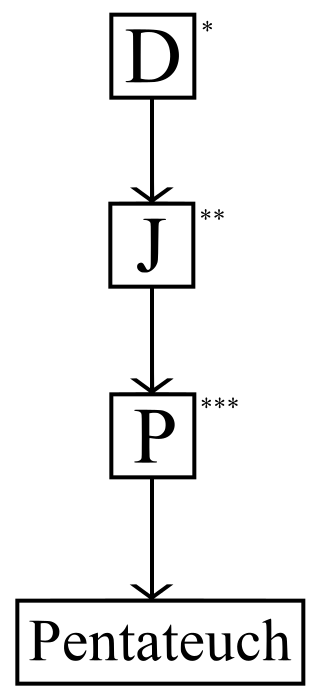
Diagram of the supplementary hypothesis, a popular model of the composition of the Torah. The Jahwist is shown as J.
Characteristics
In J, Yahweh is an anthropomorphic figure both physically (Genesis 3:8, Genesis 11:5, Exodus 17:7) and mentally (such as when Abraham bargains with Yahweh for the fate of Sodom and Gomorrah, or when, during the exodus, Yahweh, incensed by the Israelites' lack of faith, threatens to destroy them all and raise Moses' descendants instead but "relented and did not bring on his people the disaster he had threatened" when dissuaded by Moses).[10]
J has a particular fascination for traditions concerning Judah, including its relationship with its rival and neighbor, Edom; its focus on Judahite cities such as Jerusalem; and its support of the legitimacy of the Davidic monarchy. J is also critical of the other tribes of Israel, for example, by suggesting that the Northern Kingdom's capital of Shechem was captured via a massacre of the original inhabitants (Genesis 34).[11]
Michael D. Coogan suggests three recurring themes in the Jahwist tradition: the relationship between humans and soil, separation between humans and God, and progressive human corruption:
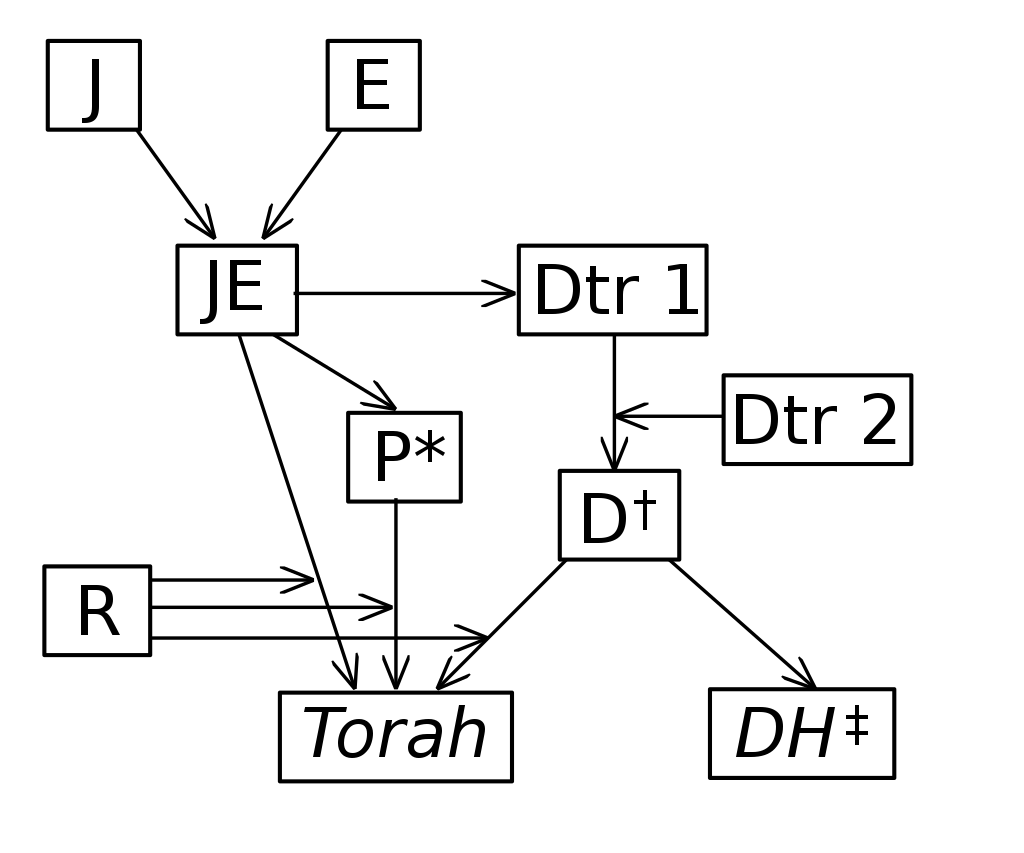
Diagram of the 20th century documentary hypothesis. J: Yahwist (10th–9th century BCE)[1][2] E: Elohist (9th century BCE)[1] Dtr1: early (7th century BCE) Deuteronomist historian Dtr2: later (6th century BCE) Deuteronomist historian P*: Priestly (6th–5th century BCE)[3][2] D†: Deuteronomist R: Redactor DH: Deuteronomistic history (books of Joshua, Judges, Samuel, Kings)