Constantinople
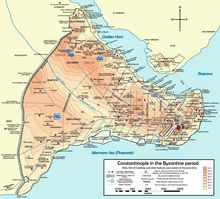
Map of Constantinople in the Byzantine period, corresponding to the modern-day Fatih district of Istanbul
Constantinople[a] (see other names) became the capital of the Roman Empire during the reign of Constantine the Great in 330.
Following the collapse of the Western Roman Empire in the late 5th century, Constantinople remained the capital of
the Eastern Roman Empire (also known as the Byzantine Empire; 330–1204 and 1261–1453),
the Latin Empire (1204–1261), and
the Ottoman Empire (1453–1922).
Following the Turkish War of Independence, the Turkish capital then moved to Ankara. Officially renamed Istanbul in 1920s, the city is today the largest city and financial centre of Turkey, the largest city in Europe, straddling the Bosporus strait, lying in both Europe and Asia.
Names of Constantinople
Main article: Names of Constantinople

The Column of Constantine, built by Constantine I in 330 to commemorate the establishment of Constantinople as the new capital of the Roman Empire
Byzantium took on the name of Constantinople (Greek: Κωνσταντινούπολις, romanized: Kōnstantinoupolis; "city of Constantine") after its refoundation under Roman emperor Constantine I, who transferred the capital of the Roman Empire to Byzantium in 330 and designated his new capital officially as Nova Roma (Νέα Ῥώμη) 'New Rome'.
During this time, the city was also called 'Second Rome', 'Eastern Rome', and Roma Constantinopolitana (Latin for 'Constantinopolitan Rome').[18]
As the city became the sole remaining capital of the Roman Empire after the fall of the West, and its wealth, population, and influence grew, the city also came to have a multitude of nicknames.

This huge keystone found in Çemberlitaş, Fatih, might have belonged to a triumphal arch at the Forum of Constantine built by Constantine I.
As the largest and wealthiest city in Europe during the 4th–13th centuries and a center of culture and education of the Mediterranean basin, Constantinople came to be known by prestigious titles such as Basileuousa (Queen of Cities) and Megalopolis (the Great City) and was, in colloquial speech, commonly referred to as just Polis (ἡ Πόλις) 'the City' by Constantinopolitans and provincial Byzantines alike.[21]
In the language of other peoples, Constantinople was referred to just as reverently.
The medieval Vikings, who had contacts with the empire through their expansion in eastern Europe (Varangians), used the Old Norse name Miklagarðr (from mikill 'big' and garðr 'city'), and later Miklagard and Miklagarth.[19]
In Arabic, the city was sometimes called Rūmiyyat al-Kubra (Great City of the Romans) and in Persian as Takht-e Rum (Throne of the Romans).
In East and South Slavic languages, including in Kievan Rus', Constantinople has been referred to as Tsargrad (Царьград) or Carigrad, 'City of the Caesar (Emperor)', from the Slavonic words tsar ('Caesar' or 'King') and grad ('city').
This was presumably a calque on a Greek phrase such as Βασιλέως Πόλις (Vasileos Polis), 'the city of the emperor [king]'.
In Persian the city was also called Asitane (the Threshold of the State), and in Armenian, it was called Gosdantnubolis (City of Constantine).[22]