GAIA
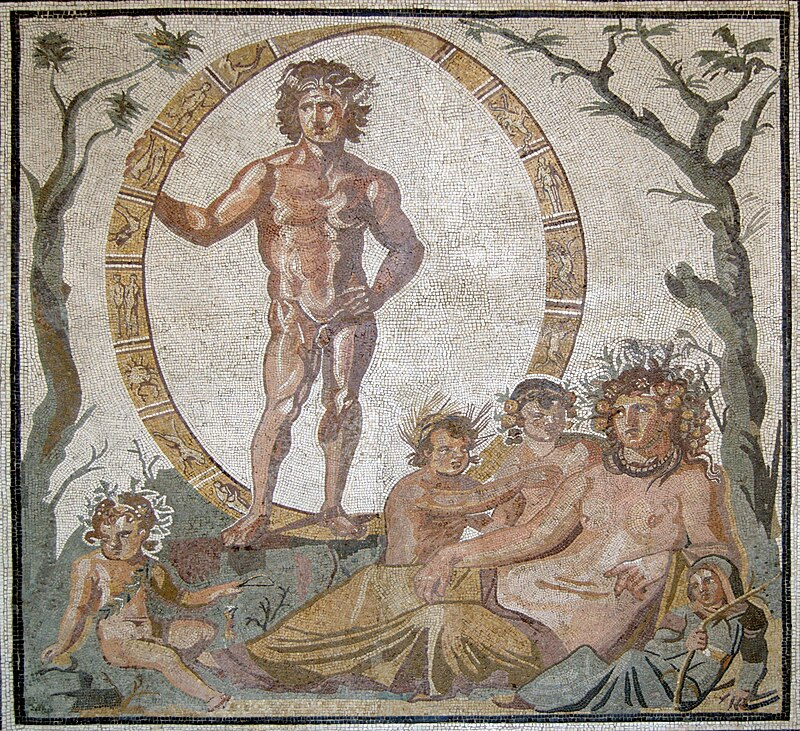
Aion and Tellus Mater with infant deities of the fruit of the seasons, in a mosaic from a Roman villa in Sentinum, first half of the third century BC, (Munich Glyptothek, Inv. W504)
Etymology
The Greek name Γαῖα (Gaia Ancient Greek: [ɡâi̯.a] or [ɡâj.ja]) is a mostly epic, collateral form of Attic Γῆ (Gē [ɡɛ̂ː]), and Doric Γᾶ (Ga [ɡâː]),[3] perhaps identical to Δᾶ (Da [dâː]),[6] both meaning "Earth".
The word is of uncertain origin.[7] Beekes suggested a Pre-Greek origin.[8]
In Mycenean Greek Ma-ka (transliterated as Ma-ga, "Mother Gaia") also contains the root ga-.
In Greek mythology, Gaia (/ˈɡeɪə, ˈɡaɪə/;[2] Ancient Greek: Γαῖα, romanized: Gaîa, a poetic form of Γῆ (Gê), meaning 'land' or 'earth'),[3] also spelled Gaea /ˈdʒiːə/,[2] is the personification of the Earth.[4]
Gaia is the ancestral mother—sometimes parthenogenic—of all life.
She is the mother of Uranus (Sky), from whose sexual union she bore the Titans (themselves parents of many of the Olympian gods), the Cyclopes, and the Giants; as well as of Pontus (Sea), from whose union she bore the primordial sea gods.
Her equivalent in the Roman pantheon was Terra.[5]